vivo’s X300 E went official in China this week as the newest entry point into the company’s flagship phone line. It’s built around a Snapdragon 8 Gen 5 chip and a ZEISS-backed triple rear camera. It also carries an 8-megapixel ultrawide camera, less than a sixth of the resolution vivo builds into the ultrawide lens on its own pricier X300 Pro.
That gap shows up in a phone that otherwise reads like a genuine flagship: a 144Hz OLED screen rated to 5,000 nits, a 7,200mAh battery, and a starting price of CNY 4,799 ($710). vivo put its component budget into the chip, the screen and the periscope telephoto camera. The ultrawide lens is where vivo cut costs.
Snapdragon 8 Gen 5 Headlines a Loaded Spec Sheet
The X300 E runs on Qualcomm’s Snapdragon 8 Gen 5, a chip built on TSMC’s 3nm process that shares its Oryon CPU cores with the pricier Snapdragon 8 Elite Gen 5. Qualcomm says the chip brings flagship-level performance to a wider range of premium phones, pairing a two-core prime cluster clocked at 3.8GHz with six performance cores at 3.32GHz.
The phone ships with LPDDR5X memory, UFS 4.1 storage and vivo’s OriginOS 6 running on top of Android 16. The screen is a 6.59-inch OLED panel at 1.5K resolution with a refresh rate up to 144Hz, and fingerprint reading runs through an under-display ultrasonic scanner rather than an optical one.
The chip choice also reflects how vivo splits engineering budget across the X300 family. vivo’s own product listings show the X300 Pro running MediaTek’s Dimensity 9500 in some markets, so the cheaper E variant and the flagship Pro do not even share a chipmaker. That kind of tiering shapes how chip choice splits across the X300 lineup more broadly.
One Lens Breaks the Pattern
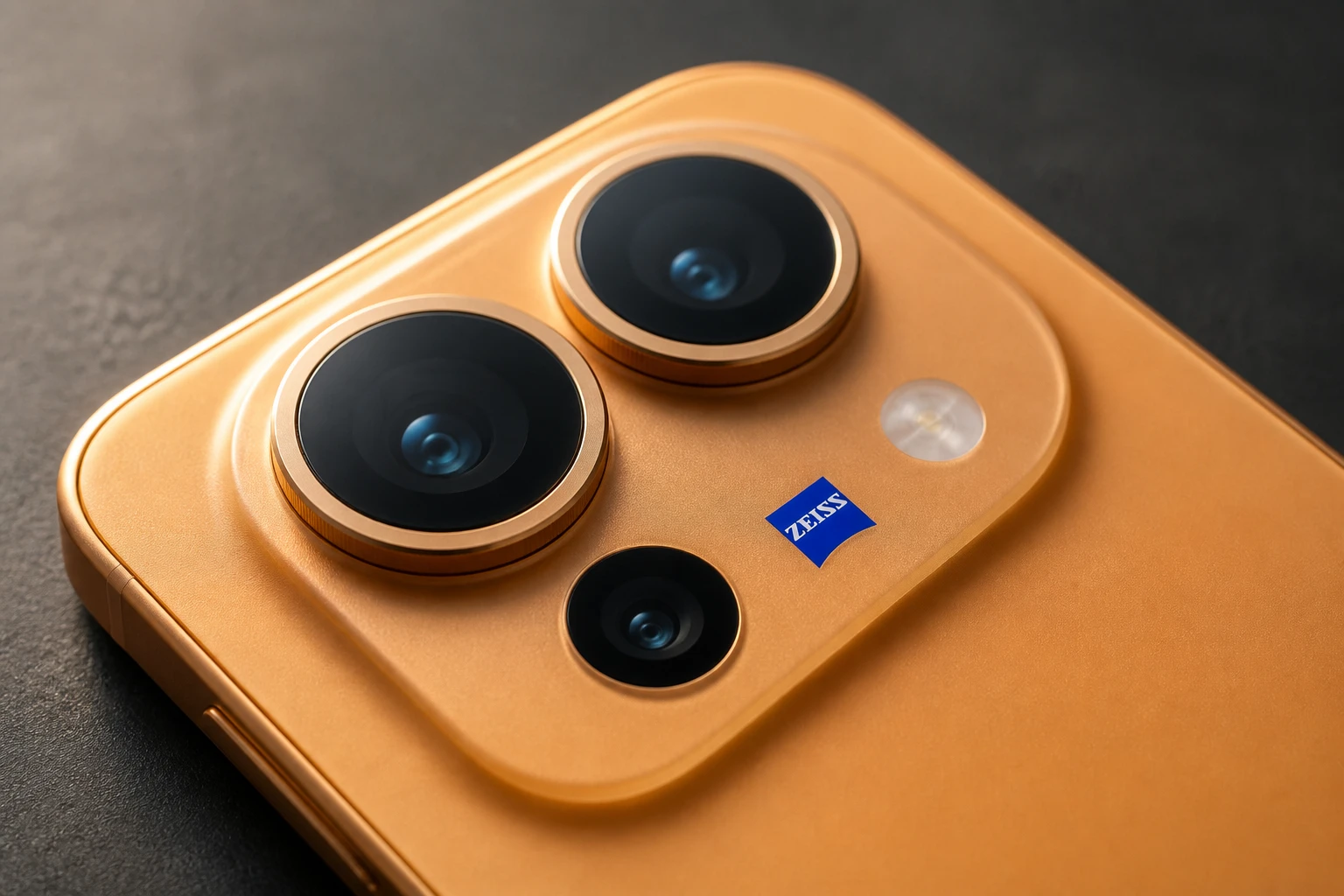
vivo built the X300 E’s camera array around three lenses, and two of them are legitimately high-end. The primary shooter uses a 50-megapixel Sony IMX921 sensor. Next to it is a 50-megapixel Sony IMX882 periscope module for telephoto shots, hardware usually reserved for phones costing well more than $710.
Then there’s the third lens.
The ultrawide camera carries just 8 megapixels. vivo has not disclosed the sensor brand or size for it, unusual for a phone that lists exact sensor model numbers for every other camera, including the selfie unit.
- Primary – 50MP Sony IMX921, the everyday main sensor
- Telephoto – 50MP Sony IMX882 periscope module for zoomed shots
- Ultrawide – 8MP, sensor brand undisclosed
The front camera, by contrast, gets a 50-megapixel Samsung JN1 sensor with autofocus, the same sensor family Samsung supplies for ultrawide duty on the pricier X300 Pro. vivo put a version of that sensor on the selfie camera here and left the rear ultrawide with a fraction of the resolution.
Vivo’s Own Flagship Outshoots It Six Times Over
The comparison gets sharper against vivo’s own lineup. The X300 Pro, which launched last autumn as the flagship of the same family, packs a 50-megapixel ultrawide camera built around a Samsung ISOCELL JN1 sensor with an f/2.0 aperture. vivo’s own product page for the X300 Pro lists a 200-megapixel ZEISS telephoto camera as part of the same imaging system.
Do the math and the X300 E’s ultrawide carries less than a sixth of the pixel count of its pricier sibling. The gap matters most in group photos, landscapes and interiors, the shots a ZEISS-branded flagship line is supposed to sell buyers on.
Even Budget Samsung Phones Clear This Bar
Readers reacting to the announcement made the same point about a very different phone. Samsung’s own listing for the midrange Galaxy A57 shows a 12-megapixel ultrawide sensor with a 123-degree field of view and an f/2.2 aperture. That’s 50% more resolution than the X300 E offers, on a phone that starts well below the price of a ZEISS-branded flagship.
Commenters on the announcement argued that a triple camera means little if one of the three lenses trails this far behind the other two, noting that Samsung’s A-series and FE-series phones have shipped 12-megapixel ultrawide units for several generations running.
| Phone | Ultrawide Resolution | Sensor | Aperture |
|---|---|---|---|
| vivo X300 E | 8MP | Not disclosed | Not disclosed |
| vivo X300 Pro | 50MP | Samsung ISOCELL JN1 | f/2.0 |
| Samsung Galaxy A57 | 12MP | Not disclosed | f/2.2 |
vivo still lists the X300 E as a triple-camera phone in its own marketing materials.
A Big Battery and an Aggressive Price
Where vivo did spend, it spent big. The X300 E packs a 7,200mAh battery, among the largest cells vivo has fitted into a current X-series phone, with 90W wired charging to refill it. The body stays thin despite the cell, at up to 7.99mm thick and 203 grams depending on color.
vivo rates the phone IP69 for dust and high-pressure water resistance, adds stereo speakers, and rounds out connectivity with Wi-Fi 7, dual-SIM 5G, Bluetooth 5.4, NFC and an IR blaster, features often trimmed from cheaper phones before the camera is. That approach lines up with vivo’s wider bet on bigger batteries across the X300 generation, even as some rivals chase thinner bodies instead.
- 7,200mAh battery with 90W wired charging
- IP69 rating plus stereo speakers
- CNY 4,799 to CNY 5,299 ($710 to $785) across the 12GB/256GB and 12GB/512GB configurations
Both configurations undercut what buyers typically pay for a Snapdragon 8 Gen 5 phone with a periscope telephoto camera. vivo sells the X300 E in Midnight Black, Moonlight White and Sunlight Orange, and the phone’s full China pricing and configuration breakdown puts it squarely below the X300 Pro on cost as well as camera specification.
Where the ZEISS Optics Show Up
The ZEISS partnership itself is real, even where it doesn’t reach the third lens. vivo and ZEISS have worked together since the X60 series in 2020, and a five-year global imaging partnership renewed last year now covers ZEISS Optics, T* anti-reflective coating and ZEISS Portrait Styles across vivo’s flagship phones. ZEISS says the joint work has reached more than 22 million users worldwide through the companies’ shared imaging lab.
That engineering shows up on the X300 E’s main and telephoto lenses, not the ultrawide. Both of the larger sensors carry ZEISS’s optical tuning, the same processing pipeline vivo uses across the X300 line for portrait and night shots. The ultrawide uses older, cheaper hardware than the other two lenses.
Will the X300 E Ever Leave China?
vivo has not confirmed international availability for the X300 E. The company’s global storefront currently lists the standard X300, X300 Pro and X300 Ultra, all ZEISS-branded flagships, but not the E variant. That gap may mean the phone stays tied to the domestic Chinese market it was built for, at least for now.
vivo has not said whether that changes, and nothing in this week’s announcement points to a release date outside China.
For now, the X300 E’s identity is set by the parts vivo chose to highlight and the one it didn’t. The chip, the screen and the telephoto lens carry the flagship pitch. The ultrawide camera carries the asterisk.