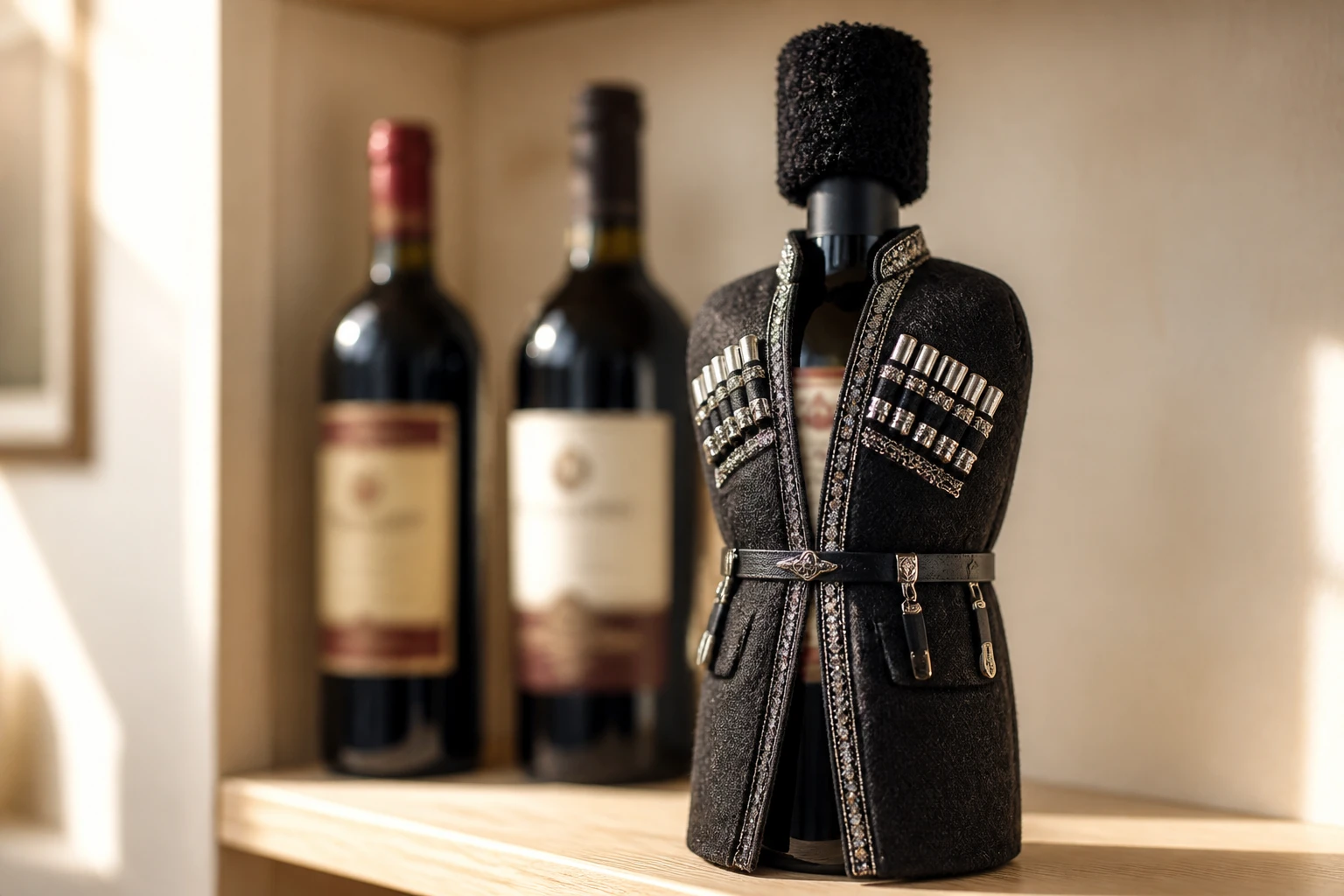
Maya Knyazeva has dressed Broadway productions, corporate lobbies and, this year, a shelf of Georgian wine bottles bound for an American museum in miniature wool chokhas trimmed with Swarovski crystal. The commission came from a Georgian emigrant who wanted his country’s wine presented the way Georgians present themselves. For Knyazeva, a costume designer, cultural scholar and professor at Akaki Tsereteli State University, it was another chance to turn a garment into an argument about identity.
Her wine-bottle couture looks like a novelty piece. It reads more like a leading indicator. Georgian wine exports to the United States have been climbing for several years running, and Knyazeva’s corporate uniforms already dress the lobbies of hotels and restaurants built by Georgian emigrants across the country.
Dressing Wine Bottles in Miniature Chokhas
The idea arrived through Georgia’s diaspora network, the same channel that feeds much of Knyazeva’s American business. “At the request of a Georgian emigrant, I created a unique collection of designer clothing for Georgian wine bottles for one of America’s wine museums,” she said. “This idea fascinated me deeply because I lived and worked abroad for 35 years, and everything Georgian is especially precious to me.”
Each bottle wears a scaled-down chokha, the fitted wool coat that has marked Georgian men’s dress since roughly the 9th century, finished with the same crystal work she uses on high-end presentation attire for Georgian cultural events. The result functions less like packaging and more like costume design applied to a product category nobody else treats as a stage.
Twenty-Five Years Behind Georgia’s Runways and Classrooms
Knyazeva’s resume covers several careers layered into one. She holds a doctorate in cultural studies, belongs to the International Designers Association, and has spent 25 years moving between costume design, brand management and higher education.
- Laureate of international design competitions
- Member of the International Designers Association
- Doctorate in cultural studies
- Professor of Fashion Design, Modeling, Technology and Textiles at Akaki Tsereteli State University in Kutaisi
- Architect of Fashion Week concepts, model selection and runway production in Georgia
- Twenty-five years of professional experience in theatrical costume and fashion design
That mix of creative output and event management is unusual in fashion circles. It is also why Georgian institutions keep handing her the organizational side of Fashion Week alongside the creative one.
Why Is Georgian Wine Suddenly Popular in the US?
Georgian wine exports to the United States grew at a 15.5% compound annual rate between 2021 and 2024, with growth continuing through 2025 and into 2026, driven by rising interest in qvevri clay-vessel winemaking, favorable pricing and an aggressive new marketing push branded “Georgia, Naturally.” Knyazeva’s bottle costumes landed squarely inside that run.
Exports to the US climbed at that 15.5% annual clip between 2021 and 2024, and US sales momentum underpinned Georgia’s strongest export year yet in 2025. The US now ranks among Georgia’s highest-value markets, with bottles fetching an average of 6 dollars a liter.
Nationally, Georgian exports of alcoholic beverages rose 22% in the first months of 2026 compared with the same period a year earlier. Forbes reported in June that Georgian wine remains caught between Russian and Western markets even as it expands, and Wine Industry Advisor described the industry in May as poised to keep growing despite turbulent conditions.
| Metric | Figure | Period |
|---|---|---|
| Georgian wine exports to the US | 15.5% compound annual growth | 2021 to 2024 |
| National alcoholic beverage exports | Up 22% | Early 2026 vs. year earlier |
| Average US bottle value | $6 per liter | 2026, among Georgia’s highest-value markets |
| Wines of Georgia campaign | “Georgia, Naturally” | Launched 2025 |
Knyazeva’s clients are riding the same current. Hotels and restaurants built by Georgian emigrants are the buyers most likely to put a chokha-inspired uniform on staff, and Georgian wine is usually already on their menu.
The Chokha Carries Georgia’s Cultural Code
“Through my art, I serve the visual image of Georgian culture,” Knyazeva said. “The Georgian chokha represents the material culture of the Georgian people. The chokha is our country’s cultural code, Georgian identity, the history of the Georgian people, and cultural heritage. It is my duty as an artist to proudly represent Georgia beyond the borders of the country.”
The garment she is describing began as battle dress. Georgian fighters wore versions of the chokha from roughly the 9th century, and the rows of cartridge pockets across the chest, now largely decorative, once held bullets and gunpowder. The coat nearly disappeared during the Soviet era before reviving in the decades since. Georgia added it to the country’s list of intangible cultural heritage in 2020, a shift from battlefield uniform to national symbol now documented by European fashion historians.
- Chokha – a fitted wool coat with rows of cartridge-holder pockets across the chest, worn by Georgian men since roughly the 9th century, with mountain, eastern-Georgian and western-Georgian variations, inscribed on Georgia’s intangible cultural heritage list in 2020.
Georgia’s claim to deep material culture runs older than any single garment. Archaeologists working in the country’s Lechkhumi region recently uncovered the country’s largest known Bronze Age copper complex, a find that pushes organized craftsmanship in the region back roughly 3,500 years. Knyazeva’s designs draw on that continuity, treating a centuries-old coat as living material rather than costume-shop nostalgia.
Uniforma.MAIASI Dresses Diaspora Hotels and Restaurants
Knyazeva’s corporate uniform brand, Uniforma.MAIASI, is where the chokha’s silhouette meets the office floor. “The concept of Uniforma.MAIASI combines functionality, comfort, style, and Georgian cultural identity,” she said. “Non-standard silhouettes, creative color combinations, branded details, signature embroidery, and Georgian visual elements are an essential part of the brand’s style.”
The uniforms use what Knyazeva describes as environmentally friendly fabric made with modern textile technology. “These uniforms not only serve a practical purpose, but also emphasize a company’s identity and corporate culture,” she said. Buyers span Georgia, several European countries and the United States, concentrated among hotels and restaurants founded by Georgian emigrants.
Those businesses are a bigger part of American cultural life than a single uniform order suggests. Georgian restaurants have opened from Pittsburgh to Portland, Oregon, over the past two decades, many built around the supra, Georgia’s communal feast tradition. Harvard’s Program on Georgian Studies has archived a restaurant-driven history of Georgia’s US diaspora, tracing emigre-owned kitchens back to the late 19th century. Knyazeva’s uniforms give that diaspora business class a visual identity to match the food already on the table.
Broadway Costumes and a Different American Dream
Knyazeva’s American client list is not limited to hospitality. Her costume work has reached the Broadway stage, and her crystal-decorated presentation pieces dress Georgian cultural events on both sides of the Atlantic. Her current US trip is built around meetings, not fittings.
“The purpose of my visit and stay in America is to explore and develop ideas for future cultural and educational initiatives that will be implemented both in the United States and in Georgia,” she said. “I want to help talented young Georgians reach the international stage.” She described the first stage of the trip as successful in building professional relationships and identifying paths for cooperation with colleagues in fashion, education and the arts.
“Everyone has their own American dream,” Knyazeva said. “Mine is a little different.”
Knyazeva’s Next Stop Is US Production
Knyazeva’s next move is manufacturing, not just export. She plans to establish production of her uniforms and theatrical costumes inside the United States, alongside continued exports from Georgia. “I strongly wish to involve young designers from Georgia in this project,” she said. “I am happy that I have reached a stage where I can guide the younger generation.”
No date has been set for a first American production run. But between the wine bottle commissions, the diaspora hotel contracts and a wine industry still adding US market share, Knyazeva’s next collection already has a built-in customer base before a single stitch goes in.
Frequently Asked Questions
What is a chokha, and is it still worn today?
The chokha is a fitted wool coat with decorative cartridge pockets across the chest, historically worn by Georgian men from roughly the 9th century onward. It nearly vanished under Soviet rule but is now worn at weddings, state occasions and cultural ceremonies, and Georgia formally listed it as intangible cultural heritage in 2020.
Why is the US such a valuable market for Georgian wine?
US sommeliers have increasingly featured Georgian qvevri wines, amber or “orange” wines fermented in buried clay vessels, as part of a broader natural-wine trend, which helps explain why Georgian producers can command a premium there. Bottles sold in the US average about 6 dollars a liter, among the highest per-liter values Georgia gets anywhere.
What is Akaki Tsereteli State University known for?
The university is named for the 19th-century Georgian poet Akaki Tsereteli and is based in Kutaisi, Georgia’s third-largest city. Its fashion design, modeling, technology and textiles program, where Knyazeva teaches, feeds directly into the country’s Fashion Week pipeline.
Has political tension with Russia affected Georgian wine exports?
Yes. Russia has restricted Georgian wine imports before during periods of political tension between the two countries, and that history is part of why Georgian producers have pushed hard to diversify into the US and European Union markets rather than depend on a single buyer.