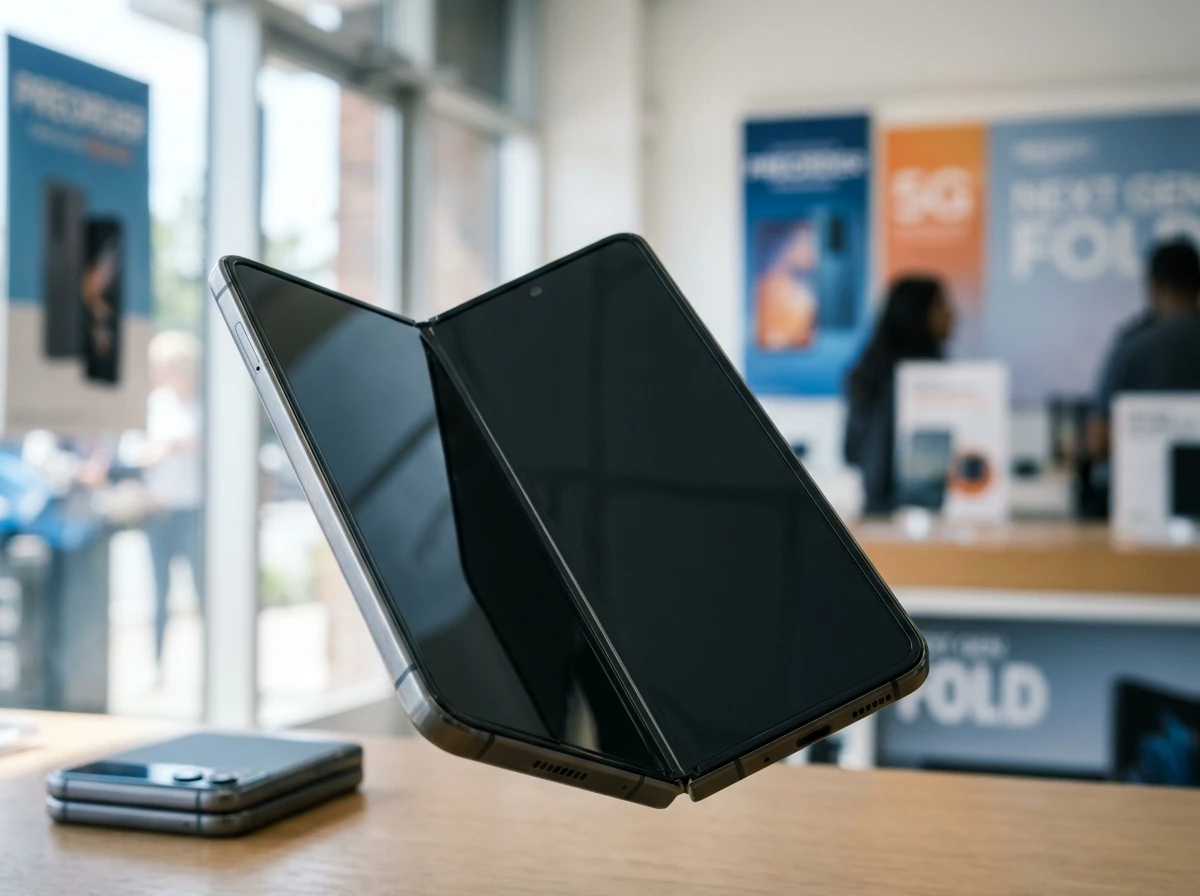
Samsung Electronics opened preorders last week for three new Galaxy Z foldables and a refreshed Watch lineup, racing to win buyers before Apple ships a folding iPhone. The Galaxy Z Flip8 starts at $1,199.99. The Fold8 Ultra tops out at $2,699.99, and all three ship August 7.
Apple has not shipped a single foldable iPhone. Counterpoint Research and IDC already credit its looming arrival with pulling this year’s entire foldable category up by around a fifth, growth Samsung is racing to bank before its own slice of that bigger market keeps shrinking.
Preorders Open at $1,199.99, Top Out at $2,699.99
The Galaxy Z Flip8 runs $1,199.99 for 256GB and $1,399.99 for 512GB. The standard Galaxy Z Fold8 starts at $1,899.99 and climbs to $2,499.99 for a 1TB model. The Galaxy Z Fold8 Ultra opens at $2,099.99 and tops out at $2,699.99.
Both the Flip8 and the Fold8 Ultra cost $100 more than last year’s comparable models. That increase lands amid a global shortage in memory chip supply that has been pushing device costs up across the industry this year, not a pricing choice unique to Samsung.
| Model | 256GB | 512GB | 1TB |
|---|---|---|---|
| Galaxy Z Flip8 | $1,199.99 | $1,399.99 | Not offered |
| Galaxy Z Fold8 | $1,899.99 | $2,099.99 | $2,499.99 |
| Galaxy Z Fold8 Ultra | $2,099.99 | $2,299.99 | $2,699.99 |
The Ultra tier is new this cycle, part of Samsung’s Unpacked event in July that also introduced updated smart glasses aimed at Meta’s headset business. Both launches signal a company spreading its bets across hardware categories while it still has the foldable field mostly to itself.
Growth Arrives Before Apple Ships a Single Phone
Global foldable phone shipments are on pace to climb 21% worldwide this year, according to Counterpoint Research, a firm that tracks handset shipments across every major phone maker. It points to three drivers: demand for premium book style devices, broader competition among vendors, and Apple’s expected foldable iPhone.
International Data Corporation (IDC), a separate research firm, is even more bullish, projecting 30% year over year growth for the category in 2026. Neither forecast required Apple to sell a single unit this year to justify the jump. The expectation of a serious new competitor is already enough to pull retailers, carriers and rival phone makers into building a bigger version of the category before Apple ships anything.
Samsung’s Slice Shrinks From 40% to 32%
That same Counterpoint forecast splits the growing market by brand, and the split is not kind to the company that built the category. Samsung keeps the top spot but its share slides well below where it stood a year earlier, as Apple and Huawei both carve out real footholds.
| Brand | Projected 2026 Foldable Share |
|---|---|
| Samsung | 32% (down from 40% in 2025) |
| Apple | 25% (first year on the market) |
| Huawei | 24% |
| Motorola | 8% |
| HONOR | 3% |
Apple is expected to grab a quarter of the category in its first year alone. Huawei holds the next largest slice at 24%, with Motorola and HONOR rounding out the field at 8% and 3%. Samsung is still selling more foldables than ever. It is simply selling them into a market it no longer owns outright.
The Screens Inside Apple’s Foldable Are Samsung’s Too
Apple’s foldable iPhone is expected to use an organic light-emitting diode (OLED) panel built by Samsung Display, the display making arm of the wider Samsung group, under a deal that locks in Samsung as the exclusive supplier for roughly three years. The panel reportedly uses a manufacturing process Apple holds a trademark on, folding touch sensors directly into the display stack and cutting overall thickness by about 19%.
Counterpoint’s separate tracker of panel supply shows why that arrangement matters to Samsung’s bottom line no matter which phone wins shelf space: panel shipments rising 46% this year, with Samsung Display named the single biggest winner of that jump, in part because some of those panels are headed straight into Apple’s own device.
It is the same setup already visible in the Fold8 line, whose own screens arm Samsung’s Apple rival even as the two companies chase the same shoppers this fall. Samsung Display sells components across the industry well beyond its sister phone division, which means Samsung profits from Apple’s entry whether or not Galaxy buyers switch sides.
When Does Apple’s Foldable Reach Buyers?
Reports point to Apple announcing its foldable iPhone alongside its other new phones in the second half of 2026, but supply chain checks suggest real shipping volume will not arrive until 2027. Analyst Ming-Chi Kuo, whose supply chain sources are closely watched on Wall Street, expects preorders and the wide retail launch to slip toward the fourth quarter.
Announced jointly but delayed in launch, with tight supply before year-end.
That is how Kuo described the likely rollout in a note to investors, pointing to early production yields on the folding display as the main bottleneck.
Not every source agrees on the shape of that timeline.
- Supply chain reports point to Apple unveiling its first foldable iPhone alongside the rest of its lineup as soon as September 2026.
- Ming-Chi Kuo expects that announcement to land roughly on schedule but says real shipping volume will not arrive until 2027.
- Counterpoint and IDC are already building an Apple effect into their 2026 forecasts regardless of exactly when full volume ships.
Kuo’s own production estimates illustrate the gap driving that disagreement: roughly 3 million to 5 million foldable iPhones in 2026, then more than 20 million in 2027 once yields improve, a jump that would hand Apple in one year the kind of scale Samsung spent most of a decade reaching.
A Global Memory Squeeze Is Already Raising the Entry Price
The $100 increase on the Flip8 and Fold8 Ultra is not just a line item. Foldables pack more display and battery hardware into a single chassis than a typical flat phone, which leaves them more exposed to swings in component pricing than Samsung’s standard Galaxy S lineup.
That leaves Samsung trying to make its foldables more appealing at the exact moment they cost more to build, with Apple’s own entry still ahead of it. A phone maker locked in a share fight usually wants to cut prices, not raise them. Samsung is doing the opposite because the chips underneath the screen, not the screen itself, are what got more expensive this year.
Watches and a Trifold Round Out the Lineup
The same preorder window covers Watch 9 and Watch Ultra 2’s switch to Qualcomm silicon, Samsung’s most direct answer yet to the chip performance gap with Apple Watch Ultra. The watches ship alongside the phones rather than as a separate event.
- Galaxy Watch 9 joins the preorder wave after Samsung swapped in a Qualcomm chip instead of its own Exynos processor.
- Galaxy Watch Ultra 2 gets the same chip switch, aimed at closing the gap with Apple’s rugged watch line.
- AI health companion software, teased alongside the watch lineup, is built to layer coaching on top of existing sensor data.
- Galaxy Z Trifold has been on shelves since the first quarter, giving Samsung a third foldable shape ahead of Apple’s single format.
Every device in this wave ships before Apple’s foldable iPhone reaches anyone. That is the entire point of the timing.
Frequently Asked Questions
What Makes the Galaxy Z Trifold Different From the Fold8?
Where the Fold8 and Fold8 Ultra use a single hinge that opens like a book, the Z Trifold unfolds across two hinges into a three panel display closer in size to a small tablet. IDC counts it as a separate line that became available from the first quarter of 2026, adding a third foldable shape alongside Samsung’s book style and clamshell designs.
How Much Will Apple’s First Foldable iPhone Cost?
Kuo has pegged pricing at roughly $2,300 to $2,500, above every configuration of Samsung’s own Fold8 Ultra. Even at that price, Kuo’s notes describe demand holding up through the rest of 2026, before Apple has to prove it can build the phone at real volume.
What Screen Sizes Is Apple’s Foldable iPhone Expected to Have?
Reports from December 2025 point to a 7.7 inch inner display and a 5.3 inch outer screen, though Apple has not confirmed final specifications. The design reportedly relies on a Samsung made panel process that integrates touch sensors directly into the display, cutting thickness by about 19%.
How Big Could the Foldable Market Get by 2029?
IDC projects the category will keep compounding at a 17% compound annual growth rate through 2029, versus less than 1% annual growth for conventional smartphones over the same stretch. That gap is what Samsung is trying to widen further in its favor before Apple’s 2027 volumes fully arrive.