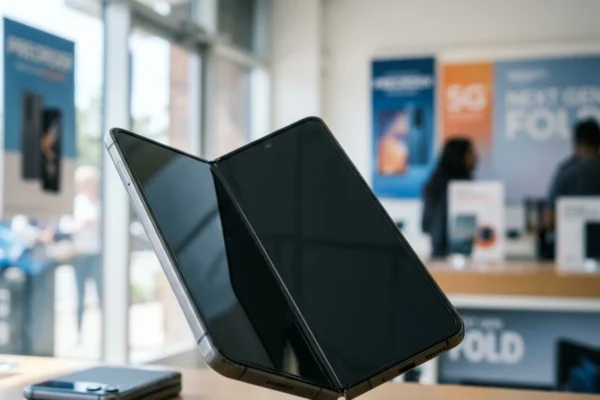
Samsung split its foldable flagship into two separate phones this week: a wider $1,899.99 Galaxy Z Fold8 built for media, and a taller $2,099.99 Z Fold8 Ultra built for power users. Pre-orders are open now, with both landing globally on August 7.
The redesign lands as Samsung’s grip on the category it created is projected to loosen. Global research firm Counterpoint expects Samsung’s foldable share to fall from 40% in 2025 to 32% in 2026, the same year Apple is expected to ship its first foldable iPhone. Samsung is not just refreshing a phone. It is redrawing the shape of its whole foldable business right as the field gets crowded.
Two Shapes, One Chipset
For six generations, the Galaxy Z Fold was one phone in one shape: tall, narrow when closed, wide when opened into something close to a small tablet. That formula ends with the Fold8.
The standard Galaxy Z Fold8 now uses a shorter, wider 4:3 internal display, closer to a paperback book than the old tall-and-narrow layout, aimed at video, browsing and everyday one-handed use. The Galaxy Z Fold8 Ultra keeps the taller, productivity-focused shape Fold owners know, paired with upgraded cameras and a larger battery. Both run Qualcomm’s Snapdragon 8 Elite Gen 5.
The hardware split runs deeper than the screen shape. The Fold8’s cover glass is 30% thicker display glass than the Ultra carries, a durability trade-off tied to the wider panel’s proportions. And buyers hunting for the privacy display feature Samsung skipped this time on the Fold8 will not find it. That feature, which narrows the viewing angle on command, stayed exclusive to the Galaxy S26 Ultra.
| Model | Starting Price | Screen Shape | Chipset | Positioning |
|---|---|---|---|---|
| Galaxy Z Fold7 (2025) | $1,999 | Tall, narrow cover screen | Snapdragon 8 Elite for Galaxy | Single all-purpose foldable flagship |
| Galaxy Z Fold8 | $1,899.99 / €1,999 | Wider 4:3 format | Snapdragon 8 Elite Gen 5 | Media and everyday use |
| Galaxy Z Fold8 Ultra | $2,099.99 / €2,200 | Taller, productivity-focused | Snapdragon 8 Elite Gen 5 | Power users, upgraded cameras, larger battery |
A Price That Brackets the Old Flagship
Look at where the two new prices land next to last year’s phone, and the strategy gets clearer. The Galaxy Z Fold7 launched at $1,999. The new Fold8 undercuts that by roughly $100. The Fold8 Ultra sits about $100 above it. Samsung did not simply raise its foldable price. It split the old price point in two and built a phone on each side of it.
That is a different move than a straightforward year-over-year price hike, and outlets covering the launch have noted Samsung raised foldable prices generally as memory chip costs climbed. Framed against the Fold7 baseline, though, the entry point for a Samsung foldable actually got cheaper, not more expensive, while the ceiling moved up. Exactly $200 now separates the two new models, a gap small enough that the choice comes down to shape and use case rather than budget tier.
Samsung’s Share Is Set to Shrink as the Market Grows
The timing is not incidental. Counterpoint Research, a market research firm that tracks global device shipments, forecasts shipments growing 20% globally in 2026, with premium book-style devices and Apple’s expected entry driving the expansion. Growth alone is not the whole picture for Samsung.
- 32% – Samsung’s projected global foldable share in 2026, down from 40% in 2025, per Counterpoint
- 25% – the share Apple’s unconfirmed first foldable iPhone, tagged the iPhone Ultra in supply chain reports, is projected to capture in its debut year
- 24% – Huawei’s projected share as the Chinese maker keeps scaling foldable output
- 20% – the overall growth Counterpoint expects across global foldable shipments in 2026
Motorola and HONOR trail at 8% and 3%. The category Samsung built almost alone since 2019 is turning into a real fight, and one twist works in Samsung’s favor either way: Samsung’s own display arm supplying Apple’s rival foldable panels means Samsung profits from Apple’s launch even as it loses phone share to it. Counterpoint’s own panel-supply research shows panel shipments rebounding on Apple’s entry across the whole foldable supply chain, Samsung Display included.
Will Two Shapes Sell Better Than One?
Splitting one flagship into two is a bet that shoppers will self-sort correctly, wide screen for readers and streamers, tall screen for spreadsheet-and-multitasking users, rather than getting stuck comparing two similarly priced phones and buying neither. Industry reaction so far is split down the middle.
- Some analysts see the wide-versus-tall split as genuine product differentiation aimed at two distinct buyers, media viewers against productivity users
- Others read it as a defensive reshuffle timed to Apple’s looming foldable debut rather than an organic design evolution
- A third view holds that Apple’s arrival helps Samsung too, by legitimizing folding phones for buyers who waited for Apple before considering one at all
Research firm Moor Insights & Strategy, in its own analysis of the launch, frames the three-phone Z8 family, Fold8, Fold8 Ultra and Flip8, as a lineup built for distinct buyers rather than one phone stretched to fit everyone. The open question is whether foldables are popular enough yet for that kind of segmentation to pay off. The category still makes up a small slice of global smartphone shipments overall, and a wider screen alone may not be what pushes a mainstream buyer to spend $1,899.99 on a phone for the first time.
A Smartwatch Wave Lands the Same Week
Samsung did not stop at phones. The Galaxy Watch Ultra2 arrived in a thinner case despite packing an 800mAh battery, its biggest yet, while keeping the single 47mm titanium build that defined the original Ultra. The Galaxy Watch9 landed alongside it in two sizes.
- Galaxy Watch Ultra2 – thinner titanium case, one 47mm size, 800mAh battery
- Galaxy Watch9 – 40mm and 44mm options, new Snapdragon Wear Elite chipset, brighter display, expanded artificial intelligence (AI) health tracking
- Galaxy Watch Classic – skipped entirely this cycle, with no refreshed model for 2026
Both watches are up for pre-order now, with general sales starting the same August 7 date as the phones. Pairing the whole hardware slate into a single wave is its own signal: Samsung is leaning on volume and simultaneous launches across categories at the exact moment its foldable share is projected to shrink.
The Real Test Starts August 7
Everything about this launch is a wager rather than a settled outcome. Samsung is betting that shoppers understand the difference between a wide Fold8 and a tall Fold8 Ultra well enough to pick the right one instead of walking away confused. It is betting that pricing $200 apart, bracketed around what a single Fold7 used to cost, keeps the category affordable rather than fragmenting it into two niche products.
None of that gets tested by a press release. It gets tested by actual sales once pre-order buyers get their phones and general retail opens on August 7, the same day Apple’s own foldable ambitions keep inching closer to market.