Samsung’s cheaper-sounding Galaxy Z Fold8 “Wide” will ship with 30% thicker ultra-thin glass than the more expensive-named “Ultra,” according to a report from ZDNet Korea, picked up by 9to5Google, Android Headlines, and Notebookcheck. The reversal puts the Wide’s display on a spec the Ultra does not get, and a year-old panel under a brand new badge.
Ultra-thin glass, or UTG, is the thin, flexible layer that sits on top of a foldable phone’s inner display, smoothing out the fold and protecting the panel underneath. The Wide carries 60μm of UTG. The Galaxy Z Fold8 Ultra carries 45μm, the same as this year’s Galaxy Z Fold 7. The 30% gap puts a year of Samsung’s own UTG development on the model with the less premium-sounding name.
What the Korean Report Found
ZDNet Korea broke the figures first, with the English-language breakout arriving on June 15 in a report on the 60μm UTG figure. The same set of numbers was restated by Android Headlines and Notebookcheck within hours, each citing the Korean outlet as the source. Samsung has not confirmed the figures itself.
The report says the Wide’s UTG thickness is expected at 60μm, a 15-micrometer jump over the 45μm the Galaxy Z Fold 7 used and the Galaxy Z Fold 8 Ultra will continue to use. The Ultra is, in this respect, indistinguishable from the phone Samsung is replacing. The Wide is the first Samsung foldable to ship with a 60μm layer on a wide chassis. The 30% gap shows up plainly on paper, even with the launch still a month away.
Both foldables are expected to be unveiled on July 22. Samsung has not commented on the leak.
- Galaxy Z Fold8 “Wide” UTG: 60μm
- Galaxy Z Fold8 “Ultra” UTG: 45μm
- Galaxy Z Fold 7 UTG: 45μm (unchanged on the Ultra)
- Galaxy Z Fold 6 UTG: 30μm
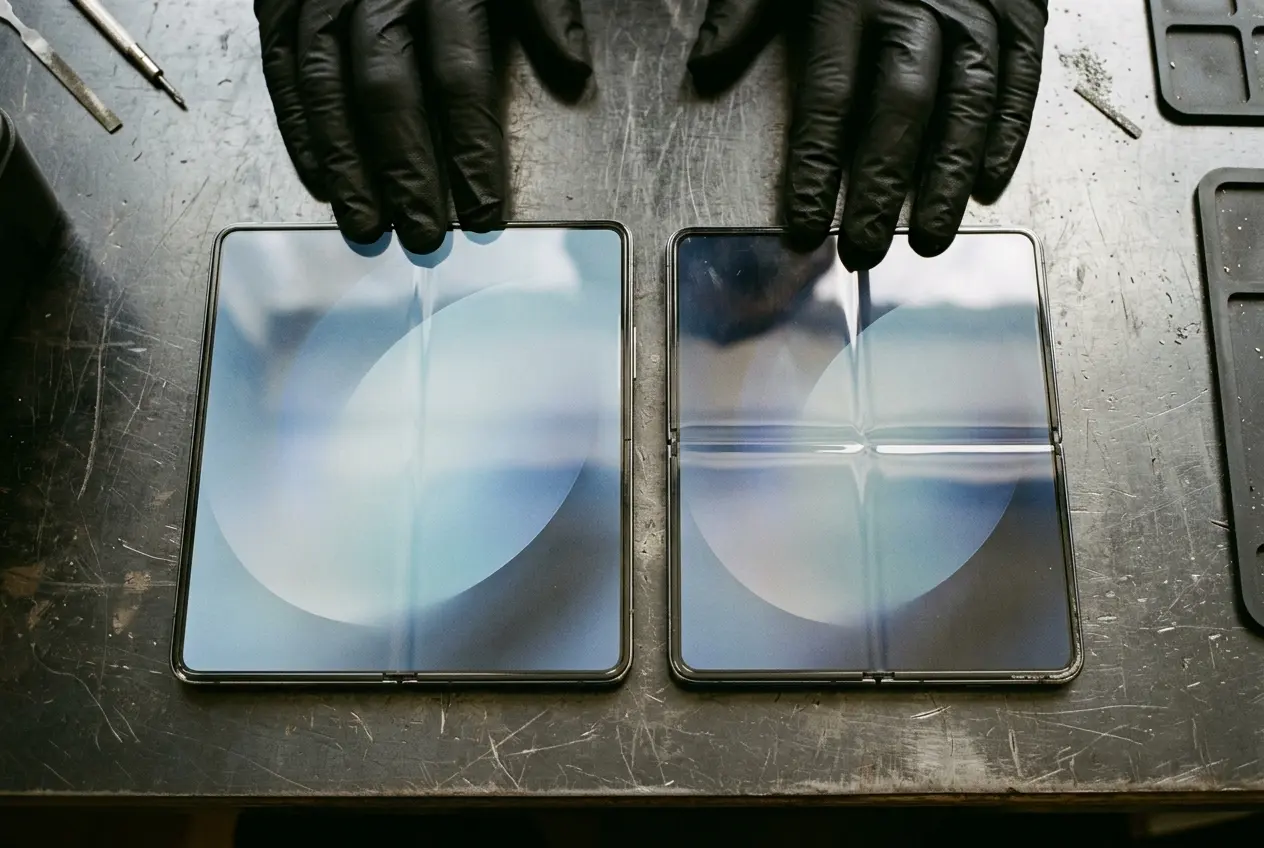
Why the Wide Got the New Glass
The Wide is the new form factor in Samsung’s lineup, the squarer, near-4:3 model the leaks peg at roughly 7.6 inches across the inner panel. The Ultra is a refresh of the tall, narrow chassis that has carried the Fold brand since 2019. That chassis was designed around a 45μm UTG layer, and Samsung’s engineering choice for 2026 is to leave it there, not to redesign a body that already ships at scale. The Wide’s chassis, on the other hand, was designed with 60μm in mind from the start, per the same set of leaks, which include a public photo of the wide Fold8’s squarer body.
The thicker glass makes more sense on the Wide. The wider aspect ratio is the one where reviewers and buyers have complained most about the visible crease running down the center, and a thicker UTG is the simplest mechanical way to push the crease down. Samsung is putting the upgrade where it shows up most, even if it sits below the more expensive badge.
The Trade-Off a Thicker Glass Carries
A thicker UTG layer changes three things about a foldable display.
It cuts the visibility of the crease. The 9to5Google write-up of the Korean report put it this way: “the thicker the glass, the better the display panel tends to look.” The Android Headlines summary, drawing on the same ZDNet Korea report, noted that the thicker layer also helps absorb impact in a drop. Both outlets treated this as the headline benefit of the 60μm figure.
It also adds stress to the fold. A 60μm layer has to bend further through a smaller angle on every open and close, and it is stiffer than a 45μm layer. Android Headlines called the trade-off directly: thicker UTG “is going to increase the risk of it breaking when folded.” The same outlet also reported that the Wide’s crease will be measured against the OPPO Find N6 and the HONOR Magic V6, both of which have set the bar Samsung is now chasing. 9to5Google went a step further and tied the trade-off to a recurring problem: “the wider device could be slightly more likely to see its display crack randomly, a problem on some past devices.”
The way Samsung’s own design choices have worked in the past, this trade-off is not theoretical. The Galaxy Z Fold 6 jumped to 30μm from a thinner layer on its predecessor. The Z Fold 6 Special Edition, sold only in Korea and China, moved to 45μm. The Z Fold 7 stayed at 45μm. The Wide’s 60μm is the next step on that line, and a wider one than the previous jumps.
| Aspect | Thinner UTG (45μm) | Thicker UTG (60μm) |
|---|---|---|
| Crease visibility | More visible | Less visible |
| Drop protection | Standard | Improved |
| Fold-cycle stress | Lower | Higher |
| Random-crack risk | Lower | Slightly higher |
How Samsung’s UTG Has Trended Across Folds
Samsung’s UTG has moved up in fits and starts, with the 2024 Special Edition as the only previous time Samsung jumped a Fold in mid-cycle. The Wide’s 60μm is the next move, not the Ultra’s.
- Galaxy Z Fold 6 (2024): 30μm UTG
- Galaxy Z Fold 6 Special Edition (Korea, China): 45μm UTG
- Galaxy Z Fold 7 (2025): 45μm UTG
- Galaxy Z Fold 8 Ultra (2026): 45μm UTG (no change from Fold 7)
- Galaxy Z Fold 8 “Wide” (2026): 60μm UTG
The 60μm figure puts the Wide on a layer that has not shipped on a retail Samsung foldable before. The closest reference point is the crease control that Chinese rivals, the OPPO Find N6 and the HONOR Magic V6, have already used to make the visible fold less of a story in their own reviews. Samsung’s foldable design team now has to match what those two devices have shipped. The 30μm step up from the Fold 6 is the largest single jump Samsung has made on a flagship Fold. The previous bumps, from the original Fold to the Fold 5, were smaller and were not documented publicly at the same granularity.
The Fold 8 Ultra sits below that line. Its UTG spec is the same as the Fold 7’s, and the same as the Fold 6 Special Edition’s. On paper, the Ultra is the model with the older glass, even though its name suggests the opposite.
That is the part the leaks have not made a fuss about. The naming convention is doing the talking, not the spec sheet, and Samsung has not produced a spec sheet of its own to clear the air. Buyers waiting for the July 22 Unpacked will need to read past the badge. They will also need to know that the Wide is not the cheaper model, only the differently-shaped one.
The point of putting the 60μm glass on the Wide first is to test the layer on a form factor that has no design heritage to compare against. The Ultra gets the same glass as the Fold 7 for one more cycle. The Fold 9, in 2027, is the model that takes the leap if the test passes.
A Test Case for the Fold9 in 2027
The thicker glass is not a one-off. Per the ZDNet Korea report, if the Wide’s 60μm UTG holds up over a normal year of use, Samsung will put it on the Galaxy Z Fold 9 across the lineup, including the Ultra, per the Galaxy Z Fold 9 likely adopting 60μm UTG in 2027. That makes the Wide a production test, in plain retail packaging, running next year’s glass a year early. Samsung has used this playbook before, with the Fold 6 Special Edition as the earlier example.
The Special Edition jumped from 30μm to 45μm and stayed a Korea-and-China exclusive. Its 45μm layer moved up to the Fold 7 as the base spec, but never made it onto the main flagship as a year-over-year upgrade. If the same pattern holds, the Fold 8 Ultra gets the same glass as the Fold 7 for one more cycle, and the Fold 9’s Ultra takes the leap the Wide just took.
If the significantly thicker UTG layer proves successful in the Galaxy Z Fold 8, the Galaxy Z Fold 9 will also likely adopt the 60-micrometer-thick UTG component in 2027.
Notebookcheck, a hardware review outlet, summarized the ZDNet Korea report that way.
Where the July 22 Unpacked Fits
Samsung is expected to lift the covers on both foldables on July 22, alongside the Galaxy Z Flip 8. The launch is the cleanest window Samsung will have to talk about the Wide’s UTG choice, and to walk through why the cheaper-sounding name gets the new glass.
Per Forbes’ write-up of leaks from Samsung tipster Ice Universe, the Ultra will measure 4.1mm unfolded, shave the Fold 7’s 4.2mm thickness, weigh 215g, and house a 5,000mAh battery that is around 13% bigger than its predecessor’s, with 45W charging. The chassis looks “identical” to the Fold 7. The display glass is the one spec the Ultra does not change.
The Wide’s spec sheet runs in a different direction. The same Forbes report puts the Wide at 201g, lighter than the Galaxy S26 Ultra, with a 4,800mAh battery and 45W charging, per the 201g weight and revised sales targets. Samsung has also revised the Wide’s internal sales target upward, from 500,000 to 1.5-2 million units for the launch window, and cut the Galaxy Z Flip 8’s target from 3 million to 1.5-2 million, a sign of where the production line is being asked to run hardest.
Frequently Asked Questions
When is the Galaxy Z Fold8 launch date?
Samsung is expected to unveil the Galaxy Z Fold8 Wide, the Galaxy Z Fold8 Ultra, and the Galaxy Z Flip 8 on July 22. The ZDNet Korea report on the Wide’s UTG lines up with that window, and Samsung has not commented on the figures.
Why does the Galaxy Z Fold8 Wide have thicker glass than the Ultra?
The Ultra inherits the Fold 7’s chassis, which was built around a 45μm UTG layer. The Wide is a new form factor, and Samsung is putting the new glass on the new shape, where the visible crease has been the loudest complaint from buyers and reviewers.
Will the Galaxy Z Fold9 use 60μm UTG too?
Per the ZDNet Korea report, Samsung plans to roll out 60μm UTG across the Fold9 lineup in 2027 if the Wide’s 60μm layer performs as expected over a normal year of use.
What does thicker ultra-thin glass do to a foldable display?
Thicker UTG makes the crease down the center of the inner display less visible and improves the panel’s drop absorption. The cost is more mechanical stress on the fold, and a slightly higher chance of the display cracking under repeated opening and closing, the same pattern that has hit some past Samsung foldables.
How does the Galaxy Z Fold8 Wide’s UTG compare to the Galaxy Z Fold 7?
The Wide ships with 60μm of UTG, the Galaxy Z Fold 7 used 45μm, and the Galaxy Z Fold8 Ultra stays at 45μm. The Wide’s 60μm is the first time this glass thickness has shipped on a retail Samsung foldable.