General Atomics Aeronautical Systems (GA-ASI) and Norway’s Kongsberg finished two engineering reviews on June 30 in Kongsberg, Norway, clearing a path to bolt a 350-kilometer stealth missile onto a drone that has no stealth of its own. The companies announced the completed System Requirements Review and Preliminary Design Review on July 20 at the Farnborough International Airshow, jointly funding the work to give MQ-9B operators a long-range strike option they have never had.
The paperwork is routine. What it unlocks is not. Kongsberg’s Joint Strike Missile (JSM) was built to protect a stealth fighter’s radar signature. Strapped externally to a slow, propeller-driven surveillance drone, its own stealth and reach do the surviving instead, which is a very different proposition for the roughly dozen air arms now lining up to fly MQ-9B.
GA-ASI and Kongsberg Clear Two Hurdles Toward an Armed MQ-9B
The System Requirements Review confirms that adding JSM to the MQ-9B is technically achievable. The Preliminary Design Review checks that the proposed design actually meets those requirements before engineers move to detailed design work. GA-ASI’s own announcement of the milestone describes the project as aimed at giving MQ-9B and its customers a long-range strike capability, funded jointly by both companies rather than by a single government contract.
“We recognize the value JSM brings to our MQ-9B platform,” said Niki Johnson, GA-ASI’s vice president for international capture and government affairs.
The integration of the JSM into an unmanned aerial platform like the MQ-9B creates a high-performance precision strike capability that can be used both in conjunction with manned aircraft and independently.
Jens Gjestvang, Kongsberg’s senior vice president for missiles and aerostructures, made that case in the companies’ joint statement, adding that the defense sector is showing growing interest in the concept.
A Stealth Missile Riding on a Drone With No Stealth at All
JSM weighs 416 kilograms, stretches four meters and carries a 118-kilogram warhead built for precision effects rather than blast. Its defining trick, the reason air forces from Norway to the United States have bought it for their F-35s, is that it is small enough to fit inside the jet’s internal weapons bay. That preserves the fighter’s low radar signature during a strike run, something no other long-range anti-ship or land-attack missile can claim.
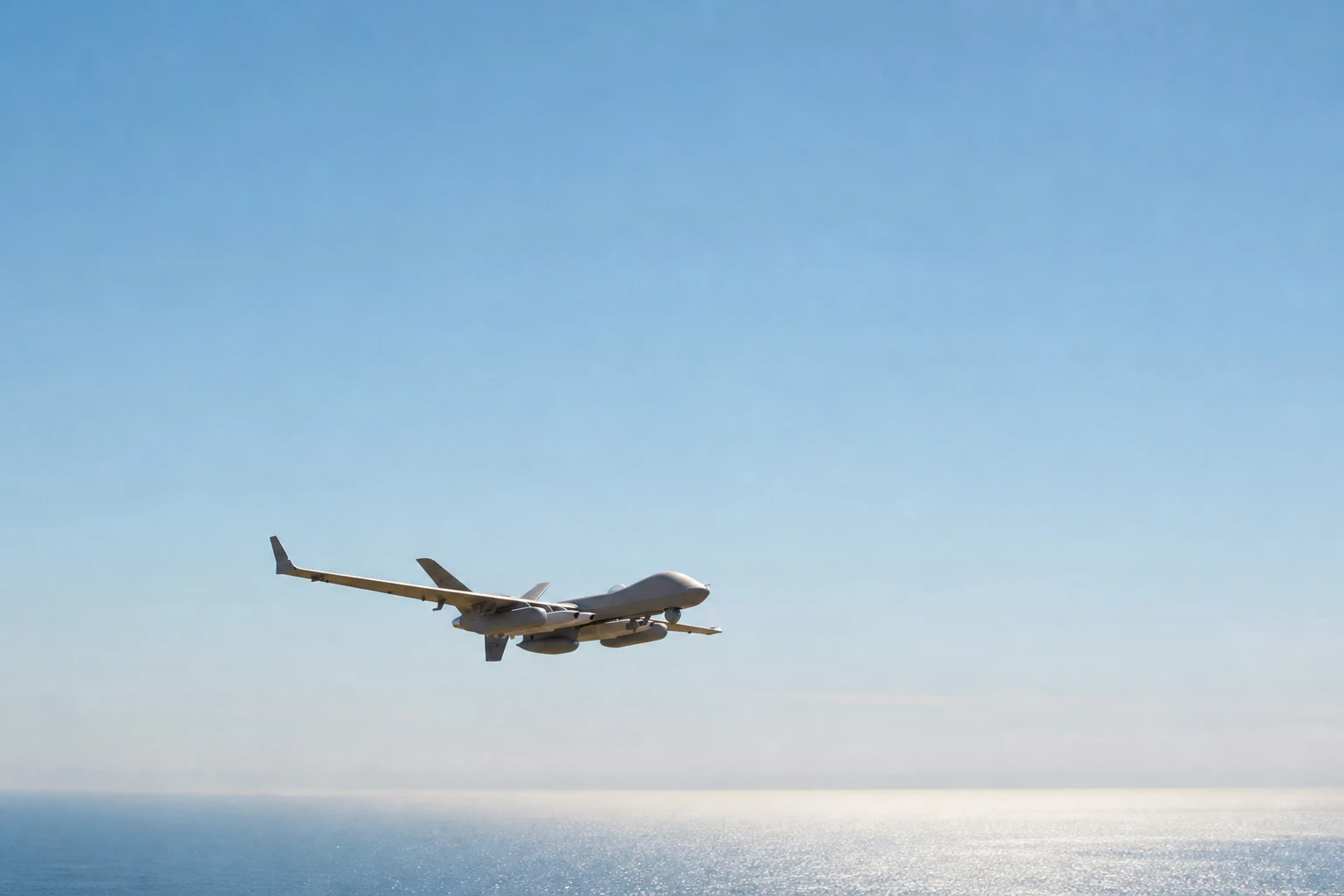
None of that internal-carriage advantage applies to the MQ-9B. GA-ASI’s own artist rendering shows a SeaGuardian variant carrying four JSMs externally under its wings, alongside two jamming pods and a maritime radar. The drone will not hide the missile inside a bay. It does not need to. Army Recognition, a defense trade publication, describes the MQ-9B as built for operation in controlled airspace, not the kind of contested skies an F-35 is designed to penetrate.
JSM solves that mismatch on its own terms. It flies at high subsonic speed, hugs terrain and sea surface to stay under enemy radar, and carries a range beyond 350 kilometers. That lets the drone launch from well outside an adversary’s air defense envelope, well short of where its own lack of stealth would matter, and let the missile do the penetrating alone.
Why JSM Might Win the MQ-9B Payload Fight
JSM is not the only weapon GA-ASI is chasing for the MQ-9B. In a February 2026 announcement, the company said it was also evaluating Lockheed Martin’s AGM-158B Joint Air-to-Surface Standoff Missile (JASSM) and AGM-158C Long-Range Anti-Ship Missile (LRASM) for the same airframe, aiming to fly at least one of the three as early as this year. Concept art released at the time, according to reporting from The Aviationist, showed one MQ-9B carrying three JSMs and two others each carrying a single JASSM or LRASM.
The weight difference explains why. MQ-9B’s SkyGuardian and SeaGuardian variants carry up to 2,155 kilograms across nine hardpoints, eight under the wings and one on the centerline. JASSM and LRASM each weigh well over a metric ton, leaving room for perhaps one round per aircraft. JSM’s far lighter build changes that math entirely.
| Missile | Maker | Launch Weight | Primary Role |
|---|---|---|---|
| JSM (Joint Strike Missile) | Kongsberg, with Raytheon | 416 kg (917 lb) | Stealth strike on ships and land targets |
| JASSM (AGM-158B) | Lockheed Martin | 1,200 kg (2,600 lb) | Deep land strike |
| LRASM (AGM-158C) | Lockheed Martin | 1,250 kg (2,760 lb) | Long-range anti-ship strike |
A single MQ-9B could plausibly carry a magazine of JSMs rather than one heavy American cruise missile, which turns the Kongsberg weapon from a niche European add-on into the default munition for any customer that wants more than one shot per sortie.
Customers Who Will Never Fly an F-35
The MQ-9B customer list has grown well past the countries that also fly the F-35. The Royal Air Force, Belgian Armed Forces and Japan Coast Guard already operate the type. Canada, Denmark, Poland, Germany, Qatar, Taiwan and India have all selected variants, and the U.S. Air Force has picked the platform to support its Special Operations Command.
- United Kingdom – the Royal Air Force flies the Protector RG Mk1 variant already in operational service.
- Taiwan – two of four ordered SkyGuardians arrived in March 2026 and are now tracking Chinese naval activity in the Taiwan Strait; Taiwan operates no F-35s.
- India – a roughly four billion dollar deal covers 31 MQ-9B drones split across its Air Force, Army and Navy; India’s fighter fleet is built around Rafale and Su-30, not the F-35.
- Qatar – selected the MQ-9B despite flying Rafale, F-15QA and Typhoon fighters rather than the F-35.
- Germany – ordered eight SeaGuardians for maritime patrol and anti-submarine warfare, separate from the 35 JSM-armed F-35s it is buying for its air force.
Taiwan’s case is the sharpest illustration. Its SeaGuardian and SkyGuardian radars already track surface vessels at 150 to 300 kilometers, useful for watching the Taiwan Strait but useless for hitting anything. A JSM-class weapon would change that math without Taipei ever needing to field a stealth jet of its own.
How Far Can an Armed MQ-9B Actually Reach?
An MQ-9B can stay airborne more than 40 hours, cruise above 40,000 feet and, according to Asian Military Review, cover roughly 5,000 nautical miles on internal fuel. Paired with a 350-kilometer missile, that endurance turns the aircraft into something closer to a loitering arsenal ship than a surveillance platform.
Asian Military Review offered a concrete illustration of what that means in the Pacific: an MQ-9B launching from Darwin, Australia, could in theory fly as far as Taiwan, release a weapon and return home on the same sortie. GA-ASI itself named the Western Pacific as the theater driving demand when it first floated the JASSM, LRASM and JSM integration work in February, citing the need to hold targets at risk from greater distances for longer periods, independently or alongside manned aircraft.
That mission set keeps expanding beyond strike alone. GA-ASI and Saab are separately working through plans for an MQ-9B airborne early warning and control demonstration in 2026, adding a radar-picket role to a platform originally built for overwatch. Strike, airborne early warning, anti-submarine patrol: the same nine-hardpoint airframe is being asked to do all three.
Delivery Dates Still Sit Years Away
This is not fielded yet. GA-ASI has targeted a captive-carry flight with an inert round as early as this year, not a live-fire test, and no MQ-9B flying today carries a missile of any kind. Germany’s eight SeaGuardians, ordered for maritime patrol and anti-submarine work, are not due at the naval air arm until 2028. The design reviews completed on June 30 sit near the start of a defense acquisition process that typically runs through a critical design review, structural testing and qualification before any weapon reaches a squadron.
That gap matters for a platform Army Recognition describes as built for controlled airspace rather than contested skies. A JSM-armed MQ-9B trades away nothing in survivability if it never has to enter the airspace the missile is meant to reach. Whether air forces are willing to trust an unstealthy, propeller-driven aircraft with that judgment call, sortie after sortie, is the question the engineering reviews cannot answer.
Frequently Asked Questions
What do a System Requirements Review and Preliminary Design Review actually confirm?
They are early defense acquisition milestones. The System Requirements Review confirms a proposed capability is technically achievable, and the Preliminary Design Review checks that the design concept meets those requirements before engineers commit to detailed design. Both precede a critical design review and flight testing, meaning the MQ-9B/JSM program remains several stages from an operational weapon.
Has an MQ-9B ever flown with a live JSM, JASSM or LRASM?
No. GA-ASI’s February 2026 announcement targeted a captive-carry flight with an inert round as early as this year, meaning a missile shape mounted for structural and aerodynamic data rather than fired. No live-fire date has been announced for any of the three weapons on MQ-9B.
What is JSM’s official U.S. military designation?
JSM is designated AGM-184A in U.S. service. The U.S. Air Force awarded Kongsberg a $240.9 million Lot 2 production contract for the missile in June 2026, an order tied to F-35 arming rather than the MQ-9B program, which shows how much demand already existed before drone integration began.
Which countries currently fly JSM on fighter jets?
Norway, Australia, Japan, the United States and Germany have all fielded or ordered JSM for their F-35 fleets, with Germany becoming the fifth customer in 2025. Canada has since placed its own order for JSM to arm its future F-35 fleet, according to The Defense Post.
Does Germany’s incoming SeaGuardian fleet arrive already armed?
No. The eight SeaGuardians Germany ordered are intended for maritime patrol and anti-submarine warfare, with delivery to the naval air arm scheduled to begin in 2028. JSM integration is a separate, jointly funded engineering program still at the design-review stage, with no confirmed timeline for arming any customer’s fleet.