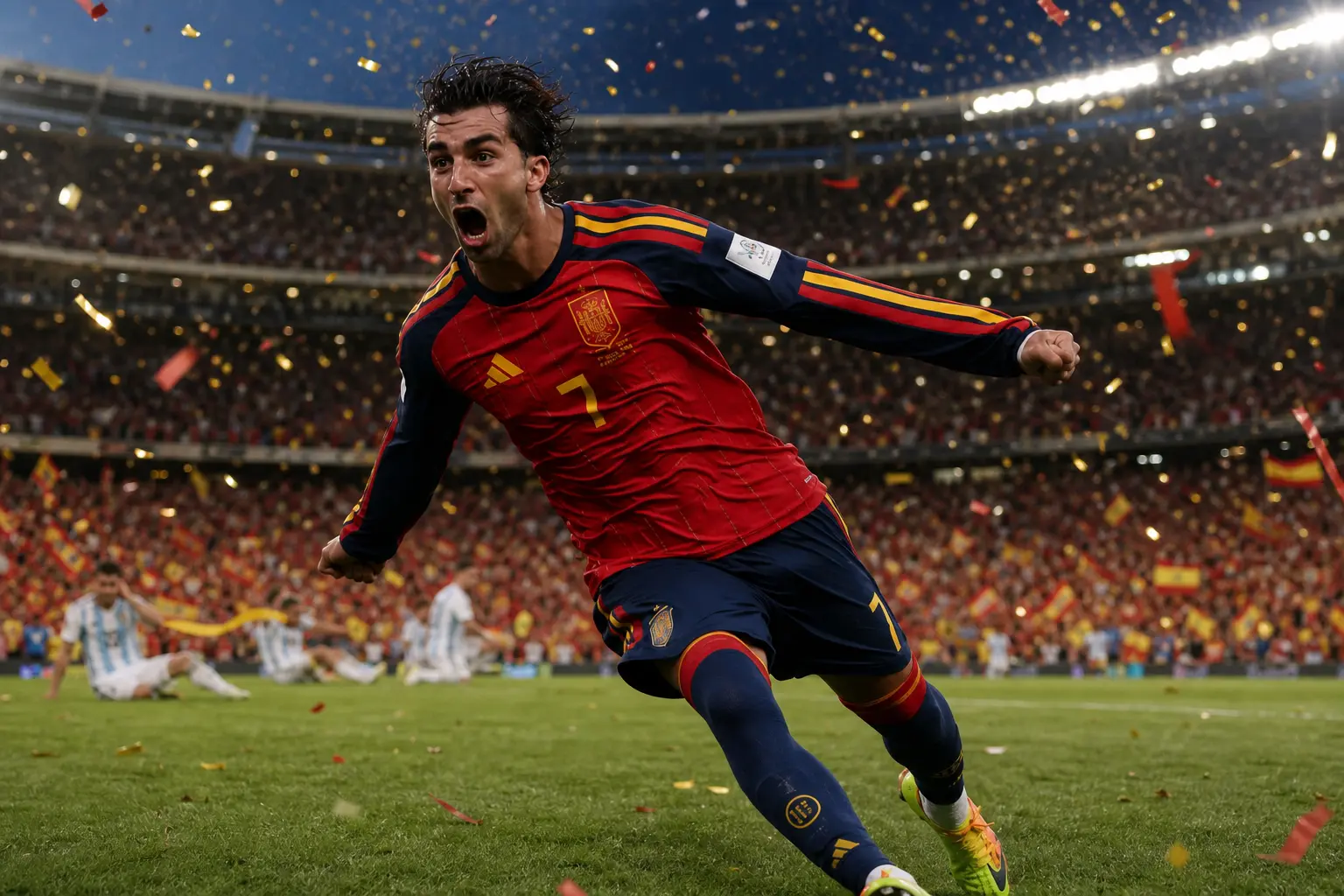
Ferran Torres scored in the 106th minute to give Spain a 1-0 extra-time win over Argentina in Sunday’s FIFA World Cup final, clinching the country’s second title and denying Lionel Messi the storybook ending to his international career. The goal came 16 years after Spain’s only other World Cup triumph, and it arrived in almost the same shape.
Spain’s win at New York New Jersey Stadium in East Rutherford, New Jersey, looked at times like a rerun of 2010: a 1-0 scoreline, extra time, an opponent reduced to ten men, and a substitute who changed everything. Even the surname on the matchwinner’s back has shown up in a Spain title game before.
Ferran Torres Ends It in the 106th Minute
Torres had spent most of the tournament on the bench. He came on in the 62nd minute for Mikel Oyarzabal and spent the next 44 minutes chasing a goal that would not arrive, not for lack of trying.
Teenage winger Lamine Yamal had already set him up once, skinning two Argentina defenders and squaring a low ball for a close-range header that goalkeeper Emiliano Martínez turned away. Then, less than a minute into the second period of extra time, the chance that mattered finally came. Pedro Porro lifted a ball to the back post. Nico Williams beat Nahuel Molina to the header and sent it back across goal. Martínez had already committed the wrong way, and Torres met it with a first-time strike for his first goal of the tournament.
Argentina played the closing stretch a man down after Enzo Fernández was sent off for a reckless foul on 19-year-old Barcelona defender Pau Cubarsí. Messi’s best look at an equalizer came from a corner with about four minutes left, when a bouncing ball found substitute Giuliano Simeone, the Atlético Madrid winger and son of Atlético manager Diego Simeone, who fired over the bar and held his head in disbelief.
The goal belonged to 47 million people. It wasn’t just mine or the 26 players.
Torres, who had also forced extra time with a stoppage-time equalizer in this season’s Copa del Rey final, said the moment overwhelmed him before he could process it as a footballer. Spain coach Luis de la Fuente, 65, became the oldest coach ever to win a World Cup. “We are world champions,” he said. “It was together we reached this stage.” Players from both sides shoved each other after the final whistle, briefly, before Spain’s squad lined up to collect their medals.
Spain Has Won This Final Before
Spain’s only other World Cup title came on July 11, 2010, when Andrés Iniesta scored in the 116th minute to beat a ten-man Netherlands side 1-0 in Johannesburg. Iniesta’s winner came seven minutes after John Heitinga was sent off for hauling him down, the same kind of late red card that shaped Sunday’s final.
That 2010 squad had eight Barcelona players in its starting lineup, Iniesta among them. The pass that put the ball into the box that day came off the boot of a wide forward named Torres, no relation to Sunday’s hero, before Cesc Fàbregas found Iniesta for the finish. Sixteen years apart, a Torres has now touched the buildup or the finish of both of Spain’s World Cup wins.
Spain’s 2010 champions had lost their opening group match before storming back to the title. This year’s team did not lose at all. La Roja conceded just one goal in eight matches, the fewest ever allowed by a champion.
| Detail | 2010 Final | 2026 Final |
|---|---|---|
| Opponent | Netherlands | Argentina |
| Venue | Soccer City, Johannesburg | New York New Jersey Stadium, East Rutherford |
| Winning goal | Iniesta, 116th minute | Torres, 106th minute |
| Opponent sent off | Heitinga | Enzo Fernández |
| Scorer’s role | Started the match | 62nd-minute substitute |
| Spain manager | Vicente del Bosque | Luis de la Fuente |
The two winning goals sit sixteen years apart but landed within ten minutes of each other on the clock, both in the second half of extra time, both against an opponent already down to ten men.
Rodri, Simón and Cubarsí Sweep the Individual Honors
Spain’s depth showed up in the tournament’s individual awards, too. FIFA’s technical study group handed three of the four major prizes to Spanish players.
- Rodri – the Manchester City midfielder won the Golden Ball as the tournament’s best player, with Messi taking Silver and Kylian Mbappé the Bronze.
- Unai Simón – Spain’s goalkeeper won the Golden Glove after seven clean sheets and a single goal conceded in eight matches, against Belgium.
- Pau Cubarsí – the 19-year-old defender fouled for Enzo Fernández’s red card was named Best Young Player.
- Kylian Mbappé – France’s forward won the Golden Boot with 10 goals, becoming the first man to win it twice, and finished his World Cup career with 22 goals, one more than Messi’s 21.
Spain’s title also gives the country something no nation has held before. Its women’s team won the World Cup in 2023, making Spain the first to hold both the men’s and women’s titles at once. Add the European Championship Spain’s men won in 2024, and the federation now sits on three of the sport’s biggest trophies at the same time, a spread it last approached between 2008 and 2012 under a different golden generation.
Was This Lionel Messi’s Last World Cup?
Nobody has said so on the record. Messi did not speak to reporters after the final, and Scaloni said he had not yet discussed his captain’s future with him. Messi, 39, wore boots stitched with the words “The Last Tango” into the match. “I feel sad,” he said afterward, having been moved to tears as he received his runner-up medal and looked into the stands at Argentina’s fans.
The numbers around him told their own story. Messi finished as the first player to appear in six World Cups and the first to start three finals. He scored eight goals this tournament, second only to Mbappé, and earned the Silver Ball. De la Fuente said his “first idea was to keep Messi at bay,” a plan that held Messi to 54 touches, his fewest in a full World Cup match, and just one shot.
Argentine journalist Gastón Edul of TyC Sports has reported that Messi is expected to keep playing for Argentina at least through the 2026 Copa América rather than walk away immediately. His club contract with Inter Miami runs through the 2028 MLS season, when he will be 41. Were he to chase a third World Cup, he would turn 43 before the 2030 tournament kicks off.
Scaloni Says He Needs Time to Decide His Own Future Too
Messi is not the only uncertain figure in Argentina’s camp. Scaloni said he also needs time to think about whether he stays on as coach, even as the Argentine Football Association builds its short-term plans around whatever Messi decides. Teammates have told reporters they intend to do everything possible to keep their captain in the squad.
Spain faces a calmer question: how to defend everything it just built. De la Fuente’s group now holds the World Cup and the European Championship at the same time, and much of its spine, Cubarsí, Yamal, Rodri and Simón among them, is young enough to chase both again. The 2030 World Cup adds an unusual wrinkle for Argentina’s rebuilding plans: Spain is one of that tournament’s hosts, alongside Portugal and Morocco, with centenary matches also scheduled in Argentina, Uruguay and Paraguay.
Frequently Asked Questions
Will Lionel Messi Play in the 2030 World Cup?
Nobody has ruled it out, but no promise has been made either. Messi would turn 43 during the 2030 tournament, and Scaloni said he has not yet spoken with his captain about it. Reports out of Argentina suggest Messi will keep playing internationally at least through the 2026 Copa América before deciding anything further.
Has Any Country Won Back-to-Back Men’s World Cups?
Yes, twice. Italy won in 1934 and 1938, and Brazil won in 1958 and 1962. Argentina’s bid to become the third team to repeat, and the first since Brazil, ended with Sunday’s loss to Spain.
Where Will the 2030 World Cup Be Held?
Spain, Portugal and Morocco are set to host the bulk of the 2030 tournament, with centenary matches also planned in Argentina, Uruguay and Paraguay to mark 100 years since the first World Cup in 1930.
How Many Teams Played in the 2026 World Cup?
Forty-eight, the first time FIFA expanded the tournament beyond 32 teams. The expanded format drew nearly 6.9 million fans across 104 matches in the United States, Canada and Mexico, filling stadiums to 99.7 percent capacity and roughly doubling the previous attendance record set when the United States hosted in 1994.