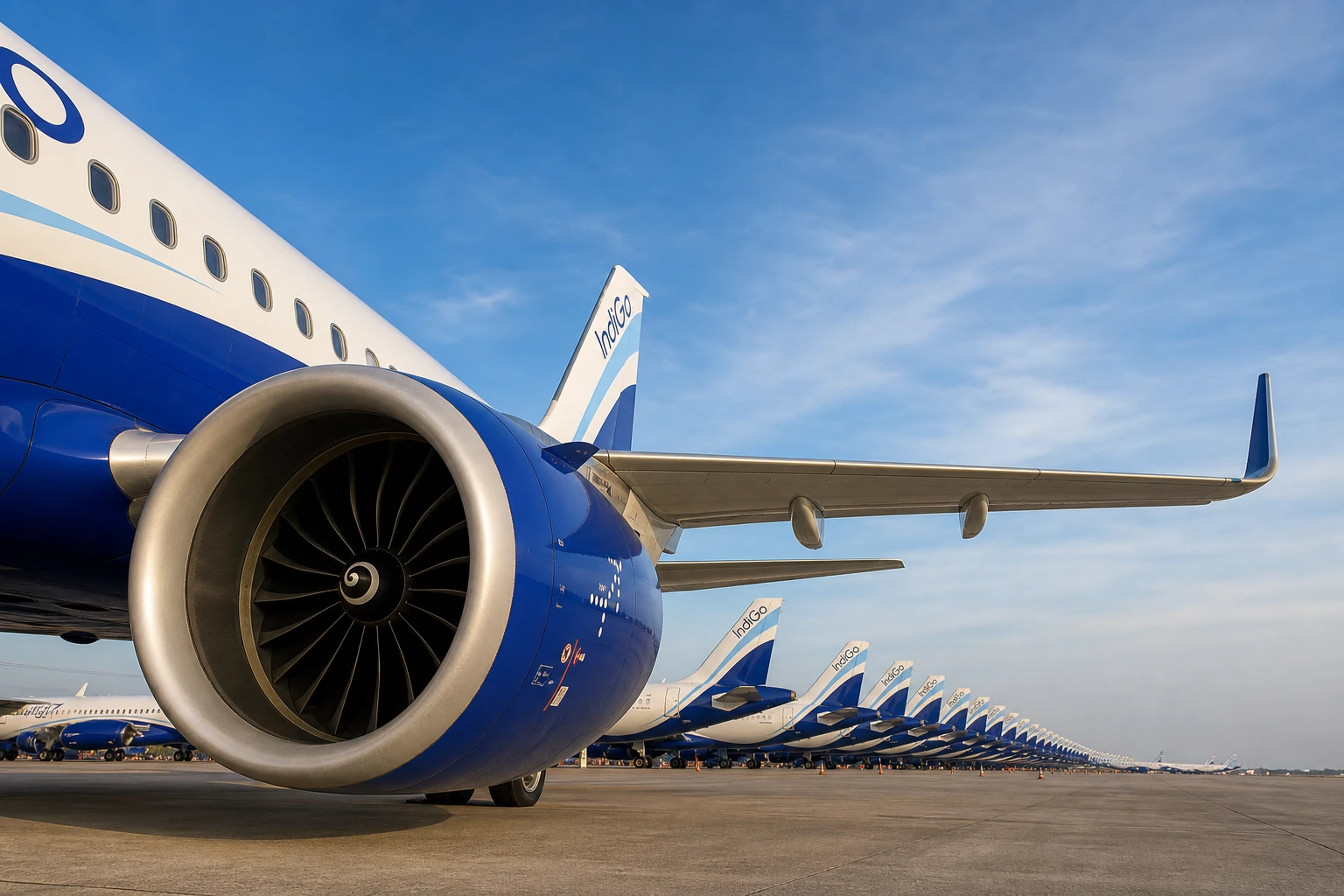
IndiGo has agreed to buy more than 1,000 CFM LEAP-1A engines to power 510 Airbus A320neo family jets, the largest single engine order CFM International has ever booked. The memorandum of understanding (MoU), signed Monday at the Farnborough International Airshow in England, also commits CFM to help IndiGo build its first dedicated engine repair shop and locks in a long-term spare parts deal.
The agreement carries zero Pratt & Whitney engines. That comes after three years in which IndiGo grounded dozens of jets, took undisclosed compensation payments, and watched a smaller domestic rival collapse into bankruptcy over the American engine maker’s reliability crisis.
A Farnborough Signing Ten Years in the Making
The signing brought together GE Aerospace chief executive H. Lawrence Culp Jr., Safran chief executive Olivier Andriès and IndiGo managing director Rahul Bhatia. Willie Walsh, IndiGo’s incoming chief executive, who previously ran British Airways parent International Airlines Group and served as director general of the International Air Transport Association, attended in his capacity as CEO designate ahead of formally taking the job in August.
As of mid-2026, IndiGo operates more than 440 aircraft, runs over 2,200 daily flights to 141 destinations across 96 domestic and 45 international cities, and carried roughly 123.4 million passengers in fiscal year 2026, commanding roughly 63 to 64 percent of India’s domestic aviation market. It has flown on CFM engines for a decade and now operates more than 375 A320 and A321 Family aircraft on that power.
Here is how the deal breaks down:
- 1,000+ engines ordered to power 510 Airbus A320neo family jets, the biggest single LEAP order CFM has ever signed.
- 375+ aircraft in IndiGo’s current fleet already fly on CFM power, a relationship that started in 2016.
- 10,000+ LEAP engines delivered worldwide across CFM’s installed base, according to the company.
- Zero Pratt & Whitney engines appear anywhere in the new agreement.
Walsh framed the order as part of IndiGo’s push toward becoming a global carrier and pointed to the engine’s track record.
The LEAP engine’s industry-leading proven reliability makes it the ideal choice to support our scale, operational resilience and sustainability ambitions.
Culp struck a similar note. “IndiGo has trusted CFM to support its performance for a decade now, and we’re honored to renew that trust with today’s agreement,” he said, adding that LEAP engines are now delivering up to twice the time on wing in hot and harsh operating conditions compared with when they entered service.
Why Wasn’t Pratt & Whitney Part of This Deal?
Because IndiGo’s existing A320neo fleet has flown on a mix of engines since 2019, and the Pratt & Whitney half of that mix has cost the airline dozens of grounded jets, an undisclosed payout and a front-row view of a rival’s bankruptcy. IndiGo’s current A320neo family fleet is powered by a mix of LEAP-1A and Pratt & Whitney PW1100G engines.
IndiGo’s history with Pratt & Whitney actually predates its CFM relationship. Years before its 2016 CFM deal, IndiGo signed a definitive agreement with Pratt & Whitney for 150 Airbus A320neo family aircraft, covering 300 firm PurePower PW1100G-JM engines with a long-term maintenance agreement, with deliveries penciled in from 2015. That bet on Pratt’s geared turbofan design ran into trouble in 2023, when the company disclosed a contaminated powder metal defect running through the PW1100G fleet.
Over 70 IndiGo aircraft were grounded because of issues with Pratt engines, with more than 30 tied directly to the powder metal defect and the rest to older problems. IndiGo eventually got paid for the disruption. On June 14, 2024, InterGlobe Aviation finalized an amendment to its agreement with International Aero Engines, a Pratt & Whitney affiliate, which agreed to “provide IndiGo with a customized compensation in relation to the ongoing situation of Aircraft on Ground due to unavailability of engines,” the company said in a stock exchange filing at the time. The amount was never disclosed.
A smaller Indian rival did not survive the same crisis. Go First filed for bankruptcy in 2023, citing faulty Pratt & Whitney engines for grounding almost half its Airbus A320neo fleet, with more than 50 percent of the fleet down since December 2022 and an estimated revenue loss of $1.32 billion. The carrier never resumed flying.
IndiGo’s reliability troubles this decade have not been limited to engines. Regulators separately hit the airline with a record ₹22.2 crore fine over flight disruption chaos, a reminder of how much operational strain the airline has absorbed even as it keeps growing.
Pratt’s problems have not gone away. The Federal Aviation Administration issued a new airworthiness directive in January 2026 requiring fuel system modifications on Pratt & Whitney PW1100G engines, affecting 586 engines powering the Airbus A320neo family after fan-blade fracture events led to three under-cowl fires.
LEAP and GTF, by the Numbers
Set side by side, the two engines that compete for space under the A320neo’s wings have had very different last three years.
| Metric | CFM LEAP-1A | Pratt & Whitney PW1100G (GTF) |
|---|---|---|
| Share of new A320neo engine orders | Roughly 75% | Roughly 25% |
| Share of global A320-family flights today | Over 25% | Under 10% |
| Overall narrowbody engine market | Over 60%, including 737 MAX exclusivity | Roughly 35% of new single-aisle orders |
| 2026 regulatory action | None reported | FAA fuel system directive on 586 engines |
CFM’s LEAP now captures roughly 75% of new A320neo engine orders against Pratt’s GTF, largely on the strength of its early reliability record, according to aviation analysis firm AirInsight. That gap shows up in the air, too. The CFM LEAP engine now powers over 25% of all A320 flights worldwide, the fastest-growing engine type in the narrowbody segment, while the Pratt & Whitney GTF accounts for less than 10% of A320 utilization.
Zoomed out across the whole single-aisle market, the picture is closer. CFM captured approximately 40% of new single-aisle engine orders in recent years, while Pratt & Whitney secured approximately 35%, primarily through GTF penetration. Pratt still has a real customer base, including major carriers beyond IndiGo. Its PW1100G customers include IndiGo, Spirit Airlines, Frontier Airlines, Wizz Air and JetBlue Airways.
How IndiGo and CFM Got Here
The relationship did not start at the size it is today. It grew in steps, against a backdrop of Pratt & Whitney’s parallel struggles.
- 2016: IndiGo begins flying Airbus A320ceo jets on CFM56-5B engines, opening its relationship with CFM.
- 2019: The airline selects LEAP-1A engines for its incoming A320neo and A321neo fleet, running alongside its existing Pratt & Whitney order.
- 2023: Pratt & Whitney discloses a powder metal contamination defect across the PW1100G fleet; Go First collapses into bankruptcy blaming the same engines.
- June 2024: IndiGo finalizes a compensation deal with International Aero Engines, a Pratt & Whitney affiliate, after grounding more than 70 aircraft.
- January 2026: The FAA orders fuel system fixes on 586 PW1100G engines following fan blade fractures and under cowl fires.
- July 2026: IndiGo signs the record 1,000-plus engine MoU with CFM at the Farnborough Airshow, with no Pratt & Whitney content.
Pune, Bengaluru and the MRO Bet Behind the Engines
The deal is not only about engines sitting on wings. It is also about where those engines get built and fixed. GE Aerospace pointed to its Indian manufacturing footprint in explaining the deepened commitment, citing production in Pune, a broad local supplier base and advanced engineering work in Bengaluru, alongside more than 40 years of support for India’s aviation sector.
Safran has been building out its own side of that footprint. The company opened its largest LEAP engine repair facility last year, a 45,000 square metre site with plans to ramp up to 300 LEAP engine shop visits annually. Andriès called India a market of strategic importance to Safran, pointing to continued investment in LEAP production and maintenance capability in the country.
CFM is not slowing down elsewhere either. The company is separately investing $2 billion over five years to expand its maintenance network and work through a backlog of early-fleet engines now reaching their first planned shop visits. The IndiGo order was not the only LEAP headline out of Farnborough this week. Singapore-based lessor BOC Aviation finalized a firm order for up to 300 LEAP engines, split between 200 LEAP-1A and 100 LEAP-1B units, and Jackson Square Aviation also selected LEAP-1A engines for part of its A320neo order book.
India is CFM’s third-largest market worldwide, with five carriers operating more than 400 LEAP-powered aircraft and about 2,000 engines still on order. That scale is exactly why the MRO build-out matters: more engines flying in the country means more shop visits needed close to home instead of overseas.
What Comes Next for India’s Biggest Airline
The 510 aircraft covered by this MoU will enter IndiGo’s fleet over the coming decade, not all at once, and financial terms of the deal were not disclosed. The commitment lands months after currency swings pushed IndiGo to a ₹2,394 crore net loss for fiscal 2026, a reminder that engine reliability is only one line item in a much larger cost base the airline has to manage.
Leaning almost entirely on one engine maker for this stretch of growth is itself a wager, even if it looks like the safer one after the last three years. If CFM stumbles on quality or delivery pace across a production ramp this large, IndiGo has far less of a Pratt & Whitney fallback than it did in 2019.
Pratt is not standing still either. The company has begun rolling out durability upgrades meant to close the gap that opened after 2023, and Rolls-Royce, absent from the narrowbody market for decades, is developing a new UltraFan 30 program aimed at cutting fuel consumption by 25% compared with today’s LEAP and GTF engines sometime in the next decade.
Frequently Asked Questions
What Does an MoU Mean in a Jet Engine Deal Like This One?
A memorandum of understanding is a preliminary agreement, not a firm, binding purchase contract. Airlines and engine makers typically sign an MoU first, then convert it into a definitive order later once pricing, delivery schedules and financing are worked out, which is why IndiGo and CFM have not disclosed a dollar value for this deal.
Which Other Aircraft Use CFM LEAP Engines?
The LEAP family also powers the Boeing 737 MAX exclusively through the LEAP-1B variant and powers the COMAC C919, China’s first domestically developed narrow-body jet, through the LEAP-1C variant. The A320neo remains the only airframe where LEAP competes directly against a rival engine.
Has Pratt & Whitney Responded to Losing This Order?
Neither Pratt & Whitney nor its parent RTX issued a statement specific to the IndiGo-CFM MoU. The company is midway through rolling out a 2026 retrofit program that brings GTF Advantage durability upgrades into its existing PW1100G fleet, its main effort to rebuild confidence in the engine.
When Will IndiGo Actually Receive the New LEAP Engines?
IndiGo has not published a delivery schedule tied to this MoU. The 510 aircraft it covers will be delivered gradually over roughly the next decade as part of IndiGo’s existing Airbus order book, rather than arriving in one batch.
Why Do Airlines Choose Between Two Engine Makers on the Same Jet?
Airbus offers A320neo customers a choice between the PW1100G-JM and the LEAP-1A specifically so the competition drives pricing and gives airlines operational flexibility. IndiGo used that choice to split its early neo orders between both makers before this latest deal shifted the newest tranche entirely to CFM.