Ferran Torres scored in the 106th minute Sunday night to give Spain a 1-0 extra-time win over Argentina and a second World Cup title. Sixteen years earlier, Spain won its first the exact same way.
Lionel Messi left the field in tears in what is likely his final World Cup match. Around him, President Donald Trump got booed off a stage he refused to leave, and a Coldplay-curated halftime show tried to turn the biggest game in soccer into the Super Bowl.
Ferran Torres Delivers the Goal Spain Waited 16 Years For
Torres had been on the pitch 44 minutes when he settled it. The Barcelona forward entered as a 62nd-minute substitute for Mikel Oyarzabal. In the 106th minute, he drove a close-range shot under the crossbar at MetLife Stadium in East Rutherford, New Jersey. FIFA had rebranded the venue New York New Jersey Stadium for the tournament. Nico Williams supplied the knockdown that put the ball at his feet.
“The goal belonged to 47 million people,” Torres said afterward. “It wasn’t just mine or the 26 players. Destiny was written, and it was meant for us to win far away from our people.”
The match turned bad-tempered late. In second-half stoppage time, Chelsea midfielder Enzo Fernández was shown a second yellow card, then red, for a reckless foul on Spain defender Pau Cubarsí. Argentina played the rest of the night with 10 men.
“When you have Messi on the other side, well, you are nervous,” Torres said. “At the end of the day, we always depended on us. We always come up with our football, and we showed it again.”
Argentina had arrived hoping to become the first team since Brazil in 1962 to win back-to-back World Cups. Captain Rodri lifted the trophy for Spain instead. “I feel sadness but knowing that we left everything out there,” Argentina coach Lionel Scaloni said.
It was only Spain’s second trip to a World Cup final. The ending felt familiar.
The Same Script, a Different Torres
Spain’s first World Cup title, won in 2010, also came 1-0 in extra time against the Netherlands. An extra-time strike in the 116th minute settled the match at Soccer City in Johannesburg.
The buildup ran through a substitute that night too. Fernando Torres had come on for David Villa moments earlier, and it was his pass that started the move Cesc Fàbregas finished by feeding Andrés Iniesta for the winner. Sixteen years later, another Torres came off Spain’s bench and did the scoring himself. Ferran and Fernando share a surname and nothing else, not even family ties, but each delivered the goal that won Spain a World Cup.
That 2010 team also lost its opening match, a shock 1-0 defeat to Switzerland, before winning six straight to lift the trophy and finish as the lowest-scoring champion in World Cup history. This year, Switzerland reached a World Cup quarterfinal against Argentina and lost. Spain never had to play the Swiss at all this time around.
| Detail | 2010 Final | 2026 Final |
|---|---|---|
| Opponent | Netherlands | Argentina |
| Result | 1-0, after extra time | 1-0, after extra time |
| Winning goal | 116th minute | 106th minute |
| Scorer | Andrés Iniesta | Ferran Torres |
| Decisive substitute | Fernando Torres, on for Villa | Ferran Torres, on for Oyarzabal |
| Head coach | Vicente del Bosque | Luis de la Fuente |
| Venue | Soccer City, Johannesburg | MetLife Stadium, East Rutherford |
Spain has now won both of its World Cup finals by that exact scoreline.
How Does a Team Win a World Cup Allowing One Goal?
Spain allowed exactly one goal across eight matches this summer, the stingiest defense of any champion in tournament history, even though no team has ever played more games to get there. Luis de la Fuente built it. At 65, he became the oldest coach to win a World Cup.
The result stretched Spain’s unbeaten run in all competitions to 38 games, 29 wins and nine draws. It broke a tie with Italy’s 2018-21 side for the longest such streak by a men’s national team. Spain also became only the third team to win a World Cup while reigning as European champion, joining its own 2008-10 side and West Germany’s 1972-74 team.
“I feel pride, to be honest,” de la Fuente told reporters. “Accompanying my players on this journey is an honor.”
The system leaned on nerve as much as tactics. Before the tournament, de la Fuente sat down for a private talk with a worried Lamine Yamal, the teenage winger carrying enormous expectation. Yamal beat two defenders in the final’s closing minutes and nearly set up a winner himself before Torres finished the job.
Argentina, for its part, could not find a way through. At halftime the team had no shots, no corners and no touches in the penalty area, managing just 35 percent of possession. Goalkeeper Emiliano Martínez made 11 saves, breaking the previous championship-match record of eight, and still lost. Spain finished with 20 shots. Argentina never got one on target.
Boos Follow Trump and Infantino Onto the Field
The stadium’s ambient noise ran about 78 decibels before Trump walked out for the trophy ceremony. It jumped to 84 once the booing started, loud enough to cut through a crowd that had just watched its own tournament crowned.
Trump had arrived by Marine One roughly 45 minutes before kickoff. He watched from a suite behind bulletproof glass, alongside FIFA President Gianni Infantino, Spain’s King Felipe VI, Canadian Prime Minister Mark Carney and Mexican President Claudia Sheinbaum. The jeering started even before the match, when Trump appeared on the video boards after Jennifer Hudson’s rendition of the national anthem.
It came back louder for the ceremony. Trump and Infantino walked onto the pitch to whistles, and the noise didn’t stop when Trump stayed on the podium as Spain’s players tried to celebrate with the trophy among themselves. Infantino jogged over to usher him aside. Argentina defender Cristian Romero declined to shake Trump’s hand while receiving his runner-up medal.
It wasn’t Trump’s first brush with FIFA’s disciplinary process this tournament. Earlier in the World Cup, he asked Infantino to review a red card shown to U.S. forward Folarin Balogun in the round of 32 against Bosnia and Herzegovina. FIFA suspended the ban, and Balogun played in the 4-1 loss to Belgium that eliminated the host nation anyway.
FIFA’s Super Bowl Bet Splits the Crowd
FIFA staged its first-ever World Cup final halftime show, curated by Coldplay frontman Chris Martin. It stretched the usual 15-minute break to 30 minutes, though the performance itself ran just 11 minutes and 20 seconds, modeled openly on the Super Bowl.
The lineup moved fast:
- Madonna opened alongside Brazilian legends Ronaldo and Ronaldinho
- Conductor Gustavo Dudamel led the Muppets through a cover of “Seven Nation Army”
- BTS performed “Dynamite” through the show’s midsection
- Actor Jason Sudeikis, in character as Ted Lasso, introduced a reworked ballad from Justin Bieber
- Shakira and Burna Boy closed with “Dai Dai,” the official World Cup anthem
- The Staten Island PS22 Chorus joined Martin for a finale under fireworks
The show doubled as a fundraiser, raising money for children’s education and football access worldwide through a four-year partnership between FIFA and Global Citizen with a $100 million goal.
Viewers argued over it well past midnight. Some praised the pacing and the star power. Others said the pageantry didn’t belong in a football final at all.
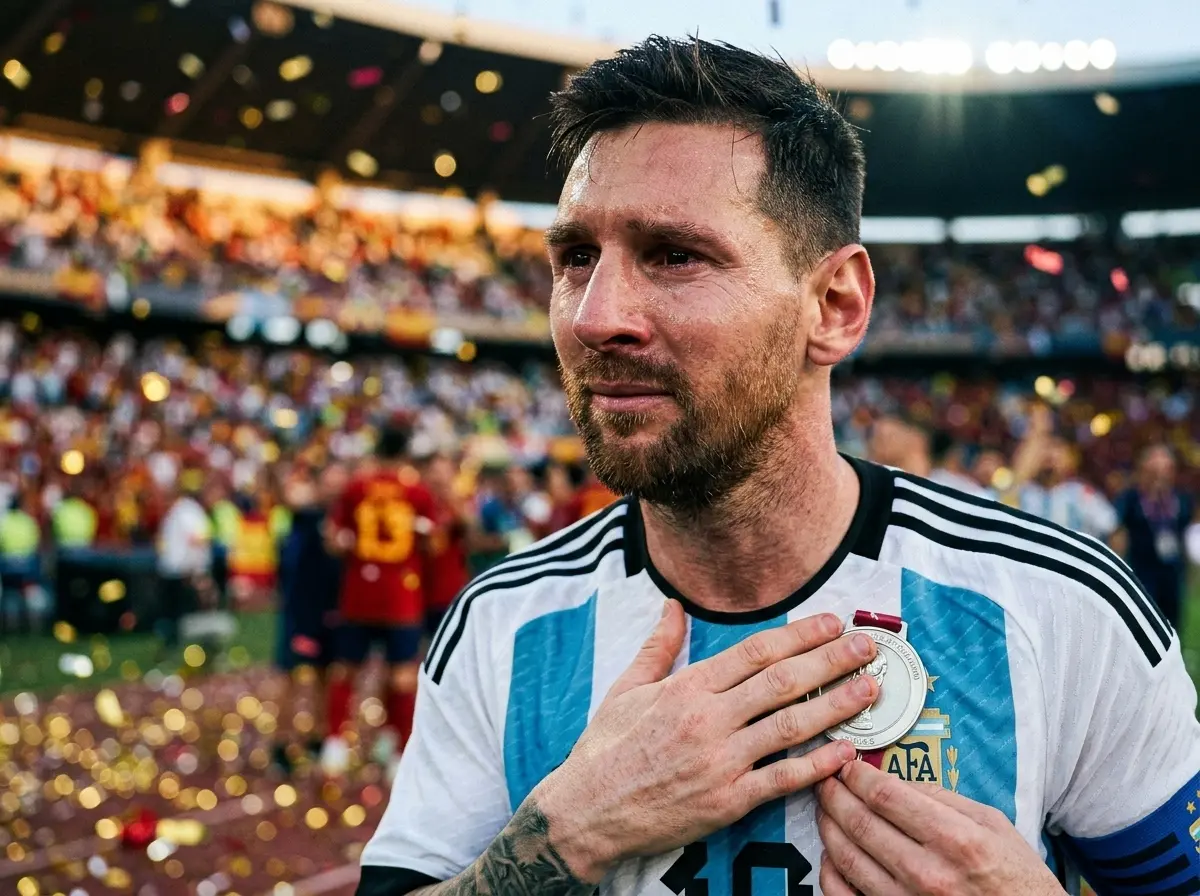
Messi’s Final Bow Echoes Maradona’s Worst Night
Messi became the first man to start three World Cup finals, in 2014, 2022 and 2026, and at 39 the oldest outfield player ever to start one. He finished this tournament with eight goals, two behind France’s Kylian Mbappé for the Golden Boot, and 21 for his career, one short of Mbappé’s record.
I feel sad. They were better, to be honest.
Messi said afterward, having been moved to tears as he stared into the crowd of Argentina supporters while collecting his runner-up medal.
Argentina’s two most painful final losses now sit 36 years apart, and Diego Maradona’s shadow touches both. His Argentina played a foul-heavy 1990 final and lost 1-0 to West Germany after two red cards. On Sunday, Argentina lost 1-0 again, reduced to 10 men by Fernández’s sending-off, this time with Messi in tears at the whistle instead of lifting a farewell trophy.
What We Know:
- Messi, 39, started Sunday’s final, his third, becoming the first man to start three World Cup finals.
- He finished the 2026 tournament with eight goals and 21 for his career, one behind Mbappé’s all-time record.
- He was moved to tears collecting his runner-up medal and has not commented publicly on his international future since.
What’s Unconfirmed:
- Whether Sunday’s final was Messi’s last match for Argentina.
- Any timeline for a retirement decision, or whether he plays on into the 2027 Copa América.
Spain’s spine for the next cycle is already on the field. Yamal and Cubarsí are both teenagers. De la Fuente is 65 and hasn’t lost a competitive match in charge. Messi is 39, and Sunday was probably the last World Cup final he’ll ever play.
Frequently Asked Questions
How many World Cups has Argentina won?
Three, in 1978, 1986 and 2022. Diego Maradona captained the 1986 title-winning team. This year’s squad, built around Messi, could not add a fourth title or match Brazil’s 1962 back-to-back feat.
Where will the 2030 World Cup be held?
Spain, Portugal and Morocco will host the bulk of the 2030 tournament, with three centenary matches staged in Uruguay, Argentina and Paraguay to mark the World Cup’s 100th anniversary.
What is Kylian Mbappé’s career World Cup goal record?
Mbappé’s World Cup career tally stands at 22 goals across three tournaments, one more than the 21 Messi finished with after Sunday’s final, making Mbappé the competition’s all-time leading scorer.