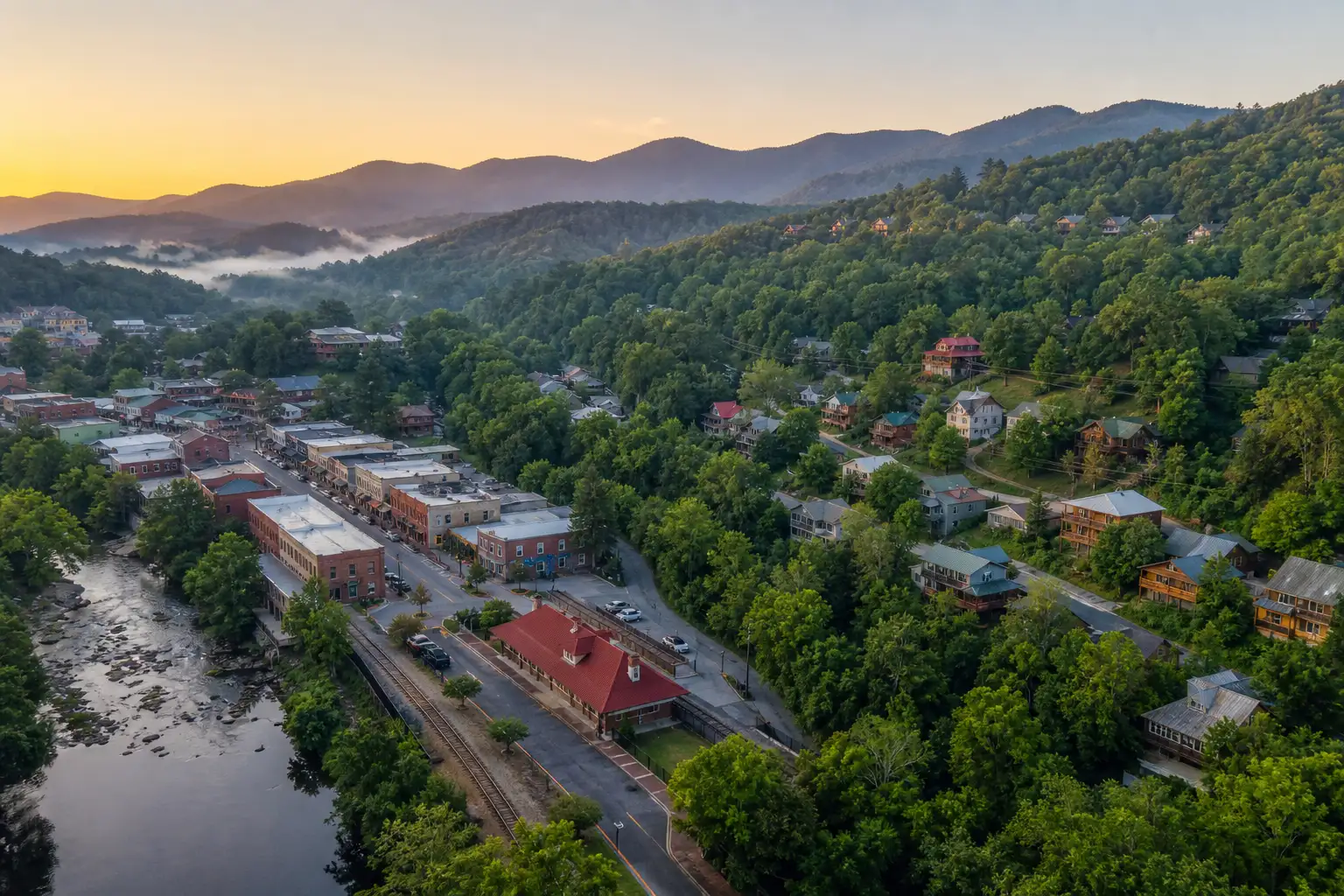
Southern Living has named Blue Ridge, a Fannin County town that runs about 10 degrees cooler than Georgia’s cities in July, one of the state’s best summer escapes. Its elevation inside the Chattahoochee National Forest keeps afternoons milder than Atlanta, Savannah or Augusta. It is the latest in a string of magazine write-ups for a town of 1,366 people.
That attention has helped fuel a short-term rental boom that has already reshaped Fannin County’s housing market. Cabin nights now generate millions of dollars in tax revenue every year, and home values have climbed well past what the area’s typical paycheck can support.
Blue Ridge Runs About Ten Degrees Behind the Rest of Georgia
Blue Ridge lies inside the Chattahoochee National Forest, in the southern stretch of the Blue Ridge Mountains, at a higher elevation than nearly anywhere else in Georgia. That height, combined with heavy tree cover, is why afternoons there tend to run cooler than in Atlanta, Macon or Savannah.
Southern Living puts the seasonal gap at about 10 degrees during the hottest stretch of summer. A National Weather Service forecast for Saturday, July 18, first tallied by Savannah Now, showed a smaller spread on that particular day.
| City | Forecast High, July 18 |
|---|---|
| Blue Ridge | 89°F |
| Atlanta | 92°F |
| Athens | 93°F |
| Macon | 94°F |
| Savannah | 95°F |
| Augusta | 97°F |
That is eight degrees behind Augusta and three behind Atlanta on a single afternoon, a smaller gap than the season long average but still enough to notice. On a humid July day, three degrees is the difference between a comfortable porch and a sticky one.
A Small Downtown Built Around the Getaway
The cooler air is only part of the pitch. Southern Living’s write-up leans just as hard on what visitors can do once they arrive, and the list reads like a long weekend already planned.
- Hiking mountain trails through the Chattahoochee National Forest
- Visiting nearby waterfalls
- Browsing locally owned shops and restaurants in downtown Blue Ridge
- Riding the historic Blue Ridge Scenic Railway
- Fishing, kayaking and boating on Lake Blue Ridge
Georgia’s own tourism office highlights 106,000 acres of national forest surrounding the town, along with 300 miles of hiking trails, a combination that has made Blue Ridge a routine weekend trip for Atlanta residents 90 miles south.
Georgia Media Has Been Pointing This Way Before
Blue Ridge has been down this road before. Southern Living named the town one of the South’s Best Mountain Towns back in 2022, and it has resurfaced on similar lists in the years since.
The year round population has barely moved in that time. Census estimates put Blue Ridge at 1,366 residents as of 2022, inside a Fannin County population of 25,319. Real estate data tied to the last two census counts shows the town’s population grew by nearly 15% between 2010 and 2020, a pace realtors in the area attribute to retirees, remote workers and second home buyers rather than new jobs.
The weekend population, filled with cabin renters and day trippers, is considerably larger. It has turned the town into what a short-term rental market analysis published this year called the most saturated cabin market in the region. That analysis ranked Blue Ridge as more competitive and more heavily managed than nearby Ellijay or Dahlonega.
How Much Money Does Fannin County’s Tourism Boom Generate?
Fannin County’s tourism economy runs on cabin nights and lodging tax dollars. The county’s most recent financial report shows millions flowing through lodging tax collections alone, and separate economic research ties tourism to a sizable share of all local employment. The figures below show the scale.
- $7,065,277 in lodging tax collected by Fannin County in 2024, with $3,417,256 of it, 48.4%, redirected into trade and tourism spending.
- $178.8 million in tourism economic output for the county in 2021, supporting 16.5% of all local jobs, according to a University of Georgia tourism snapshot.
- 600 to 900-plus active short-term rental listings estimated across Fannin County this year, fluctuating with the season.
- $150 to $1,000-plus a night, the range separating a basic two-bedroom cabin from an eight-bedroom property with a private theater or pool.
Fannin County publishes its own lodging tax collection and disbursement figures, and the trend has only pointed upward as cabin inventory has grown.
Renters Edge Out Owners in a Town of 1,366
Blue Ridge has 741 total housing units. Only 616 of them are occupied, leaving 125 vacant, a vacancy rate near 17%. Much of that vacancy is cabins rented out nightly rather than left empty.
Of the occupied units, renters narrowly outnumber owners, 312 to 304, an unusual split for a town this size. Local officials and demographers attribute it to a mix of service workers, the same people staffing the downtown shops, restaurants and cabin cleaning crews, competing for housing against vacationers filling the rest of the stock. Median gross rent runs $803 a month, according to census estimates.
Zillow put the town’s typical home value at $512,473 in April. That is more than 10 times the area’s typical household income of $45,000 to $50,000 a year, according to a local cost of living breakdown, even though overall living costs in Blue Ridge otherwise run below the national average.
City rules confine short-term rentals to commercial districts and one multi-family zone, barring them from most residential streets. That zoning has not stopped cabin style investment from pricing out full time buyers elsewhere in the county.
County Rules Are Trying to Catch Up
Inside Blue Ridge’s city limits, short-term rental hosts have needed a vacation rental certificate and an occupation tax certificate, plus a $150 annual renewal fee, under the city’s short-term rental ordinance.
Unincorporated Fannin County, where much of the surrounding cabin inventory actually sits, moved slower. Commissioners scheduled public hearings for August 12 and August 26, 2025, on revisions to the county’s rental ordinance, with a final vote planned for the second date.
The same meetings also took up a “Habitat Protection” ordinance, adding noise limits and a new lighting rule meant to preserve dark hours across the county’s rural stretches. Traffic and light spilling from a growing cabin economy had become real friction points for residents living among the rentals.
The rule changes have not slowed outside interest. A Georgia short-term rental guide published this spring still listed Blue Ridge and Fannin County among the state’s most investor-friendly markets. Neither requires formal rental registration, even as cities like Atlanta and DeKalb County tighten their own rules.
Frequently Asked Questions
Is Blue Ridge walkable without a car?
Not really, outside downtown. Census figures show 342 of the town’s 422 workers drive alone to their jobs, and Blue Ridge has no public transit system. Thirty two people walk to work, a notable share for a rural mountain town, but reaching trailheads, the lake or the scenic railway depot generally requires a car.
When is the busiest tourist season in Blue Ridge?
Fall, driven by the Blue Ridge Scenic Railway’s foliage excursions each October, brings the tightest bookings and highest nightly cabin rates of the year, even above the summer rush this recommendation is riding. Spring wildflowers and winter holiday train rides also draw steady crowds.
Do Airbnb hosts need a permit in Blue Ridge?
Yes. Hosts inside city limits must also designate a local contact who can respond to problems within one hour, on top of the vacation rental certificate and tax registration the city already requires.
How big is Lake Blue Ridge?
Lake Blue Ridge covers 3,290 acres with 65 miles of shoreline, part of a Toccoa River watershed that includes 100 miles of trout streams, making it a draw for anglers as well as boaters and kayakers.