Three Macon toddlers have drowned in backyard pools within a month. Bibb County’s chief deputy coroner, a local swim coach, and a state representative are pushing the same water safety playbook in response. Free swim lessons open to 40 children on July 27, even as coaches repeat the same calls for alarms, self-latching gates, and uninterrupted adult supervision.
The Toll in Macon and What Coroners Are Seeing
The string of fatalities began in late June and has now reached three in a month. Chief Deputy Coroner Lonnie Miley, a former U.S. Coast Guard member, said he personally responded to two of the drownings. One victim was an 18-month-old found floating in a three-foot above-ground pool on Scotland Avenue. The other was a 2-year-old boy who died on the Fourth of July. All three occurred in backyard pools no more than three feet off the ground, in yards that parents described as ordinary. The latest in the string of Bibb County drownings ended with a child pronounced dead on a residential patio.
By the numbers, Bibb County, past month
- 18-month-old victim found in a backyard pool on Scotland Avenue
- 2-year-old victim drowned on July 4 in a backyard pool
- All three pools: above-ground, three feet tall
- Lead coroner on two of the scenes: Lonnie Miley, Bibb County Chief Deputy Coroner
Miley framed the deaths in plain terms for parents. He urged families to “keep an eye on (their children) all the time” near any body of water. Even a three-foot pool wall, he said, “is a lot for a child.” He warned that the same caution applies to adults; “anything can happen,” Miley said, and he leaned on his own Coast Guard background to push the point home.
Bibb County is not an outlier in the broader picture. Drowning is the leading cause of death for American children between ages 1 and 4, according to the U.S. Centers for Disease Control and Prevention. For children between 5 and 14, it is the second leading cause of unintentional injury death, the agency says. Backyard pools are where most drownings in that younger age band occur.
The Three Rules Swim Coaches Drill Every Morning
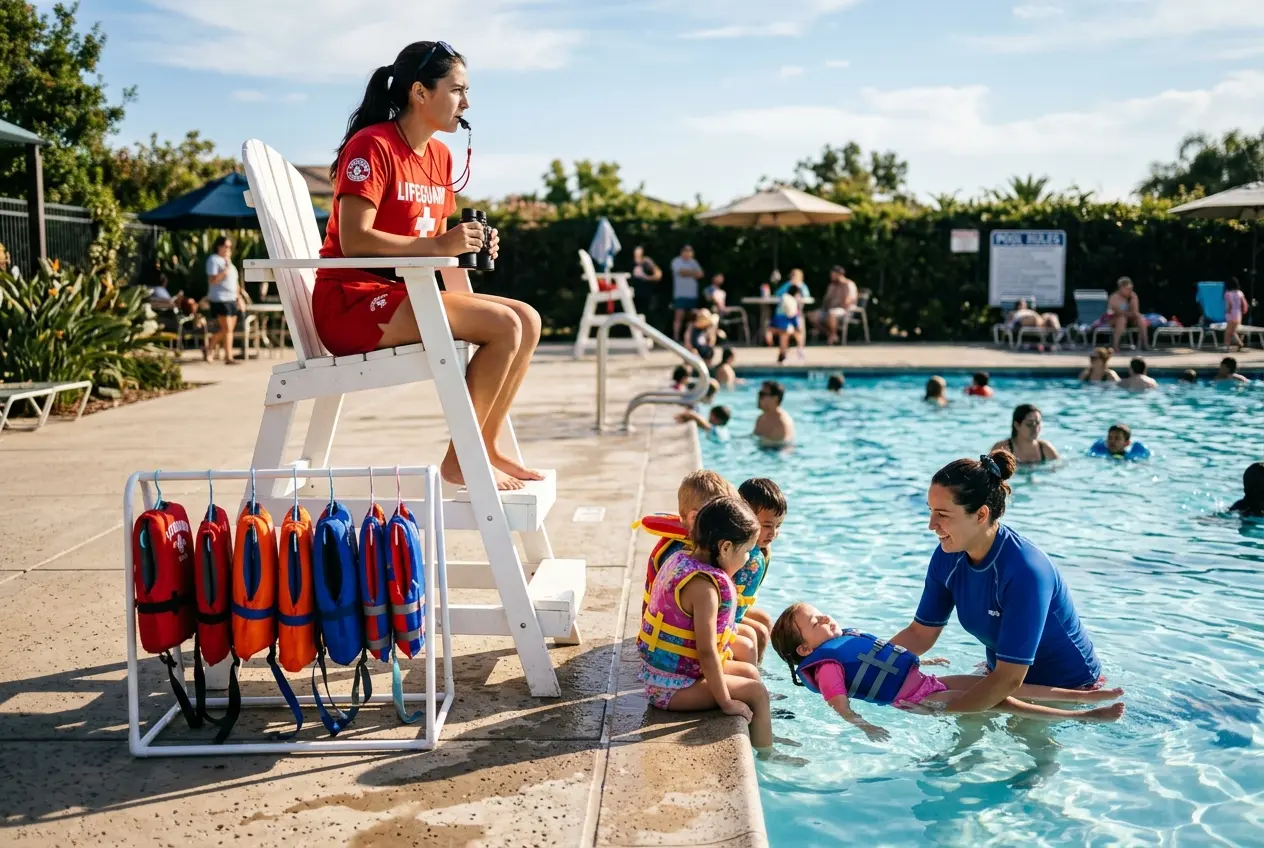
At Fusion Swim Club on Northside Drive in Macon, head coach Wesley Hamborg runs each class the same way. Children move through about two weeks of lessons across six stations. They learn to kick, glide, and pull through the water. Each skill mastered earns a strike on a gong before the next station begins. The school follows the SwimAmerica curriculum, developed by the American Swim Coaches Association.
Hamborg’s three pool rules, recited at every lesson
- Never swim alone.
- Never run on the pool deck.
- Never dive into shallow water.
Every morning begins the same way. Hamborg recites the three rules aloud before a single swimmer enters the water. The list is short because water safety, he says, does not survive a long list.
Hamborg watches the lesson from the deck while parents watch from a few feet back. He tells them they “can never be too vigilant as far as keeping an eye on your children at all times.” “Kids will push boundaries,” he adds; “they’ll see what they can get away with.” The risk, he says, is not the absence of ability. It is the assumption that a child who swims well will not slip, cramp, or wander. “Even the most well-behaved child can have a leg cramp or something go wrong unexpected,” Hamborg says; “they need to be supervised by an adult at all times.”
Children hear the rules, parents repeat them back, the deck clears, and the lesson begins. Repetition, not novelty, is the safety mechanism on Hamborg’s pool deck.
Life Vests vs. Pool Noodles
Gear is where most backyard routines quietly fail. Hamborg recommends well-fitted U.S. Coast Guard-approved life vests, the kind designed to stay in place in the water. Pool noodles, inflatable floaties, and toys tell a different story. They are built for play, not for keeping a small child’s head above water. Hamborg has watched the difference close up, twice.
Flotation gear: what helps and what hurts
| Recommended | Avoid |
|---|---|
| U.S. Coast Guard-approved life vest, sized for the child | Pool noodles, inflatable floaties, ride-on toys |
| Stays in place when the wearer shifts in the water | Can slip out, deflate, drift away, or flip over |
| Holds a weak swimmer’s head above water | Adds to play but not to survival |
One of his rescues involved an elderly woman who swam to the shallow end on a noodle. The noodle slipped out from under her, and she struggled in place. A swimmer nearby pulled her to safety before anything worse happened.
The second rescue involved a child clinging to an inflatable dolphin. “Everyone’s distracted, nobody was paying attention,” Hamborg says. “They think, ‘oh, there’s flotation things out there, that’s safety, maybe we don’t have to watch our kids as much.'” “It’s actually more dangerous.” A Coast Guard-approved life vest, by contrast, holds a weak swimmer above water without being held. It does not replace a watching adult. It does replace the false sense of security that comes with a foam noodle drifting in the deep end.
In the First Minutes of a Drowning Emergency
When something goes wrong at a pool, the response runs on seconds, not minutes. Drowning can happen in as little as 20 to 60 seconds and is often silent, the National Drowning Prevention Alliance notes. Hamborg’s standing instruction is to call 911 first, then start CPR before paramedics arrive. He also urges every parent to take a basic CPR class alongside installing the pool gate.
- Lock back doors that open toward the pool.
- Set an alarm on those doors or the closest window.
- Install a four-sided, self-latching isolation fence around the pool.
- Keep U.S. Coast Guard-approved life vests sized for every child in the home.
- Designate an undistracted adult water watcher on every pool visit.
Each step is small on its own. Combined, they make the difference between a child who walks into water and a child who is met with a closed door, a closed gate, or a watching adult. No single barrier is designed to do all the work. The combination is what lowers risk, and the combination is what gets skipped when the summer crowd shows up. Hamborg’s three daily rules sit on top of that stack: never swim alone, never run on the pool deck, never dive into shallow water.
Toddler Drowning by the Numbers
The Macon deaths sit inside a national pattern that has been widening for years. Drowning kills more than 4,000 people in the United States each year, according to the CDC, with children making up roughly one in four of those fatalities. For American children between ages 1 and 4, drowning is the leading cause of death, more than car crashes, more than birth defects, the CDC reports. For children between 5 and 14, drowning ranks second, behind motor vehicle crashes. Most drownings in the 1-to-4 age band occur in backyard swimming pools, the facts on childhood drowning in the United States show. Infants under 12 months are most often found in bathtubs.
Drowning in U.S. children, by the numbers
- 4,000+ U.S. drowning deaths each year (CDC)
- ~900 children and teens unintentionally drown each year (CDC)
- Children with autism: 160 times more likely to drown than their peers (NDPA)
- Three out of four child drowning victims are boys (Children’s Safety Network)
- Black and American Indian children drown at rates above the national average (NDPA)
Black children and American Indian children drown at rates well above the national average, the National Drowning Prevention Alliance says. Children with autism are estimated to be 160 times more likely to drown than their neurotypical peers, the same group reports, and the gap has driven a parallel push for specialized swim lessons for children with autism. Boys account for three out of four child drowning deaths, the Children’s Safety Network reports. These are averages; the Bibb County children who drowned this summer were very young.
By the CDC’s estimate, roughly 900 children and teenagers drown unintentionally each year in U.S. water. Macon’s three-in-a-month toll tracks the national pace. Every backyard pool, every open bath, every retention pond in a neighborhood carries the same baseline risk that does not lower because the water looks calm.
Free Swim Lessons in Bibb County, July 27 to 31
Macon State Representative Tangie Herring, a Democrat, announced a free water safety program in response to the Bibb County drownings. Safety Around Water lessons will run July 27 through July 31 at the South Bibb Recreation Center on Houston Road. Each session runs from 9 a.m. to 11 a.m. and space is limited to 40 children.
The classes are aimed at children ages 6 to 12. Partners include Amazon, Georgia Power, Macon-Bibb County government, Y Not Us, and the YMCA of Metro Atlanta. The YMCA Safety Around Water curriculum covers basic swimming technique, emergency response, and other skills that lower drowning risk. Macon-Bibb Recreation Director Robert Walker called the partnership a way to connect families with life-saving instruction. Herring, a former educator, framed the program in personal terms. She pointed to her classroom years, and she pointed to the work of protecting and supporting children both inside and outside the classroom.
Every child deserves the opportunity to learn how to stay safe around water. As a former educator, I’ve spent my career working to protect and support children both inside and outside the classroom. These free lessons can equip young people with skills that may one day save their lives, and I’m proud to partner with organizations that are making this opportunity available to families throughout Macon-Bibb County.
Herring made the comments in a written announcement distributed by Macon-Bibb County government. The YMCA Safety Around Water curriculum is taught in cities across the country. Free YMCA Safety Around Water lessons in Macon can be registered through the county’s online portal, with families encouraged to sign up before slots fill. Forty seats, one week, no cost.
For families outside the 6-to-12 window, Hamborg’s Fusion Swim Club on Northside Drive takes younger swimmers through SwimAmerica stations on a paid basis. Lessons there run about two weeks, with graduation requiring 50 yards of freestyle, 25 yards of backstroke, and one minute of treading water, according to Hamborg. Both the free YMCA week and Hamborg’s paid track target the same skill set: a child who can float, kick, and call for help. Herring said the 40-child cap was deliberate, to keep instructors close to each swimmer. Slot registration stays open until the cap is reached.
Frequently Asked Questions
How long should a child be supervised near a backyard pool?
Bibb County Chief Deputy Coroner Lonnie Miley was blunt: parents should keep an eye on their children ‘all the time’ near any body of water. Fusion Swim Club head coach Wesley Hamborg adds that continuous adult supervision is non-negotiable even for children who can already swim. The National Drowning Prevention Alliance notes drowning can happen in as little as 20 to 60 seconds and is often silent.
Are pool noodles and floaties safe for young swimmers?
Hamborg says no, calling them ‘actually more dangerous’ than no flotation device at all. He has rescued an elderly woman whose noodle slipped out and a child clinging to an inflatable dolphin, with a distracted adult in both cases. Well-fitted U.S. Coast Guard-approved life vests are the only flotation he recommends for weak swimmers, and they do not substitute for an adult watching the water.
What should a parent do first in a drowning emergency?
Call 911 immediately, then start CPR before paramedics arrive, Hamborg teaches at Fusion Swim Club. He also urges every parent to take a basic CPR class. Drowning is often silent and can happen in under a minute, so the first adult on the scene carries the responsibility for those opening minutes.
At what age can my child start swim lessons in Macon?
Free YMCA Safety Around Water lessons accept children ages 6 to 12 and run July 27 through July 31 at the South Bibb Recreation Center. For younger children, Fusion Swim Club on Northside Drive runs a paid SwimAmerica curriculum that begins with comfort in the water, floating, and basic propulsion. Hamborg says graduation requires 50 yards of freestyle, 25 yards of backstroke, and one minute of treading water, with most students reaching the milestone in about two weeks of classes.
Why are backyard pools especially risky for toddlers?
Pools as shallow as three feet above ground have killed toddlers in Bibb County this summer, Miley said, calling that height ‘a lot for a child.’ The CDC lists drowning as the leading cause of death for American children between ages 1 and 4, with backyard pools the most common location for that age band. Hamborg and Miley both recommend layered protection, including door locks, alarms, four-sided fences with self-latching gates, and continuous supervision.