Georgia’s National Agency for Cultural Heritage Preservation has halted unauthorized construction at the 10th-century Lamaria Monastery in the UNESCO-protected Upper Svaneti mountains, after independent media outlet Chai Khana reported the work had been underway for more than a month without a permit. The agency confirmed this week that no permit had been issued and that further decisions will be communicated to the public. The agency’s public response came after it learned of the work from locals in mid-June and dispatched inspectors, but kept the file open until journalists arrived in early July.
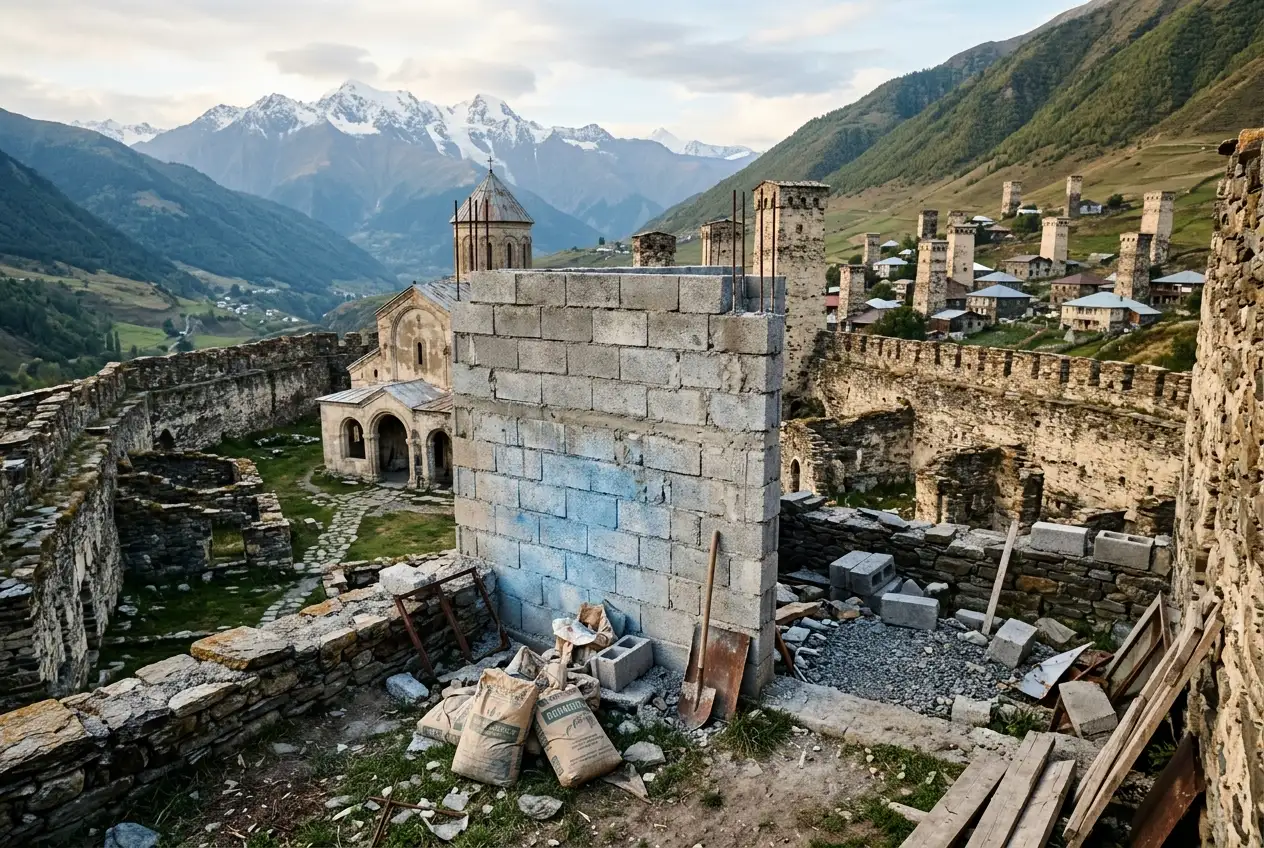
Lamaria sits on a hilltop above the village of Zhibiani, one of the highest permanently inhabited villages in Europe at 2,100 meters above sea level, in the western Georgian region of Svaneti. The monastic complex is on Georgia’s list of Immovable Cultural Monuments of National Significance and lies inside the Upper Svaneti UNESCO World Heritage zone, which the country inscribed in 1996. Georgian law requires the agency to approve any construction, rehabilitation, or other intervention at cultural heritage sites before work begins, and that standard applies to monasteries on church-owned land as well. The size of the unauthorized project now halted on the site: a building 4.3 meters tall, 21.5 meters long, and 12.7 meters wide.
Construction Halted, Permit Never Issued
The agency laid out its position in a written statement this week. It confirmed that no permit for the work had been issued on its file. Construction of residential cells at the medieval monastery has been halted following a warning from the agency.
The watchdog reminded that Georgian legislation requires prior approval for any construction, rehabilitation, or other intervention at cultural heritage sites. That prior approval covers work on nationally listed monuments and on the buffer zones of protected sites alike, under Georgia’s cultural heritage law. Officials say they are still investigating the case and will provide further details after completing the procedures required by law. The agency did not say whether the partially built structure had been ordered to be demolished, whether the diocese would be fined, or whether the work could resume under a later permit.
The Agency has not issued a relevant permit for the construction work of the cells on the territory of the Lamaria Monastery in Ushguli.
Statement of the National Agency for Cultural Heritage Preservation of Georgia, issued this week.
What the construction is, by whose authority it proceeded, and what shape it now takes remain in dispute. The agency’s statement calls it the construction of “cells,” but the Georgian Orthodox diocese behind the work had only just begun using the same word in its post-press-coverage messaging. The workers on site, when Chai Khana’s reporter visited, said they were building a refectory, hired by Metropolitan Ilarion of Mestia and Upper Svaneti.
| Source | What they call it | What they said about permitting |
|---|---|---|
| Workers on site (Chai Khana, July 8) | A refectory | “The Metropolitan hired us; we don’t know about permits.” |
| National Agency for Cultural Heritage Preservation | Cells | “No permit issued”; construction “unauthorized”; investigation continuing |
| Diocese, via workers’ account on the ground | Refectory and bathrooms | Project drawn by a private firm, started “of their own accord” without coordinating with the agency |
| Diocese public statement (after Chai Khana article) | A building for monks’ living quarters | “Continuing the monks’ life in the existing building would have been impossible”; project to be sent to the agency this week |
A 10th-Century Hilltop on the UNESCO List
The Lamaria complex perches on a low rise on the northern edge of Zhibiani, set against the backdrop of the 5,201-meter Shkhara peak. The church is dedicated to the Dormition of the Mother of God and is sometimes called by its old Svan name, “Lamaria,” a borrowing from a pre-Christian goddess of motherhood and fertility. Two layers of medieval frescoes, the earlier dated to the 10th century, line the interior and are “in a state of deterioration,” according to the encyclopedia summary of the site.
Lamaria sits inside the larger Upper Svaneti landscape that the country inscribed on the UNESCO World Heritage List in 1996, in recognition of its medieval villages, defensive Svan towers, and ecclesiastical architecture. It is one of four Georgian entries on the UNESCO list. Three are cultural sites (Gelati Monastery, the Historical Monuments of Mtskheta, and Upper Svaneti) and one is natural (the Colchic Forests and Wetlands). The blend of medieval Orthodox stonework and Caucasus highland terrain earns the area what UNESCO calls its “outstanding universal value,” with both national and international protection.
The agency’s role, as UNESCO’s own listing for Upper Svaneti confirms, includes overall management and monitoring of the property, plus prior approval for any intervention on the national monuments within it. The agency was founded in 2008 and is headquartered in central Tbilisi; its director general, the art historian Nikoloz Vacheishvili, has held the post since the agency’s first year, per the encyclopedia entry. National heritage law and international convention both apply, and both were bypassed when the Lamaria construction began.
The unauthorized building on Lamaria’s grounds was set to be faced in slate stone with dark metal-plastic doors and dark gray tin, according to the diocesan project plan reviewed by Chai Khana. At 4.3 meters high, it would have stood taller in places than the low stone wall that surrounds the medieval church.
Six Weeks of Work That Escaped Notice
Construction at the Lamaria site had been underway for about a month and a half when Chai Khana’s reporter visited in early July, by the workers’ own account. Four men were working at the time: one mixing cement with a trowel, the other three laying blocks on a poured foundation, the structure already raised to seven blocks high. They told Chai Khana they did not know about any project or permit and had been hired by the Metropolitan of Mestia and Upper Svaneti, Ilarion, who was, in the workers’ words, “doing his own work.”
The agency’s involvement began in mid-June, after it learned of the construction from local residents. On June 15 or 16, two agency representatives climbed to the site and met with Father Kviriike at the monastery. Following the visit, Culture Minister Tina Rukhadze personally contacted Metropolitan Ilarion, and the eparchy sent the refectory project to the ministry, the patriarchate, and the agency via WhatsApp. The agency reviewed the project and asked for revisions, including a switch to natural stone on the exterior.
Up to early July, the work continued without a formal permit and the eparchy had no plans to inform the public. Mother Sidonia, one of the nuns on site, told Chai Khana that the Metropolitan “did not deem it necessary” to obtain the agency’s approval. The original private project was revised to address the agency’s notes, but the construction on site did not pause. It took an outside newsroom to make the project a public matter.
- Construction begins on Lamaria’s territory (workers said they had been on the job for about a month and a half when Chai Khana’s reporter arrived). Four workers hired by Metropolitan Ilarion pour a foundation and build up a seven-block concrete-block structure.
- June 15-16, 2026: After locals flag the construction, the National Agency for Cultural Heritage Preservation sends two inspectors to the site. They identify themselves to Father Kviriike at the monastery as agency representatives.
- Following the inspection: Culture Minister Tina Rukhadze contacts Metropolitan Ilarion directly. The eparchy sends the refectory project via WhatsApp to the ministry, the patriarchate, and the agency, which reviews it and asks for revisions.
- Up to early July 2026: The construction continues without a formal permit. The eparchy does not announce the work publicly.
- July 8, 2026: Chai Khana publishes its investigation, including the on-the-record accounts of the workers, the project details, and the missing permit.
- Shortly after: The National Agency issues a public statement confirming no permit was issued and reminding that prior approval is required; further decisions will follow. Construction at Lamaria is halted.
- Same period: The Mestia and Upper Svaneti eparchy posts a public statement about the project, drops the “refectory” language in favor of “monks’ living quarters,” and says it will formally submit the project to the agency this week.
How Chai Khana’s Reporting Brought the Response
Chai Khana’s article on July 8 named the workers, the Metropolitan, and the missing permit, and quoted an art historian on site, Tamar Amashukeli, who immediately began calling for the agency’s intervention when she saw the blocklayers at work. The National Agency’s public confirmation of the halt followed Chai Khana’s reporting, not the agency’s own monitoring, and both happened in the same week.
The diocese’s public response came only after the agency’s statement. It did not address the missing permit directly, but acknowledged that legal procedures were not yet complete and that the project would now be formally submitted. Its terminology shifted in the same stretch: the words used on the ground by the workers and the project plans (“refectory,” “bathrooms”) were replaced in the eparchy’s public-facing language with references to “monks’ living quarters” and to health grounds for the new building.
- 9th-10th century: age of the Lamaria monastic complex.
- 2,100 meters above sea level: altitude of the village of Zhibiani below the monastery.
- 4.3 meters / 21.5 meters / 12.7 meters: dimensions of the proposed diocesan building.
- 7 blocks high: how far the unauthorized construction had risen when Chai Khana visited.
- 1996: year the Upper Svaneti zone, which contains the monastery, was inscribed on the UNESCO World Heritage List.
- About 1.5 months: how long construction at the site had been underway before any public action.
From Refectory to Cells in One News Cycle
On the morning Chai Khana’s reporter arrived, the workers and Mother Sidonia described the project in plain terms: a refectory and bathrooms for the monks, replacing an older shed used for firewood storage. That older shed itself had been unauthorized too, they said. By the time the agency’s public statement appeared, the same project had become “the construction work of the cells.” By the time the diocese’s own statement appeared a step later, it had become a building for nuns’ living quarters, justified on health grounds.
The revision of language mattered because the project’s history reflects it. Mother Sidonia told Chai Khana that the eparchy had decided to demolish the older structure and replace it after Lamaria was converted to a convent. The new construction the eparchy wanted was a single larger building, not a series of small cells in the older medieval style.
The shift in vocabulary also reflected a recognition by the eparchy that the framing affects how the work is judged. “Refectory” reads as a hospitality structure; “cells” reads as a monastic necessity. The first framing speaks to a building that feeds the community; the second framing speaks to a building that shelters the sisters. Both descriptions point to the same set of walls, but the second framing is what the agency, the UNESCO protocols, and the existing heritage law consider when assessing whether an intervention is appropriate to the site.
Why Heritage Monitors Catch So Little in Svaneti
The halt of the Lamaria project is an enforcement win, but the conditions that allowed it to begin in the first place are unlikely to change quickly. The Georgian body UNESCO credits with overall management of the Upper Svaneti zone is the same body that learned of the Lamaria construction from residents in mid-June. It dispatched only two inspectors. The agency’s public statement did not arrive until an independent newsroom forced the issue. And the diocese’s own description of the work shifted on the same day the agency spoke up.
UNESCO’s own listing for Upper Svaneti acknowledges the limits: “Due to the severe weather conditions that isolate the region in winter and the lack of financial resources it is difficult to implement regular monitoring missions at the site.” The same listing adds that “severe climatic conditions as well as insufficient conservation and management capacities remain among the risks to the property.” For a buffer zone that places the national monuments inside a 500-meter protection radius, the absence of routine checks leaves the kind of gap that only an outside reporter noticed.
ICOMOS Georgia president Natio Tsintsabadze made the same point more directly: any construction in the Upper Svaneti zone is unacceptable without coordination with the World Heritage Center, she told Chai Khana. National heritage protection standards apply to monuments in church ownership as well, since the church holds its buildings under a constitutional concordat but not the right to ignore cultural heritage law. Father Egnate, a priest who said he serves 67 churches and chapels in the Latali area, told Chai Khana that church builders often have to work around the agency because the agency does not respond; he said he had spent ten years asking for attention to leaky church roofs in the Latali parishes, to no avail, and that waiting for permits before building or repairing would have left no church standing and no fresco preserved in Svaneti. The diocese’s argument and the agency’s enforcement gap end up pointing in the same direction: in Svaneti, the agency can react, but it does not yet catch what it has not been told.
The diocese said it would formally submit the refectory project “this week” to the agency, which will then have a final say. If the agency rules against the project as built, the diocese has said it would abide. If the agency allows a revised version, the same monitor gap that let the work proceed for about a month and a half will, next time, do so all over again.