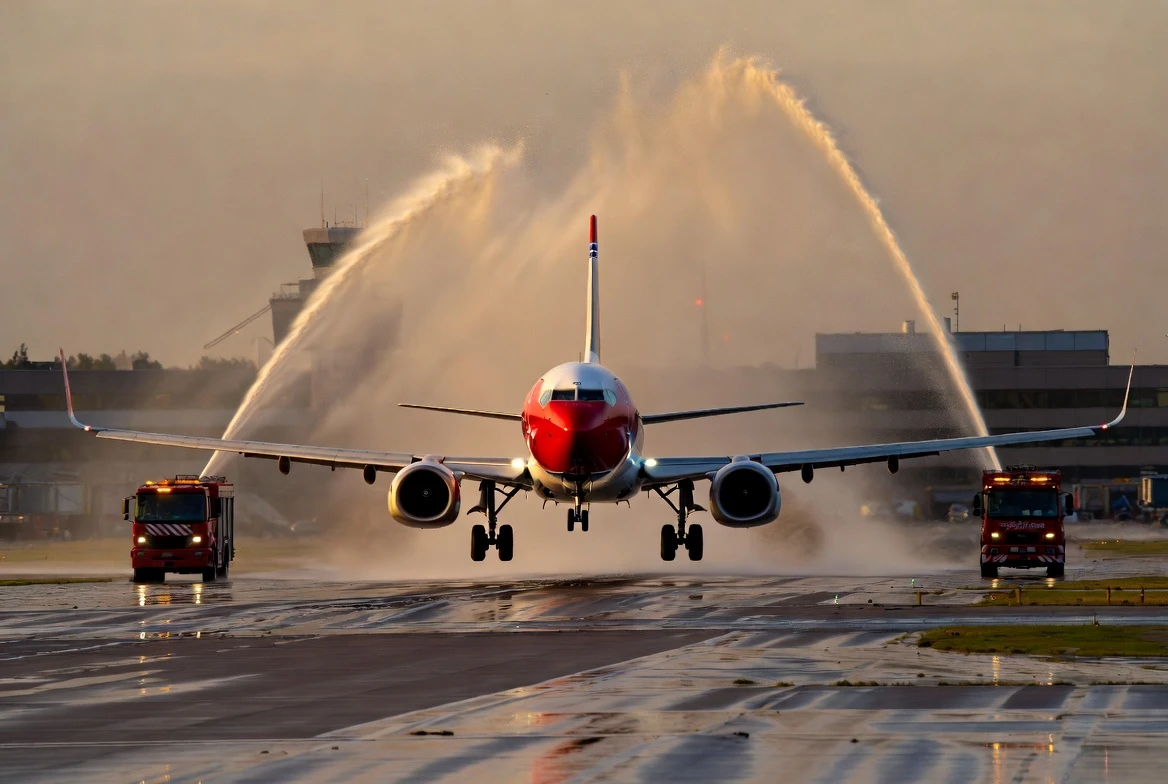
Norwegian Air Shuttle, Scandinavia’s second-largest carrier, launched direct scheduled flights between Copenhagen and Tbilisi on June 27, 2026, opening the first regular air route in history between the capitals of Denmark and Georgia. The inaugural Boeing 737-800 service carried 180 passengers from Copenhagen to Tbilisi International Airport, a load factor that Georgian aviation officials called “notably high” for a first service. Flights will operate twice a week.
The route is being run by Norwegian Air Sweden, the Swedish-registered subsidiary that shares branding and commercial functions with Norwegian Air Shuttle. It marks Norwegian’s official entry into the Georgian aviation market and the country’s first direct capital-to-capital connection with Denmark. Previously, the only Danish air link to Georgia ran from Copenhagen to Kutaisi International Airport, Georgia’s western low-cost hub.
Why This Route Matters
For most of the post-Soviet era, Denmark and Georgia have had no direct flight between their capitals. Travelers between the two countries had to route through Kutaisi, Istanbul, Vienna, or a third hub, adding hours and one or more connections to what is otherwise a mid-range European journey. Norwegian’s twice-weekly Copenhagen-Tbilisi service closes that gap for the first time.
Tbilisi is the country’s largest city, its political center, and the primary gateway for full-service and business carriers. Copenhagen, by contrast, is one of Northern Europe’s biggest transit hubs, with Norwegian itself describing the Danish capital as a node that can feed onward travel across Scandinavia and into transatlantic networks. The new Tbilisi link therefore functions as more than a bilateral route; it gives Georgian passengers a new one-stop path into Northern Europe and gives Scandinavian travelers a direct door into the South Caucasus.
The Airline Behind the Route
Norwegian Air Shuttle ASA, founded in Norway on January 22, 1993, is the largest carrier in Norway and Scandinavia’s second-largest airline behind Scandinavian Airlines (SAS). Across Europe it ranks as the fourth-largest low-cost carrier, behind Wizz Air, easyJet, and Ryanair, and the ninth-largest airline in Europe by passenger numbers. Its fleet of around 94 aircraft, including subsidiaries, is dominated by Boeing 737-800 and Boeing 737 MAX 8 narrowbodies, the same type that operated the inaugural Tbilisi rotation.
The airline operates as a low-cost carrier, selling basic fares with paid extras for baggage and seat selection. After a bruising expansion-and-restructuring cycle, including the loss of its long-haul subsidiaries in early 2021 during the COVID-19 pandemic, Norwegian narrowed its focus to Scandinavian and short-haul European routes. The Copenhagen-Tbilisi service fits that strategy precisely: a medium-haul leisure-and-visit link, operated by the Norwegian Air Sweden AOC, with the parent group’s marketing muscle behind it. Skytrax named Norwegian the best low-cost airline in Northern Europe in 2021.
The application for the Tbilisi route was filed with the Civil Aviation Agency of Georgia and approved on March 23, 2026, according to reporting by the Caspian Post. Norwegian Air Sweden then opened sales for flights beginning June 27.
Slotted Into a Larger Summer Push
The Tbilisi service does not arrive in isolation. Georgia’s three main airports, Tbilisi International, Kutaisi International, and Batumi International, are each adding capacity for summer 2026, and Copenhagen is one of several European capitals gaining or regaining direct service to the country. Georgia Today, summarizing the summer schedule, listed the following new or returning routes touching Tbilisi or Batumi:
- Norwegian Air Sweden: Copenhagen to Tbilisi, twice weekly, from June 27
- Eurowings: Cologne to Tbilisi, twice weekly, from July 2
- Condor: Frankfurt to Tbilisi, daily, from June 15, using Embraer 190 aircraft
- FlyArystan: Astana to Batumi, three times weekly, June 2 to August 29 (seasonal)
- Air Cairo: Cairo to Batumi, weekly, late June through September
- Wizz Air Malta: increased frequency on Venice to Kutaisi, three times weekly, mid-May through early September
The pattern across the schedule is a deliberate diversification away from a once Russian-and-Eastern-European-heavy market. Low-cost carriers continue to anchor the Kutaisi side of the network, with Wizz Air Malta alone linking Kutaisi to more than 20 European destinations. Tbilisi is now absorbing new scheduled services from full-service and hybrid operators (Condor, Eurowings) alongside Norwegian’s Scandinavian capacity. Batumi remains the seasonal Black Sea play, fed by charter-style capacity from Central Asia and the Middle East.
What Georgia Expects to Get Out of It
Officials in Tbilisi are framing Norwegian’s entry in tourism-economy terms. An inaugural reception at Tbilisi International Airport was attended by Deputy Minister of Economy and Sustainable Development Tamar Ioseliani, Director General of the United Airports of Georgia Levan Moseshvili, and General Manager of TAV Georgia Tea Zakaradze, according to Georgian Public Broadcaster.
Moseshvili, whose agency runs the country’s airport network, called the route “an important step in the development of Georgia’s aviation market and the enhancement of its air links with Europe.” He said the new service “will boost business and tourism travel while helping attract high-spending visitors from Denmark and other Scandinavian countries.”
For the first time in history, the capitals of the Kingdom of Denmark and Georgia are connected by a direct air route. This is an important milestone in the development of Georgia’s aviation market and the enhancement of its air links with Europe. The new route will boost business and tourism travel while helping attract high-spending visitors from Denmark and other Scandinavian countries, positively contributing to the growth of the aviation and tourism sectors, as well as the country’s economy.
The numbers underpinning that pitch are modest. In 2025, more than 20,000 visitors from Scandinavian countries travelled to Georgia, according to Imedi TV. A twice-weekly 737-800 service, with around 189 seats in a typical Norwegian configuration, has the theoretical capacity to add tens of thousands of seats a year to that market. Real load factors will determine how many of those seats actually fly. On the inaugural service, with 180 of roughly 189 seats filled, demand ran near full.
From August 15, the schedule shifts from Wednesdays and Saturdays to Wednesdays and Sundays, a small adjustment that Norwegian Air Sweden filed with the Civil Aviation Agency when it applied for the route.
Frequently Asked Questions
When did Norwegian’s Copenhagen to Tbilisi flights start?
The first scheduled Norwegian Air Sweden service between Copenhagen and Tbilisi departed on June 27, 2026. The Civil Aviation Agency of Georgia authorized the route on March 23, 2026.
How often will the flights operate?
The route is scheduled twice a week. Norwegian Air Sweden initially filed Wednesdays and Saturdays as the operating days; from August 15, the schedule shifts to Wednesdays and Sundays.
Is this the first direct connection between Georgia and Denmark?
It is the first direct scheduled air service between the capitals of the two countries, Tbilisi and Copenhagen. Previously, the only Danish link to Georgia ran from Copenhagen to Kutaisi International Airport in western Georgia, not to the capital.
What aircraft is Norwegian using on the route?
The inaugural service was operated by a Boeing 737-800. Norwegian’s fleet is dominated by Boeing 737-800 and Boeing 737 MAX 8 narrowbodies, and Norwegian Air Sweden operates under the same branding and commercial setup as the parent group.
Will there be more Norwegian routes from Georgia?
Neither Norwegian Air Sweden nor the Georgian Ministry of Economy and Sustainable Development has publicly announced additional routes. The current filing covers the single Copenhagen-Tbilisi service.