Georgia sits fifth from the bottom in a new national ranking of the best and worst states to have a baby, a placement that puts it in the middle of a regional pattern the analysis calls striking: eight of the bottom 10 are in the South. Only West Virginia, Louisiana, Arkansas, and Mississippi scored lower than Georgia in the 2026 analysis from ConsumerAffairs, which examined pregnancy, childbirth, and postpartum care across all 50 states and Washington, D.C.
Georgia Lands Fifth From the Bottom
The ConsumerAffairs research team, writing in a report updated June 3, 2026, placed Georgia fifth from the bottom in its ranking of where it is easiest, safest, and most affordable to start a family. The bottom ten is dominated by Southern states, with Alaska and Nevada the only non-Southern entries. At the top, the Northeast fills four of the first five slots.
The full lists, drawn from the 2026 ConsumerAffairs state-by-state ranking, look like this:
- Best states for childbirth: New Hampshire, Vermont, Massachusetts, Connecticut, Oregon, Minnesota, Maine, Washington, D.C., Rhode Island, Washington.
- Worst states for childbirth: West Virginia, Louisiana, Arkansas, Mississippi, Georgia, Florida, Alaska, Nevada, Alabama, Texas.
Where Care Is Hardest to Find
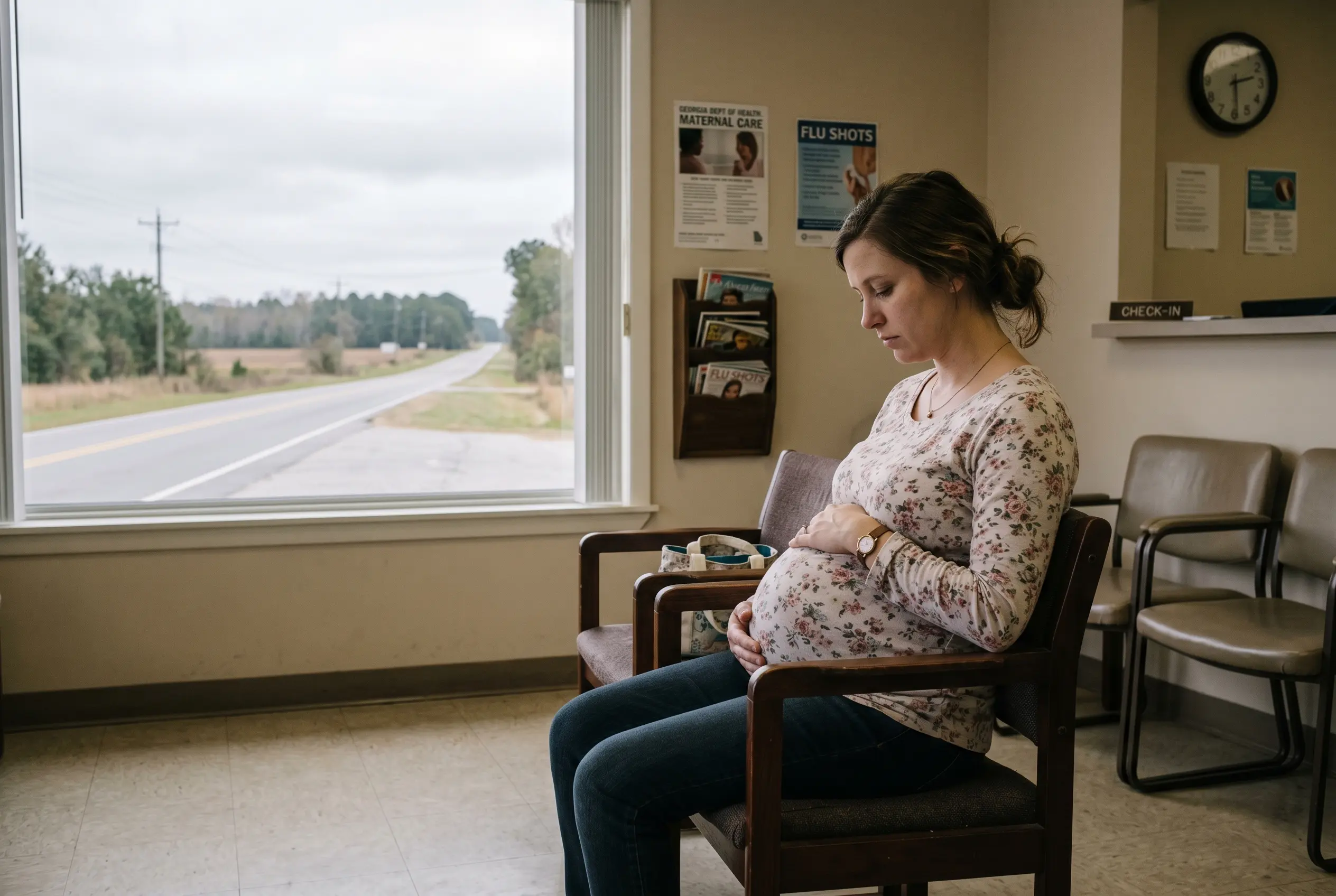
Georgia’s placement reflects a structural gap in who can get to a maternity provider. The analysis found that 34.6% of Georgia counties are maternity care deserts, meaning residents in those areas have limited or no access to maternity healthcare services. The state has about 79.8 maternal care providers per 100,000 women, a hair below the national average of 81.6. About 79.4% of women in Georgia received what the report classified as adequate or intermediate prenatal care, including early pregnancy care and recommended prenatal visits. That share places Georgia in the middle of the pack, not at the bottom, but it sits on top of a provider base that thins out sharply outside the state’s metropolitan corridors. The national picture is unforgiving elsewhere, too: the average cost to deliver a baby is $16,495 for in-network care and $35,378 for out-of-network care, including delivery, anesthesia, ultrasounds, and lab work, a baseline against which every state’s affordability score was set.
The March of Dimes has been mapping this geography for years, and its state-level data confirms the access pattern. In Georgia, 15.8% of women had no birthing hospital within 30 minutes of home, and 16.6% of birthing people received inadequate prenatal care, per the March of Dimes breakdown of Georgia’s maternity care deserts. The 34.6% desert figure used in the ConsumerAffairs analysis is the same share the March of Dimes reports for Georgia, and it is the share that decides how the rest of the state’s numbers land.
Maternal and Infant Outcomes
Behind the access gap sits a stack of outcome numbers that all point the same direction. According to the analysis, Georgia recorded 50.3 maternal deaths per 100,000 women within a year of giving birth from causes connected to pregnancy. The state’s infant mortality rate was 6.4 deaths per 1,000 live births. Researchers also found that 11.8% of babies in Georgia were born prematurely, before 37 weeks of pregnancy, and 10.3% were born with a low birthweight of less than 5 pounds, 8 ounces.
Those numbers line up, with one wrinkle, against the most recent March of Dimes 2025 report card for Georgia. The March of Dimes puts Georgia’s preterm birth rate at 11.8%, identical to the ConsumerAffairs figure, and assigns the state an F grade and a rank of 45th of 52. Its infant mortality rate, using 2023 data, is 7.0 per 1,000 live births, higher than the 6.4 in the ConsumerAffairs analysis and a slightly different data vintage. For maternal mortality, the March of Dimes reports 30.4 per 100,000 births, a smaller number than ConsumerAffairs’ 50.3, because it counts deaths within six weeks of pregnancy rather than within a year. Different windows, different denominators, same direction.
The 11.8% preterm rate carried a particular weight in the March of Dimes data: 14,907 babies were born preterm in Georgia in 2024, and 874 babies died before their first birthday in 2023. The state ranks 36th of 48 for maternal deaths, 43rd of 52 for infant mortality, and 30th of 47 for severe maternal morbidity, which it puts at 99.7 per 10,000 hospital deliveries, the highest in the country by that measure.
The Southern Cluster at the Bottom
Georgia is not an outlier in this ranking. It is the middle of a cluster. The ConsumerAffairs report flags the regional divide as one of its key insights: eight of the bottom 10 states for having a baby are in the South, while the top performing states are in the Northeast. West Virginia, Louisiana, Arkansas, Mississippi, and Georgia occupy the first five spots from the bottom, and Florida, Alabama, and Texas join them in the bottom ten. Alaska and Nevada are the only two non-Southern states in the group.
Looking up the list, the pattern reverses. The Northeast is home to the top four states, New Hampshire, Vermont, Massachusetts, and Connecticut, and to six of the top ten, with Maine and Rhode Island also in the top group. Oregon, Minnesota, and Washington round out the top ten alongside Washington, D.C.
The five worst states, by the ConsumerAffairs ranking, all sit in the same broad region of the country:
- 1. West Virginia – South.
- 2. Louisiana – South.
- 3. Arkansas – South.
- 4. Mississippi – South.
- 5. Georgia – South.
What the Top States Have That Georgia Doesn’t
The contrast with the top of the list is where the access story sharpens. New Hampshire, ranked first, has the best maternal healthcare access in the nation, with zero counties classified as maternity care deserts and about 92% of women receiving adequate or intermediate prenatal care. Vermont, ranked second, earned the strongest maternal and infant health outcomes in the country, with what the analysis calls a near-zero rate of pregnancy-related deaths for women. Connecticut, ranked fourth, has more than 90.7% of women receiving intermediate or adequate prenatal care, the third best rate in the country, and zero counties classified as maternity care deserts.
Family support is a thread that runs through the top ten. The analysis notes that all ten of the best states have good postpartum and family support, with at least six weeks of paid parental leave. Nine of the top ten rank in the top ten for maternal healthcare access, and seven rank in the top ten for maternal and infant health outcomes. The report’s authors point out that this is not, on its own, an affordability story: only two of the top ten rank in the top ten for affordability, and the rest fall in the middle of the pack or near the bottom, despite nine of them having median household incomes above the national median.
Whether a place is ‘safe’ for having a baby isn’t only about hospitals and clinics. The surrounding environment shapes the conditions a pregnancy unfolds in, and with it the health of both the pregnant person and the infant.
Jun Wu, a professor of environmental and occupational health at UC Irvine, made that point in remarks quoted in the ConsumerAffairs report. The same report that ranked Georgia fifth from the bottom argues that the surrounding environment, the provider base, the cost of care, and the family support on the other side of delivery, sets the conditions a pregnancy unfolds in.
What Georgia Has, and Hasn’t, Put in Place
Georgia has not been standing still. The state has received four consecutive F grades in the March of Dimes annual report card, the latest published in November 2025, and is currently implementing three of the six supportive maternal and infant health initiatives the report tracks. Georgia extended postpartum Medicaid coverage from 60 days to 12 months in November 2022, and the state’s Medicaid program covered 52,967 births in 2024, or 41.9% of all live births in the state. The March of Dimes notes that Medicaid pays for about 4 in 10 deliveries nationwide, a share that runs as high as 62% in some states, and the report urges states to maintain or expand eligibility, ensure continuity of care during policy changes, and increase access in communities hit by hospital closures or maternity care deserts.
The ground inside Georgia is uneven. The Atlanta Birth Center is one of only four certified birth centers in the state, and its midwife director, Anjli Hinman, told local press in 2025 that her center reports a preterm birth rate of roughly 3%, well below the state average above 11%. Hinman said the center is also not seeing the racial gap that shows up across much of the state, even as March of Dimes data shows babies born to Black mothers in Georgia are 1.5 times more likely to die than the average statewide rate, and babies born to Pacific Islander mothers are 2.1 times more likely to receive inadequate prenatal care. Charles Johnson, founder of the maternal health nonprofit 4Kira4Moms, said in coverage of the report card that