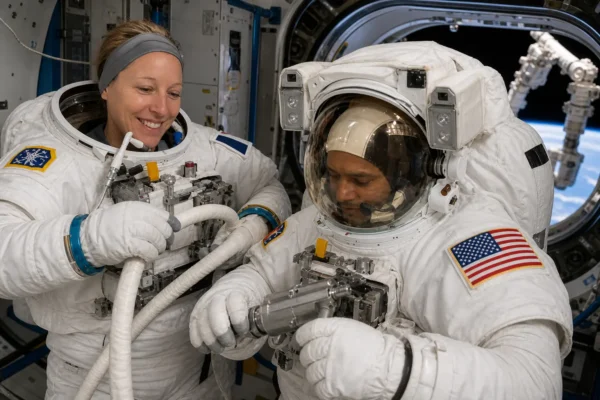
NASA on Tuesday named U.S. Army Col. Frank Rubio, the holder of the American record for the longest single spaceflight, to the four-person Artemis III crew. Bob Hines was named as a backup. Rubio will serve as Mission Specialist 1.
Rubio is the only Artemis III crewmember with prior long-duration spaceflight behind him, and his 371-day stay aboard the International Space Station in 2022 and 2023 remains the longest single spaceflight by any American.
The Four Astronauts Named to Artemis III
NASA Administrator Jared Isaacman unveiled the crew Tuesday at Johnson Space Center, calling the mission “another bold step in humanity’s return to the Moon.” Three Americans and one Italian will fly, with a fifth U.S. Air Force officer assigned to train as a backup.
The crew spans three space agencies and four services. Bresnik has logged more than 7,000 hours in 95 types of aircraft and flew on the space shuttle Atlantis in 2009. Parmitano, who commanded the space station’s Expedition 61 in 2019, is the first ESA astronaut assigned to an Artemis mission. Douglas, a former Coast Guard officer, is making his first spaceflight.
NASA’s full crew list looks like this. Each row lists the role, the astronaut’s name, and the agency the astronaut represents.
| Role | Astronaut | Agency |
|---|---|---|
| Commander | Randy Bresnik | NASA |
| Pilot | Luca Parmitano | ESA |
| Mission Specialist 1 | Frank Rubio | NASA |
| Mission Specialist 2 | Andre Douglas | NASA |
| Backup | Bob Hines | NASA |
The crew will train on Orion systems and assist in the development of test versions of the Blue Origin and SpaceX landers that are slated to meet Orion in orbit during the mission. They begin training immediately, according to the four-person Artemis III crew announcement. Mission length will be set in real time as launch and docking events unfold.
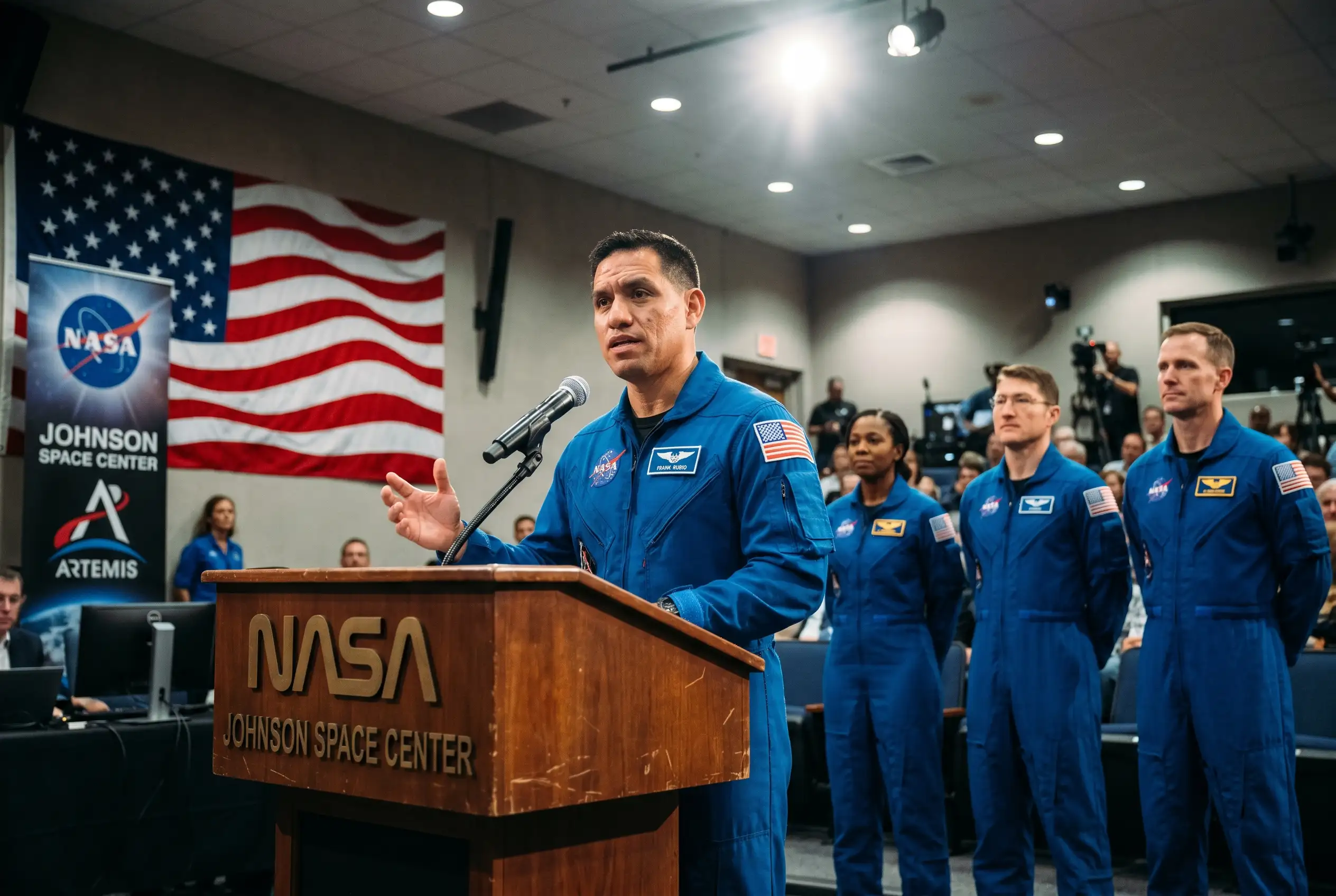
Why Rubio’s Seat Is the Headline
Of the four seats on Artemis III, Rubio’s is the one that traveled farthest to get here. The Army colonel spent 371 consecutive days aboard the International Space Station between September 2022 and September 2023, the longest single spaceflight by an American. The previous record, 355 days, was held by Mark Vande Hei. Rubio broke that mark on Sept. 21, 2023, his 355th day in space.
His path to that record was unplanned. Rubio launched on Soyuz MS-22 in September 2022 for what was supposed to be a roughly six-month stay. A coolant leak on the Soyuz forced NASA and Roscosmos to fly a replacement capsule, MS-23, which kept Rubio on the station through the following September. The mission that began as a half-year rotation became a year and a week. Rubio’s stay stretched to 371 days, with most of the extra weeks spent helping his replacement crew arrive safely.
The figures all come from official accounts of Rubio’s time in orbit, drawn from the September 2023 return-to-Earth release and the U.S. Army’s biography of the astronaut. Both were released in the days around his selection.
- 371 days in orbit, the longest single U.S. spaceflight
- More than 157 million miles traveled
- 5,963 complete orbits of Earth
- Three spacewalks totaling 21 hours, 24 minutes
An Army Physician, Not a Test Pilot
Rubio’s path to the astronaut office ran through flight surgery. He graduated from the U.S. Military Academy in 1998 and was commissioned as a second lieutenant in the Army. He then flew UH-60 Black Hawk helicopters for the better part of a decade.
The combat came first. Rubio logged more than 1,100 flight hours, including 600 in combat or imminent-danger conditions, during deployments to Bosnia, Iraq, and Afghanistan. He earned a doctor of medicine from the Uniformed Services University of the Health Sciences in 2010. He then completed a family medicine residency at Fort Benning, Georgia.
He was working as a battalion surgeon with the 3rd Battalion, 10th Special Forces Group (Airborne) at Fort Carson, Colorado, when NASA selected him as part of the 2017 astronaut candidate class. His full biography is laid out in the Army’s account of Rubio’s path from West Point to Artemis III, published on Tuesday.
I am deeply honored to be selected for Artemis III, a mission that continues to build upon the foundation for the day Americans return to the surface of the Moon. My Army training has been an integral part of the experiences that have enabled me to be ready for this mission. Serving taught me to lead under pressure, how to stay calm when the stakes are highest, and how to put the mission and the people beside you above yourself.
Rubio framed the assignment in service terms in the Army release. Lt. Gen. John Rafferty, the commanding general of U.S. Army Space and Missile Defense Command, said Rubio’s selection is a testament to his leadership, physical and mental toughness, and technical capability. The U.S. Army has sent 20 astronauts and payload specialists to NASA since 1978.
A Docking Rehearsal in Low Earth Orbit
Artemis III is, on paper, a Moon mission without a Moon landing. NASA has scheduled it for 2027 with the explicit job of testing the rendezvous and docking operations that later Artemis crews will need to reach the lunar surface. The mission is also where two pieces of new hardware will get their first operational tests. Both are central to the eventual lunar South Pole landing Artemis IV is meant to deliver in 2028.
The choreography, laid out in the agency’s release, runs through two commercial landing systems in sequence. The four steps below describe how the flight is meant to unfold.
- Blue Origin’s Blue Moon lander pathfinder launches first and waits in orbit.
- Orion, lifted by the Space Launch System from Kennedy Space Center, meets the Blue Moon vehicle and spends about two days docked for tests.
- Orion undocks and meets a SpaceX Starship pathfinder, a test version of the crewed lunar lander, for about a day of checkouts.
- Orion returns to Earth and splashes down in the Pacific Ocean, where a U.S. Navy and NASA team recovers the astronauts.
The crew is expected to remain in space for about two weeks, with the exact mission length set in real time as launch and docking events unfold. The mission’s commercial lander partners are working through test articles in parallel, with Starship Flight 12 test results as one SpaceX data point. Two pieces of hardware that have not yet flown in crewed configuration will get their first tests on this flight: the docking system that connects Orion to the commercial landers, now being integrated at Kennedy, and Axiom Space’s next-generation extravehicular spacesuit, which NASA plans to put through its first operational checks in orbit during the mission.
An Army Pipeline Running Through Georgia
For readers tracking a local angle, the Georgia connection is Rubio’s residency. He completed his family medicine training at Martin Army Community Hospital on Fort Benning, the Army post now restored to its original name after a 2023 redesignation to Fort Moore and a March 2025 reversal ordered by Defense Secretary Pete Hegseth. His training there ran in the late 2000s, before either of those name changes. The Martin Army Community Hospital campus is where family-medicine residents from the Fort Benning area complete most of their clinical work. The Army named the post for Cpl. Fred G. Benning, a World War I infantryman, when the name was restored in 2025.
The connection runs deeper than one training rotation. The Army’s NASA Detachment at Johnson Space Center, the unit that has fed active-duty soldiers into the astronaut corps since 1978, now has Rubio as its most senior crewmember. The detachment also includes Col. Anne McClain, a veteran astronaut who serves as its commander, and Chief Warrant Officer 3 Joseph “Ben” Bailey, who in 2025 became the first Army warrant officer ever selected as an astronaut candidate. Rubio’s seat puts an active-duty soldier on an Artemis crew rotation for the first time, a setup that differs from the Georgia Tech alumni on the Artemis II crew who flew the previous mission.
Frequently Asked Questions
Who are the four Artemis III astronauts?
NASA on Tuesday named Randy Bresnik (commander), Luca Parmitano (pilot), Frank Rubio, and Andre Douglas as mission specialists, with Bob Hines as backup. Parmitano, who became the first Italian to command the space station during Expedition 61 in 2019, is the first European Space Agency astronaut assigned to any Artemis mission.
What will Artemis III do in orbit?
Artemis III will launch on the Space Launch System and meet a Blue Origin Blue Moon lander test article and a SpaceX Starship test article in low Earth orbit, spending about two days docked with the first and about a day with the second. The mission will mark the first crewed flight to demonstrate rendezvous and docking with two different commercial human landing systems in the same mission.
Why is Frank Rubio on this crew?
Rubio holds the American record for the longest single spaceflight at 371 days, set on the International Space Station between September 2022 and September 2023. He is part of NASA’s 2017 astronaut candidate class and the only Artemis III crewmember with a year-plus spaceflight behind him, putting the most flight time of any astronaut on the crew.
When does Artemis III launch?
NASA has Artemis III targeted for 2027. The agency said in Tuesday’s release that the mission is currently scheduled for mid-2027, with rocket processing already underway at Kennedy Space Center and engine installation onto the core stage planned for this summer.
How does Artemis III fit into the Moon program?
Artemis III is the second crewed flight of the Artemis program, following the Artemis II mission that completed a crewed lunar flyby in April 2026. The mission’s docking demonstrations will be the first time a crewed spacecraft has met two different commercial lunar lander test articles in a single flight, a key test for the planned 2028 South Pole landing by Artemis IV.