Starship Flight 12 gave SpaceX the result it needed most and the warning it could not ignore: the upgraded rocket reached space, separated cleanly and deployed Starlink test payloads, but the Super Heavy booster was lost on return and the upper-stage engine-relight goal did not close.
That makes Friday’s flight less a neat win than a pressure test for SpaceX’s next business and government milestones. The Version 3 vehicle has now flown. The question is whether it can be flown again soon enough to support heavier Starlink satellites, lunar docking rehearsals and a reuse plan that still depends on catching hardware, not fishing data out of the sea.
A Bigger Rocket Cleared the Pad but Not the Checklist
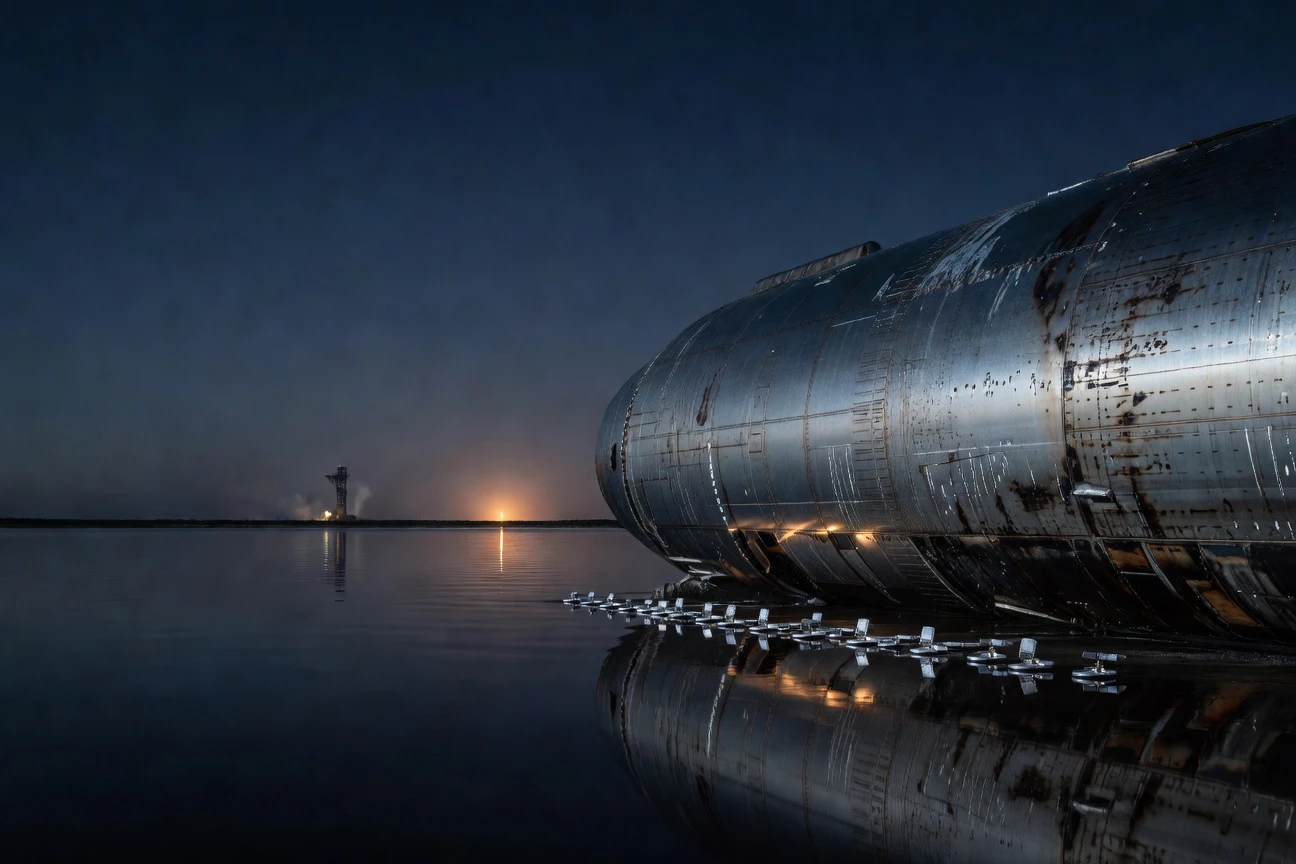
The launch from Starbase in Texas marked the first flight of Version 3 (V3, the redesigned Starship configuration) and the twelfth integrated test of the Starship and Super Heavy system. SpaceX laid out the mission on the official Flight 12 mission page, with the new stack meant to prove redesigned hardware in flight rather than recover either stage.
The cleanest moment came early. Starship performed hot staging, a maneuver in which the upper-stage engines ignite before the booster has fully moved away, and continued toward space. That mattered because a failed separation would have ended the debut almost at the pad. Instead, the upper stage kept flying long enough to test the payload door, cameras and in-space stability.
The messy part came on the way down. Super Heavy did not complete the controlled splashdown profile, and the upper stage ended its mission in the Indian Ocean after the planned Raptor engine (SpaceX’s methane and liquid oxygen rocket engine) relight was not completed. The debut proved ascent before it proved reuse, which is exactly where the program’s harder work sits.
The Payload Door Became the Business Case
The most commercially useful part of the flight was not the fireball. It was the payload sequence. The upper stage released 22 Starlink-size payloads, including modified units used to send back views of the vehicle in flight, a bigger deployment rehearsal than the eight-simulator tests SpaceX ran on recent flights.
That number matters because Starship is being built around mass. Falcon 9 remains SpaceX’s workhorse, but the next Starlink generation is larger and more power-hungry. Starlink’s own third-generation satellite network update says each Starship launch of third-generation satellites is projected to add 60 terabits per second (Tbps, a measure of network data capacity) to the constellation, more than 20 times the capacity added by each current launch.
- 22 payloads tested the deployment system on the V3 flight.
- 60 Tbps is Starlink’s projected capacity gain from a full third-generation Starship launch.
- More than 20 times is Starlink’s comparison with capacity added by current launches.
- 1,000 Gbps downlink and more than 200 gigabits per second (Gbps, another data-rate measure) uplink are the stated per-satellite targets for the newer spacecraft.
Test payloads do not pay subscriber bills. They do show whether the door, dispenser sequence and attitude control can handle something closer to the future mission. On that count, Flight 12 moved Starship from a rocket spectacle toward a logistics machine, even while the return profile lagged behind.
Recent Flights Show a Staircase, Not a Finish Line
The V3 debut is easier to read against the last two flights. Flight 10 and Flight 11 gave SpaceX clean late-stage demonstrations with the older vehicle line. Flight 12 changed the hardware and raised the payload count, but it also reopened questions that the prior sequence had seemed to quiet.
| Flight | Main Hardware | Payload Demonstration | Engine Relight | What It Proved |
|---|---|---|---|---|
| Flight 10 | Second-generation vehicle | Eight Starlink simulators | Completed | Payload release and upper-stage control were back on track |
| Flight 11 | Final test of the prior vehicle line | Eight Starlink simulators | Completed | Repeat performance before the redesign |
| Flight 12 | First V3 vehicle | 22 Starlink-size payloads | Not completed | New architecture reached space but did not close the return checklist |
That table is the reason the result cannot be graded with one word. The payload system scaled up. The booster return went backward. The upper stage survived long enough to gather useful flight data, but missing a relight matters because future operational missions need reliable engine restarts for deorbit, trajectory shaping and lunar architecture.
Artemis Turned This Into a Schedule Test
The National Aeronautics and Space Administration (NASA, the U.S. space agency) has changed the near-term moon script since the early Starship contract. NASA now describes Artemis III as a low Earth orbit mission, meaning a crewed test around Earth, to rehearse rendezvous and docking between Orion and one or both commercial landers from SpaceX and Blue Origin. The agency’s current Artemis III mission page lists a 2027 launch target.
While this is a mission to Earth orbit, it is an important stepping stone to successfully landing on the Moon with Artemis IV.
Jeremy Parsons, Moon to Mars acting assistant deputy administrator at NASA’s Exploration Systems Development Mission Directorate, said that in the agency’s May 13 mission update.
Starship’s role is still large. NASA picked SpaceX to develop Starship Human Landing System (HLS, the agency’s astronaut lunar lander program) hardware, and its preliminary Artemis III mission plan says astronauts could potentially enter at least one lander test article during the orbital mission. A Starship pathfinder that cannot show repeatable ascent, restart and docking readiness would narrow NASA’s options fast.
The schedule pressure is not guesswork. A March report from NASA’s Office of Inspector General said SpaceX’s HLS concept requires a depot, more than 10 tanker flights and a launch tempo as tight as one tanker every six days for propellant aggregation. The same NASA inspector general HLS report called vehicle-to-vehicle cryogenic propellant transfer one of the provider’s most significant technical challenges.
Three Problems Remain Before Routine Reuse
SpaceX’s development model accepts breakage. That does not make every break equal. A booster loss during an early redesigned test may be acceptable. A recurring inability to repeat critical late-flight events would be a different kind of problem.
- Booster recovery needs to move from controlled descent to tower catch. Starship’s cost case depends on getting expensive stages back intact, then flying them again after short inspections.
- In-space restart has to become routine. Relight is tied to safe deorbit, orbital insertion cleanup, tanker operations and any mission that does more than skim space and fall home.
- Launch cadence has to survive regulators, weather, pad work and redesigns. The Federal Aviation Administration (FAA, the U.S. commercial launch regulator) reviews safety, license and environmental issues through the Starship license review process, and mishaps can slow the next attempt.
The cadence point is often treated as paperwork. It is more than that. The lunar version of the program needs repeated launches in a short window, while the Starlink version needs enough flights to make a new satellite design economically useful. A single spectacular test can lift confidence. It cannot replace repetition.
The Signal From the Fireball
Flight 12 gave SpaceX a cleaner story than a pad failure and a less complete story than a full-duration success. The upper stage did the part that makes the future visible: it reached space, opened the payload path and showed off the camera-equipped Starlink test articles. The booster supplied the reminder that reusability is still a physical problem, not a branding claim.
For Starlink, the flight says the larger network upgrade is moving out of animation and into hardware trials. For NASA, it says the V3 line is now real enough to judge by flight data. Both readings help SpaceX, but both also raise the standard for the next launch.
The program’s strength has always been its tolerance for public failure. Its weakness is that the next milestones are less forgiving. A moon lander pathfinder cannot be graded like an early prototype forever. A broadband deployment vehicle has to put working satellites in useful orbits, not just prove that a door can open above Earth.
If SpaceX turns this flight into a quick repeat with a cleaner descent and a completed relight, the booster explosion will age as launch-day noise. If the next V3 attempt slips or repeats the same late-flight gap, Flight 12 will be remembered as the day the biggest Starship reached space and showed how much schedule was still riding on fire.