Apple headlines this week looked scattered: an iPhone 18 Pro modem rumor, encrypted texting with Android, accessibility upgrades, Fortnite’s App Store return and Eddy Cue’s Cannes honor. Taken together, they show the same bet. Apple is trying to own more of the stack while regulators, carriers and developers press at the edges.
The noisy item is the next Pro iPhone. The more useful read is the pattern around it. A custom modem, Rich Communication Services encryption, Vision Pro accessibility controls and a reopened Fortnite door all ask how much of the experience Apple can still define on its own terms.
The Week Apple Put Control Back in the Center
The iPhone 18 Pro modem report is still an expectation, not an Apple announcement. That distinction matters. Apple does not confirm next iPhone silicon months ahead of launch, and modem claims can change late because carrier testing is unforgiving.
What is confirmed is the direction of travel. Qualcomm Technologies said in 2023 that it had entered an agreement to supply Snapdragon 5G Modem-RF Systems for Apple smartphone launches in 2024, 2025 and 2026. Apple has since put its own modem line into lower priced and thin models, giving it a live test bed before any Pro move.
That is why the week’s mixed batch of stories hangs together. The modem touches suppliers. RCS touches carriers and Google. Accessibility touches artificial intelligence as a daily control layer. Fortnite touches the App Store’s payment rules. Cue’s award touches services as a media business.
| Story Line | Confirmed Fact | Control Question | User Impact |
|---|---|---|---|
| iPhone modem | Apple’s C-series modem line is shipping in current devices | Can Apple reduce its reliance on outside radio silicon? | Battery life, carrier support and data speed |
| Encrypted RCS | Cross-platform encrypted chats are rolling out in beta | Can Apple widen privacy without making iMessage less special? | Safer iPhone to Android texting where carriers support it |
| Accessibility AI | VoiceOver, Magnifier, Voice Control and Accessibility Reader are getting new AI features | Can Apple make AI useful without turning it into a chatbot layer? | Better device access for people with disabilities |
| Fortnite | Epic says the game is back on the App Store worldwide, with Australia still excluded | Can Apple defend App Store fees while courts demand more detail? | Game access, payment links and developer rules |
Modems Move From Supplier Story to Product Strategy
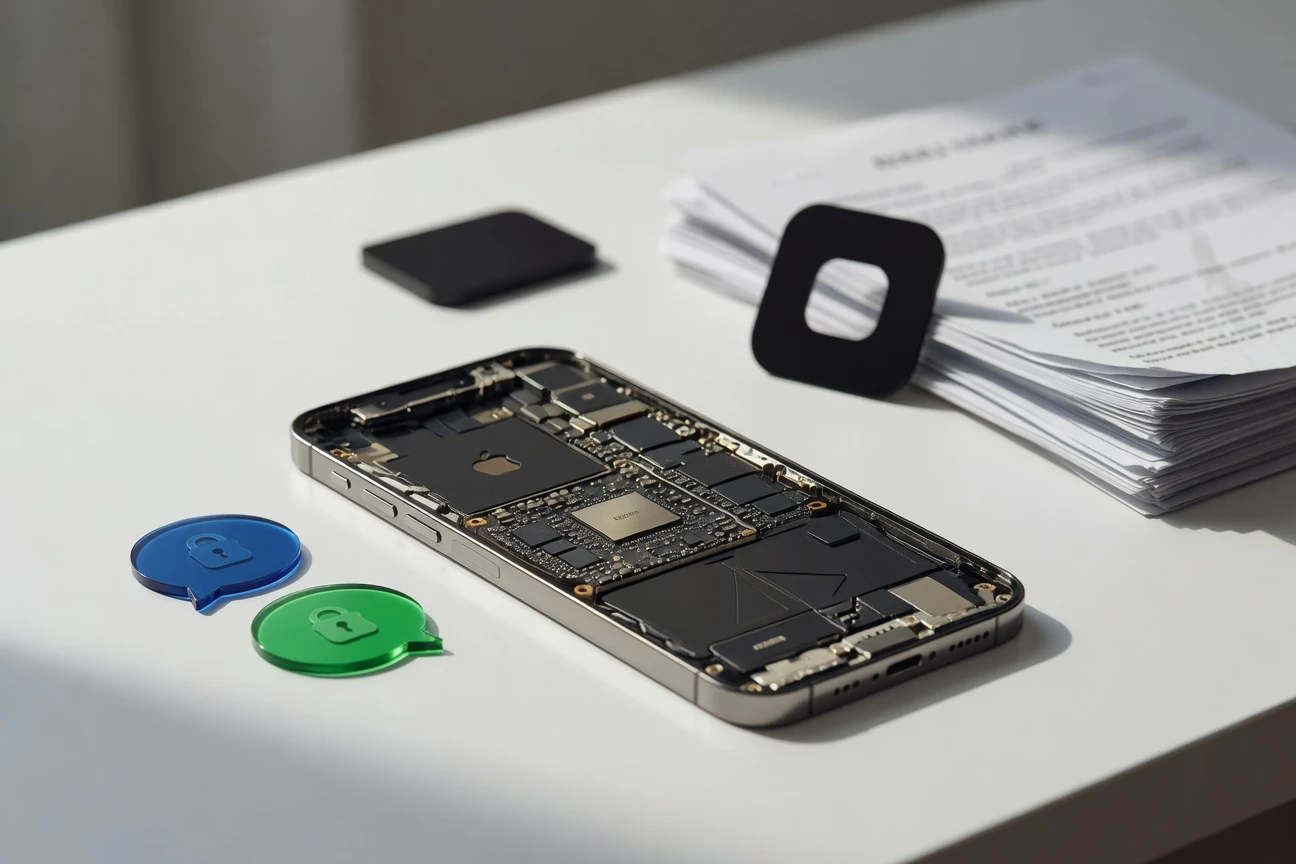
Apple’s modem push matters because the modem is the worst kind of component to replace. If it works, most people never think about it. If it fails, the whole phone feels broken, even when the display, camera and processor are excellent.
Apple’s March iPhone 17e release gave the clearest public marker so far. The company said C1X, its latest cellular modem, is up to 2x faster than C1 in iPhone 16e and uses 30 percent less energy than the modem in iPhone 16 Pro. That is a product claim, not a supply-chain whisper.
- Up to 2x faster is the speed claim Apple attached to C1X compared with C1.
- 30 percent less energy is Apple’s comparison with the modem in iPhone 16 Pro.
- 2026 smartphone launches were covered by Qualcomm’s earlier chip supply deal with Apple.
The iPhone 18 Pro question, then, is not whether Apple wants the radio. It clearly does. The question is whether the company is ready to put its own part into the models bought by customers who expect the strongest reception, fastest roaming and widest band support.
That is a higher bar than saving a few dollars on a bill of materials. A Pro modem would turn Apple’s vertical integration story into a carrier-by-carrier performance test.
Messaging Privacy Gives Apple a Cleaner Answer
The messaging news gives Apple an easier win. Apple said on May 11 that end-to-end encrypted RCS messaging is rolling out in beta for iPhone users on iOS 26.5 with supported carriers and Android users on the latest Google Messages. Rich Communication Services, or RCS, is the carrier messaging standard meant to replace Short Message Service, or SMS.
Encryption is on by default, Apple said, and users will see a lock icon when a conversation is protected. That still leaves carrier support as a gating factor, but it narrows a complaint that has followed Apple for years: iPhone to Android texting could be private without forcing everyone into one company’s chat app.
- It gives Apple a better answer to privacy critics who point at unencrypted cross-platform texts.
- It keeps iMessage as the premium Apple-to-Apple channel, since the company still says iMessage is the best way to communicate between its own devices.
- It hands carriers and Google part of the rollout problem, which matters because RCS deployment has never been uniform.
The move also changes the color of the argument. The green bubble stays. The security complaint gets harder to make when both sides have supported software and the network is ready.
Accessibility Turns Apple Intelligence Into Interface Work
The accessibility announcement may be the least flashy part of the week, but it is the most concrete use of Apple Intelligence. Apple said detailed descriptions and natural language navigation are coming to VoiceOver, Magnifier, Voice Control and Accessibility Reader, with on-device generated subtitles and Vision Pro wheelchair control also due later this year.
Now, with Apple Intelligence, we are bringing powerful new capabilities into our accessibility features while maintaining our foundational commitment to privacy by design.
Tim Cook, Apple’s chief executive, said that in the company’s May 19 accessibility release. The line matters because it shows where Apple can make AI feel less speculative. A model that describes a bill through Magnifier, lets a user control Voice Control with plain language, or generates subtitles for personal video has a job before it has a brand campaign.
There are limits. Apple says some language support and feature availability vary, and Vision Pro wheelchair control launches with specific compatible systems in controlled environments. But the direction is clear: Apple wants its intelligence layer to sit close to input, vision, speech and motion.
That makes accessibility a proving ground. If the features work there, Apple can argue that its AI work is not late so much as aimed at places where system control and privacy matter most.
Fortnite Shows the Cost of the App Store Fight
Fortnite’s return lands on the other side of the control ledger. Epic Games said on May 19 that Fortnite is back on the App Store worldwide, while noting that Australia remains excluded as Epic waits on court action there. For iPhone owners, the headline is simple: the game is available again in many places.
For Apple, the larger issue is the price of defending the store. In a Supreme Court filing, Apple said the Ninth Circuit had sent the case back to district court to determine what commission Apple may charge on certain purchases, and warned that the process could force disclosure of confidential business information. The company also said regulators around the world are watching the case as they weigh commission rates in other markets.
That filing puts numbers around the stakes. Apple told the Court that the App Store in the United States facilitated more than $400 billion in developer billings and sales in 2024, and that developers pay a one-time $99 registration fee. Those facts sit inside Apple’s emergency application to stay the mandate.
So the return of one famous game does not settle the fight. It shows how hard the fight has become to contain. A store rule written in Cupertino can now become a data point for judges, regulators and developers far outside California.
Services Get Their Cannes Moment
The services story gives Apple the prestige version of the same theme. Cannes Lions said Eddy Cue, Apple’s senior vice president of Services and Health, will be honored as Entertainment Person of the Year and will appear with producer Jerry Bruckheimer at the festival on June 22.
That is not just a trophy for Apple TV. Cue oversees Apple TV, Apple Music, Apple Podcasts, Apple Books, Apple Pay, Apple News, Fitness+, Apple Card, Apple Maps, iCloud and productivity apps, according to Cannes Lions. The services group is where Apple’s hardware base turns into recurring revenue, media rights and cultural reach.
The financial scale is already large. Apple’s consolidated statements show Services net sales of $30.976 billion for the quarter ended March 28, up from $26.645 billion a year earlier. That is roughly 16 percent growth, and it explains why a Cannes stage belongs in the same conversation as modems and App Store rules.
Hardware control gets customers into the system. Messaging, accessibility and store policy decide how sticky that system feels. Services turn the whole structure into margin, entertainment and payments.
If the next Pro iPhone ships with an Apple modem and performs like a Pro device should, this week will look like a preview. If the radio stumbles or the App Store fight forces deeper fee changes, the same headlines will read like early warnings.