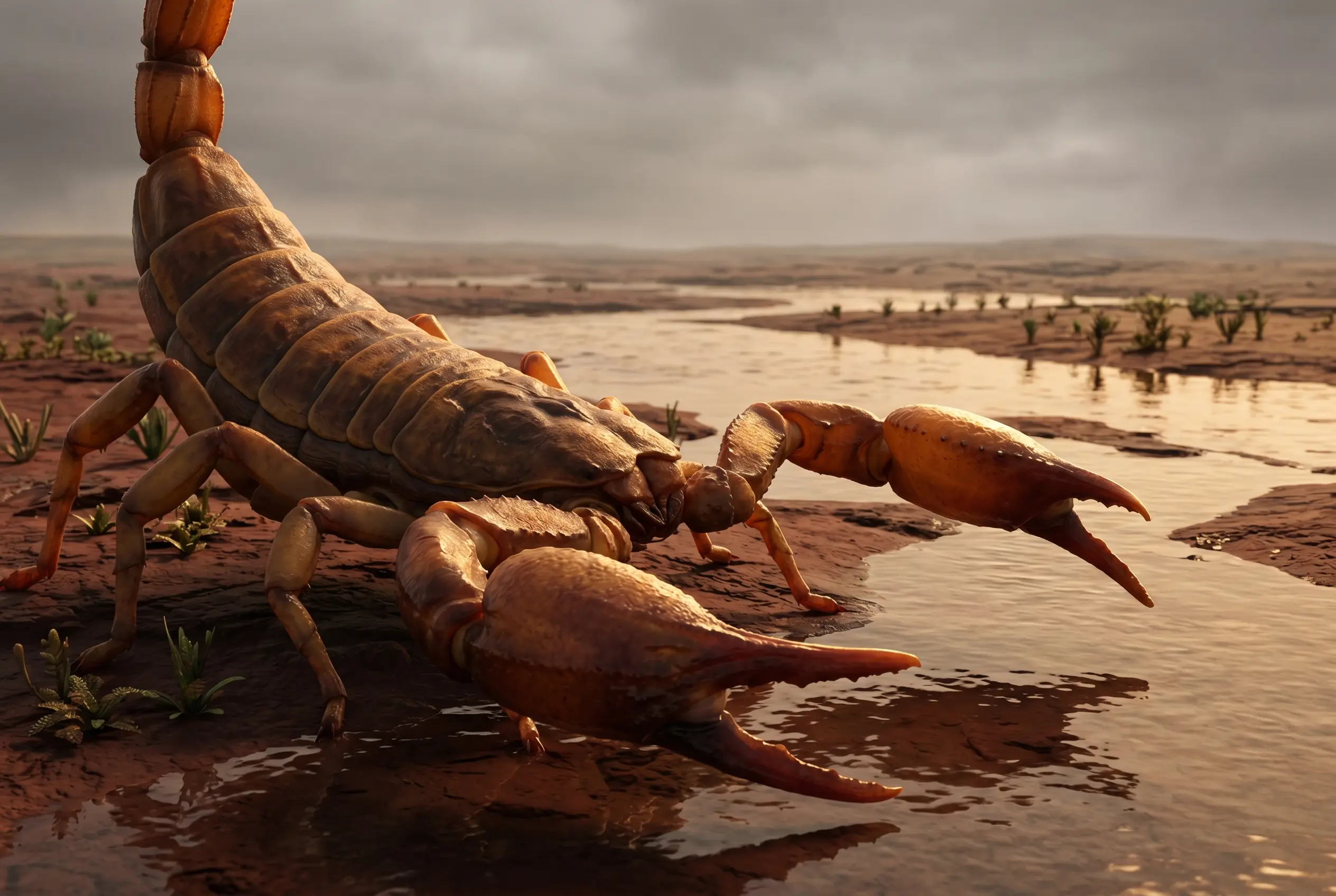
The world’s largest known scorpion, Praearcturus gigas, prowled the floodplains of England and Wales 415 million years ago, stretched roughly a meter from end to end, and carried pincers just over 16 centimeters long, per a study published June 2 in the journal Palaeontology by researchers at the Natural History Museum (NHM) in London and the University of Manchester. The fossils behind that identification have been in the museum’s collection since the 1870s.
The find pushes giant predatory arachnids back roughly 50 million years beyond the oversized insects of the Carboniferous, and it arrives before the elevated atmospheric oxygen levels researchers long invoked to explain why that era’s arthropods grew so large.
A Century and a Half in the Collection
The fragments were first described in 1871 by Henry Woodward at what was then the British Museum (Natural History), who classified them as a giant isopod, a woodlouse-like crustacean. They came from the St. Maughans Formation, a river and floodplain deposit in the Old Red Sandstone of England and Wales, dated to the Lochkovian Stage of the Lower Devonian.
A separate research effort in the 1980s re-described the same specimens as a giant scorpion, but the revision was sparsely illustrated. No characteristic scorpion tail had turned up among the fragments, and the material had accumulated competing species names over the decades, each attached to what turned out to be pieces of the same animal.
Praearcturus has puzzled us palaeontologists for more than a century.
That was Russell Garwood, a paleontologist at the University of Manchester and co-author of the paper. The team behind the 2026 revision also included Dr. Richard J. Howard, Curator of Fossil Arthropods at the NHM and the paper’s lead author; Gregory D. Edgecombe, Merit Researcher at the NHM; and D. A. Legg. It was a joint project between the University of Manchester and the Natural History Museum, using imaging capabilities unavailable to the researchers who had last attempted a full revision in the 1980s.
The Early Devonian landscape they were piecing together was barren by any later standard. Low-growing primitive plants, mosses, and fungi had begun spreading across mudflats and riverbanks, but no forests existed. Arthropods were among the first animals to venture beyond shorelines. Nothing in that setting came close to Praearcturus in scale.
The St. Maughans Formation also preserves freshwater fish, including the jawless fish Cephalaspis, alongside a sparse variety of small arthropods. These were the animals sharing the floodplain with what the study would confirm as the largest scorpion in Earth’s fossil record.
What Tomography Resolved
The team applied X-ray tomography, light photography, and camera lucida drawings to the key specimens in the NHM’s collections, building three-dimensional detail from fragments that earlier researchers had been forced to assess from flat surfaces. They also compared the results against newly described fossil species from other collections worldwide.
Several anatomical structures placed the fossils within the scorpion lineage. The preserved pedipalps (the claw-bearing appendages near the head) show a fixed and movable finger arrangement characteristic of true scorpions. A stridulatory surface on one of the coxae and an elongate, subtriangular sternum morphology match those of Eramoscorpius brucensis, an unambiguous Silurian scorpion from the Wenlock period of Canada, roughly 15 million years older than Praearcturus and part of the same evolutionary line.
The analysis also untangled the taxonomy. Specimens previously catalogued under different names from the same formation turned out to share enough structure with the type material to be reassigned to P. gigas, collapsing what had appeared to be multiple distinct species into one large predator.
Comparable results have come recently from applying modern imaging to existing collections. In May, bones from a northeastern Thai pond were confirmed as Nagatitan chaiyaphumensis, Southeast Asia’s largest known dinosaur, after analysis by a team from University College London and three Thai institutions.
Two specimens at the University of Bristol from Famennian (Late Devonian) rocks in Somerset, England, catalogued as BRSUG 28848 and BRSUG 28854, may belong to Praearcturus as well. The paper flags the identification as unconfirmed.
Anatomy of a Record Holder
- ~1 meter (3.3 feet) body length
- Pincers over 16 centimeters (6.3 inches), larger than a standard table knife
- 415 million years old, Lower Devonian (Lochkovian Stage)
- St. Maughans Formation, Old Red Sandstone of England and Wales
- Contemporary land fauna: small arthropods, primitive low-growing plants, freshwater fish
The published study reports that P. gigas was an order of magnitude larger than any other known terrestrial animal of the Early Devonian. Vascular plants were small and structurally primitive. Tetrapods had not yet emerged. The arthropods sharing its habitat were, on average, small enough to serve as prey.
Praearcturus gigas is a true scorpion in the order Scorpiones, and its size record applies to that group specifically. The eurypterids, often called sea scorpions, are a related but distinct order of chelicerates. Jaekelopterus rhenaniae, a Devonian eurypterid that grew substantially longer, lived underwater and belongs to a separate category entirely. Among fossil true scorpions, Pulmonoscorpius kirktonensis, a Carboniferous species from Scotland that exceeded 70 centimeters, was previously among the largest known. Praearcturus, at roughly a meter, takes that place.
The animal’s diet covered both environments. Smaller arthropods on land were obvious prey; in water, its size put fish and large aquatic animals within reach.
Why the Carboniferous Playbook Doesn’t Apply Here
The Oxygen Hypothesis and Its Limits
The standard account of giant arthropods points at the Carboniferous, roughly 359 to 299 million years ago. Dense forests had evolved, pumping oxygen into the atmosphere until levels peaked at around 35 percent, well above the roughly 21 percent in the air today. Because arthropods move oxygen through their bodies by passive diffusion, with no circulatory lung system to regulate intake, that surplus eased the metabolic constraints on large body size, at least in principle, and at least for the Carboniferous arthropods whose gigantism has been most closely studied.
The iconic examples are Carboniferous: Arthropleura, a millipede relative, reached 2.6 meters, and Meganeura, a dragonfly-like insect, had a 75-centimeter wingspan. Pulmonoscorpius kirktonensis holds its place in that same period. As Dr. Howard stated in the discovery announcement, “When we think of giant arthropods, people often picture Carboniferous rainforests with giant millipedes or dragonfly-like insects from later in Earth’s history.”
Praearcturus gigas lived at least 50 million years before any of them. During the Early Devonian, complex forests had not yet evolved. Atmospheric oxygen was at roughly modern-day levels. The mechanism that supposedly explains Carboniferous gigantism simply wasn’t present.
Ecological Vacancy as the Driver
The study’s authors suggest the animal grew large because its ecological position was uncontested. Nothing in its habitat matched its size, so Praearcturus could dominate the floodplain food chain and keep growing without the competitive constraints that denser ecosystems would eventually apply.
The case of Arthropleura reinforces the point. The largest known Arthropleura specimen comes from a geological interval when atmospheric oxygen was still near modern concentrations, which has shifted the favored explanation for its gigantism away from atmospheric chemistry. The research on both animals now converges on ecological vacancy as the primary explanation: an open niche, with no apex predator already filling it, produces size extremes.
When an animal colonizes an ecologically empty position, body size can compound across generations without the checks that come from competition and predation. Praearcturus occupied a niche that was more recently opened than the Carboniferous forests: terrestrial land before any forest existed.
| Animal | Period (approx.) | Maximum size | Atmospheric O2 | Gigantism driver (per research) |
|---|---|---|---|---|
| Praearcturus gigas | Early Devonian (~415 Ma) | ~1 m | ~21% (near modern) | Ecological vacancy; no large competitor present |
| Pulmonoscorpius kirktonensis | Early Carboniferous (~335 Ma) | >70 cm | Rising, ~25-30% | Elevated O2; sparse megafaunal competition |
| Arthropleura | Carboniferous-Permian (~345-290 Ma) | up to 2.6 m | Peaked ~35%; largest specimen at ~23% | Ecological vacancy (O2 attribution contested) |
| Meganeura | Late Carboniferous (~300 Ma) | 75 cm wingspan | ~35% (near peak) | High atmospheric O2 |
Hunting from the Shoreline
A feature unique among scorpions suggests Praearcturus spent significant time in water. The mesosomal tergites (the armored plates along the abdomen) carry lateral epimera, descending flap-like structures more typically found in crustaceans like lobsters. As the giant scorpion revision’s published abstract notes, this is structurally unusual within the scorpion lineage and, combined with the fluvial environment of the St. Maughans Formation, supports the conclusion that P. gigas was at least partly aquatic.
Dr. Howard has stated that without complex terrestrial ecosystems to sustain a large predator on land, Praearcturus probably spent part of its life hunting in water. Dr. Greg Edgecombe, Merit Researcher at the NHM and co-author of the study, noted that the boundary between land and sea at that time was “much less defined” than in later geological periods. The St. Maughans Formation, while primarily interpreted as a floodplain deposit, preserves traces of occasional brackish incursions at its lower horizons, consistent with a creature that moved between the two.
The researchers raise the possibility that the lateral epimera indicate a complicated evolutionary path. Silurian scorpions are widely considered aquatic or partly so based on where their fossils occur. If Praearcturus represents a lineage that moved back toward water after earlier ancestors had already ventured onto land, early scorpion evolution involves reversals as well as steady advances, complicating the picture of a clean march from sea to shore.
Verification of the two Bristol specimens from Late Devonian rocks in Somerset would extend Praearcturus‘s known range by roughly 40 million years, into the Famennian Stage.