Georgia’s economy grew 6.2% in April 2026 from a year earlier, the National Statistics Office of Georgia (Geostat) reported in its rapid estimate. That reading still beats every major international forecast for the full year. It also marks the slowest monthly pace of 2026, down from 10.7% in March and a 9.1% first quarter.
Most of the gap between a strong April and a softening one traces back to one facility. The launch of domestic oil refining added 1.83 percentage points to April’s expansion. Strip that single contribution out, and the rest of the economy grew closer to 4.4%.
The 6.2% Print Masks a Sharp April Slowdown
Read on its own, 6.2% looks healthy. Read against the months before it, the number reads like a step down. Average real GDP (gross domestic product, the total value of goods and services produced) growth for January through April stood at 8.3%, according to Geostat’s gross domestic product estimates. April came in nearly two full points under that four-month average.
The deceleration is steep when measured month to month. March printed 10.7% and the first quarter closed at 9.1%, so April’s reading represents the loss of more than four points of annual pace in a matter of weeks. Some cooling was expected after a torrid winter, but the size of the drop is what stands out.
The underlying activity gauges held up better than the headline. Turnover of enterprises paying value-added tax (VAT, the consumption levy applied at each stage of sale) reached 15 billion Georgian lari (about $5.5 billion) in April, a 10.3% annual increase.
- 6.2% April GDP growth, the slowest monthly pace recorded so far in 2026
- 8.3% average growth for January through April, the benchmark April fell short of
- 10.3% annual rise in VAT-payer turnover, a sign domestic activity has not collapsed
One Refinery Did Heavy Lifting for April Growth
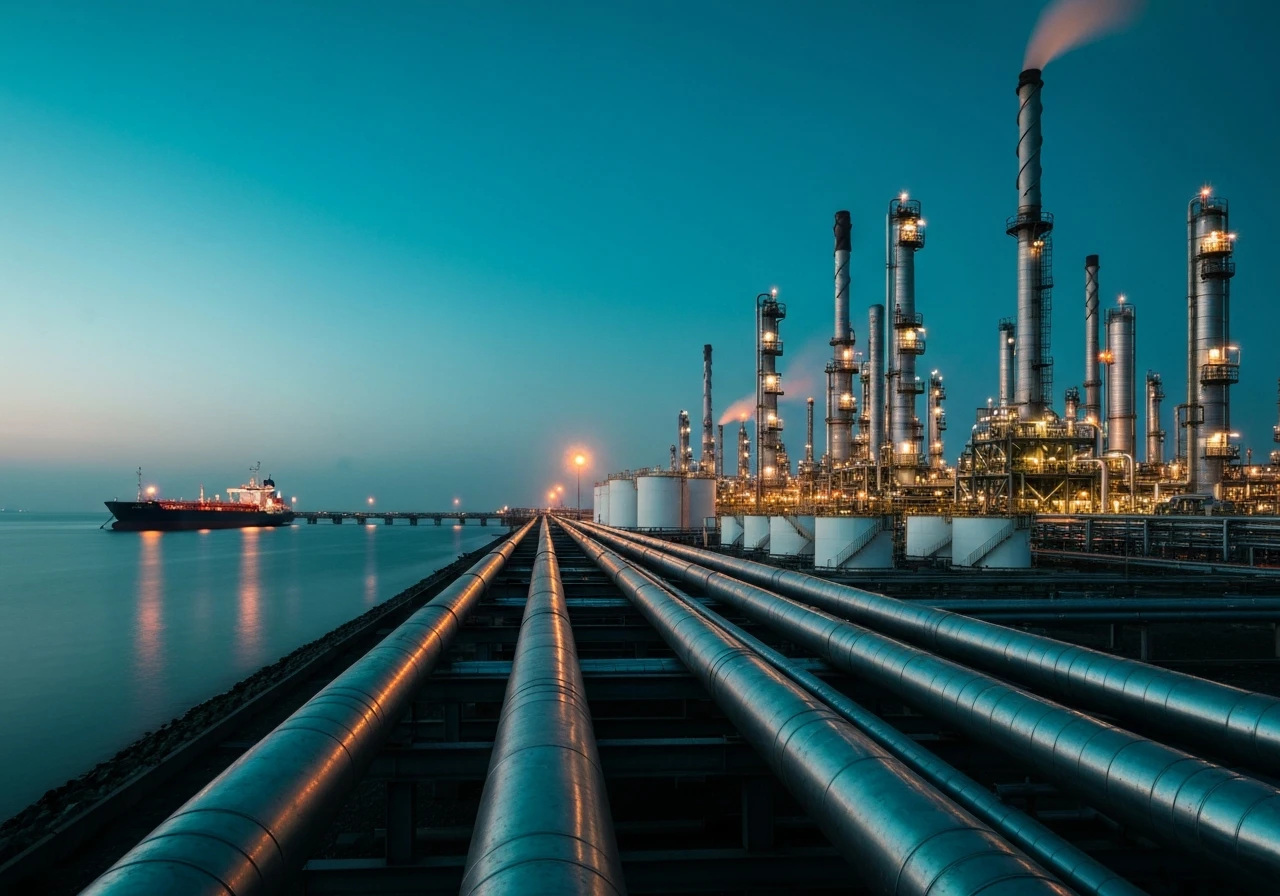
The clearest reason April still cleared 6% sits on the Black Sea coast. The start of domestic petroleum refining contributed 1.83 percentage points to the month’s GDP expansion, by far the largest single push from any new activity. No other sector came close to that kind of marginal boost.
The export numbers show why. Georgia shipped $324 million worth of petroleum products in January through April, a 933% jump from the same stretch a year earlier. That growth is almost entirely the work of a facility that did not meaningfully exist twelve months ago, which is exactly what makes the contribution so large in percentage terms and so hard to repeat.
The plant behind it is the Kulevi refinery run by Black Sea Petroleum’s refinery operations, billed by the government as one of the largest private investments in the country’s history at a projected $700 million. It began processing at the end of 2025 with an initial capacity of about 1.2 million tons of oil per year, roughly 24,000 barrels a day, importing crude, refining it, and selling the products abroad.
That model is good for the export ledger. It is also a narrow base on which to hang a national growth story, because the boost is a one-off step change rather than a recurring engine.
Where the Crude Comes From, and Where the Fuel Goes
The refinery’s inputs and outputs both carry political weight, and neither is fully settled.
A Supply Chain Rooted in Russian Oil
In the first quarter, all of the crude feeding the plant came from Russia, valued at about $118 million. Company representatives have said they are working to diversify toward Turkmen and Kazakh barrels, but the starting point is a supply chain anchored in Russian oil at a moment when Georgia’s relations with Moscow and with Brussels are both under strain. That tension has played out elsewhere too, including a widening espionage crackdown in Tbilisi.
The sanctions question came to a head this spring. The European Union removed the Kulevi port from a potential sanctions list on March 10, 2026, after the Georgian government and port operator SOCAR (the State Oil Company of Azerbaijan Republic) committed to full compliance with EU measures, including the price cap on Russian oil. The reprieve kept the export channel open, but it also showed how quickly the whole arrangement could be reclassified.
The Markets Buying Georgian Fuel
The finished products travel far. In the first quarter, the top destinations for Georgian petroleum exports were spread across three continents, with West Africa and the eastern Mediterranean leading.
| Destination | Q1 2026 petroleum exports |
|---|---|
| Togo | $55.3 million |
| Turkey | $48.1 million |
| China | $22.8 million |
| Malta | $17.1 million |
| Morocco | $16.7 million |
A buyer base that leans on Togo and Malta as much as Turkey and China is a young one, still finding its footing. It can grow, but it can also thin out fast if any single market reconsiders the origin of the crude.
Exports Carry the Quarter as Construction and Mining Slip
Petroleum is the loudest export story, not the only one. Total exports rose 21.1% to about $2.44 billion in January through April, while domestically produced exports surged 73.5% to $1.55 billion, according to the Ministry of Economy’s January-April trade data. Total trade turnover hit a record $8.13 billion. That export strength is the same diversification logic behind moves like a plan to auction a historic state wine cellar to lift Georgia’s wine trade.
Below the trade line, growth was uneven. Geostat flagged the sectors that pulled April higher and the ones that dragged.
- Manufacturing, the strongest contributor, lifted by the new refining activity
- Information and communication, a consistent outperformer through the year
- Transport and storage, tied to the rising trade volumes
- Wholesale and retail trade, plus financial and insurance services
Two sectors moved the other way. Mining and quarrying declined, and construction contracted, a worrying signal because building activity often leads the wider cycle. New business formation stayed positive, with newly registered entities up 6.9% to 6,195, a sign that confidence on the ground had not cracked even as the headline pace cooled.
Forecasters Split on Whether the Pace Holds
The April slowdown lands in the middle of an unusually wide forecast spread. Local and international institutions disagree by more than two full points on where 2026 ends up, which is a large gap for an economy this size.
Local research house TBC Capital recently lifted its full-year call to 7.4% from 6.1%, citing commodity-driven export strength. International lenders sit well below that.
| Institution | 2026 GDP growth forecast |
|---|---|
| TBC Capital | 7.4% (raised from 6.1%) |
| World Bank | 5.5% |
| United Nations | 5.4% |
| EBRD and ADB | 5.0% |
The case for the higher number rests squarely on trade.
Exports, particularly of commodities, have accelerated, supported in part by rising global prices.
That assessment came from TBC Capital in its upgraded outlook. The more cautious institutions, including the World Bank’s Georgia growth outlook, are effectively betting that the export surge cools as base effects fade and geopolitical risk lingers. April’s print is the first monthly data point that leans toward the cautious camp.
The Base Effect Fades by Next Spring
The refinery’s outsized push has a built-in expiry date. Because the comparison runs against a period when the plant barely operated, the 933% export jump and the 1.83-point GDP lift are partly a low-base illusion. Once the calendar laps the late-2025 startup, those eye-catching percentages collapse toward something ordinary, even if the refinery keeps running flat out.
Capacity expansion could offset some of that. A second processing unit is slated for April 2027, with total nameplate capacity targeted at roughly 4 million tons a year by 2028. Whether that ramp arrives on schedule, and whether the crude keeps flowing without a sanctions snag, will decide how much real momentum is left underneath the statistics.
If the May reading holds near 6% without the refinery’s one-time help, Georgia has a genuinely broad expansion and the bulls are right. If it slips further as the base effect drains away, then April was the month the headline and the economy started telling two different stories.