426. That is how many runs Vaibhav Sooryavanshi has scored inside the first six overs of Rajasthan Royals innings this season, second-most by any batter in a single Indian Premier League campaign and only 41 short of David Warner’s 2016 mark with one league game still on the calendar. The number landed quietly on Tuesday night in Jaipur, almost as an afterthought to a 93 off 38 balls that dragged Rajasthan back into the playoff conversation and turned a meaningless press-conference shrug into the most replayed cricket clip of the week.
The clip everyone shared was the celebration: an inverted V, one finger sliced across it, held up to the Sawai Mansingh crowd after he reached fifty. The clip almost nobody clicked through to was the answer that followed. Asked what the gesture meant, the 15-year-old said it meant nothing at all.
The 93 That Lifted Rajasthan off the Mat
Mitchell Marsh had already shifted the night sideways. The Lucknow Super Giants opener hit 96 off 57 balls after captain Rishabh Pant put his side in, sharing a 109-run stand with Josh Inglis (60 off 29) and another 64 with Pant himself. Lucknow finished on 220 for 5. In a season averaging around 190 in the first innings at Jaipur, that should have been more than enough.
It was not. Stand-in Rajasthan captain Yashasvi Jaiswal made 43 and stitched a 75-run opening stand with Sooryavanshi. After Jaiswal fell, Sooryavanshi paired with wicketkeeper Jitesh Sharma, who finished unbeaten on 53, for another 105 in barely seven overs. Rajasthan got home with five balls to spare and seven wickets in hand.
| Innings | Score | Top scorer | Partnerships of note |
|---|---|---|---|
| Lucknow Super Giants | 220/5 in 20 | Mitchell Marsh 96 (57) | 109 with Inglis; 64 with Pant |
| Rajasthan Royals | 221/3 in 19.1 | Vaibhav Sooryavanshi 93 (38) | 75 with Jaiswal; 105 with Jitesh |
The chase itself was strange to watch. Rajasthan needed 11 an over from ball one, a rate no IPL team had pulled off twice in a single venue all year, and the Royals were 25 for 0 inside three overs without anything that looked rushed. By the time the spinners arrived, Sooryavanshi was hitting 10 sixes in an innings that ran 38 balls long, a strike rate of 244.
Inverted V, No Meaning, No Plan
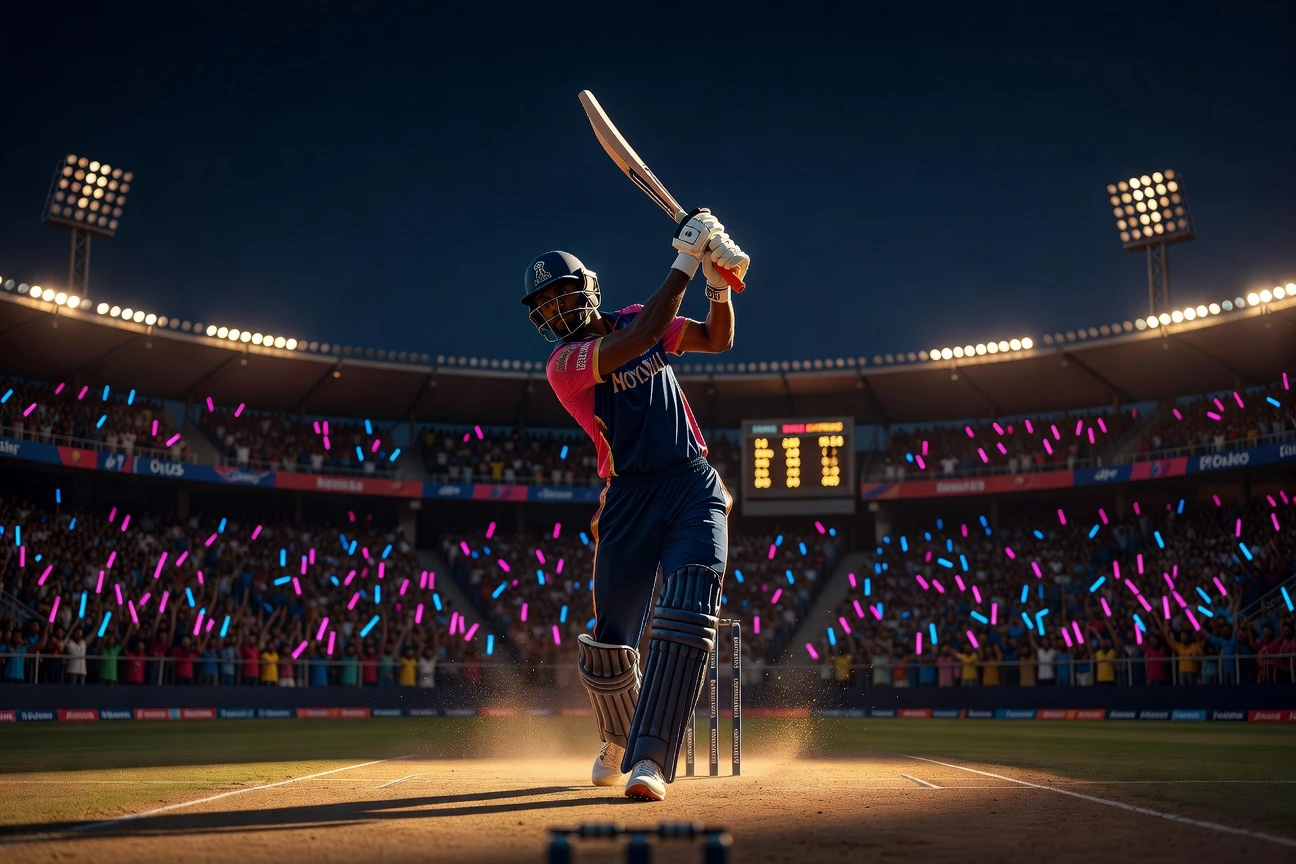
The celebration came at the fifty, which he reached off 23 balls. He held up the gesture, smiled, walked back to his guard, and proceeded to clobber 42 runs off the next 13 deliveries he faced before holing out to long-on.
Reporters wanted the story behind the V. There was no story.
I don’t know. I just do something new every match. I don’t really plan it. There’s no meaning behind it. Even the celebration I did in the last match had no meaning. I just keep trying new things.
Sooryavanshi said that in the post-match press room, then added a second line that several reporters underlined. “I don’t read any newspapers,” he said. “This is just the start. If I end up making a long career, people will always speak something about me.” Two sentences, no follow-up, and the room moved on to questions about the chase. It is hard to overstate how unusual that is from a teenager whose Instagram clips collect millions of views a week.
Sooryavanshi Now Owns the Powerplay
The number that survives this match longer than the celebration is buried in the BCCI’s match notes. With 25 runs off 16 balls inside the first six overs of the chase, Sooryavanshi pushed his season powerplay tally to 426, lifting him past Travis Head and Sai Sudharsan and into second on the all-time IPL list.
Where the All-Time Powerplay Board Stands
Warner’s 2016 season produced 467 powerplay runs for Sunrisers Hyderabad, a number that has held the top of the list for almost a decade. Sooryavanshi now sits 41 runs short with Rajasthan’s final league match against Mumbai Indians on May 24 still to play, plus potential playoff fixtures.
| Powerplay runs | Player | Season |
|---|---|---|
| 467 | David Warner | 2016 |
| 426* | Vaibhav Sooryavanshi | 2026 |
| 402 | Travis Head | 2024 |
| 402 | Sai Sudharsan | 2025 |
| 382 | Adam Gilchrist | 2009 |
Why the Powerplay Number Matters More Than the Total
Single-innings 90s come and go. Powerplay aggregates over a full season are a different kind of evidence. They mean a batter has cleared the new ball, multiple bowling attacks, sticky pitches in the first hour, and the field restrictions almost every IPL season has tried to weaponise back against openers. Warner spent a career building that number. The teenager from Tajpur, Bihar, has put it together inside his second IPL campaign and his first as a regular opener.
The other detail that matters: he is doing it left-handed against attacks that have not had film on him for more than a few months. By season three, captains will plan for him. The 2026 numbers are a one-off in that sense, not a baseline.
The Orange Cap Comes Home to Jaipur
The 93 also moved him to the top of the Orange Cap leaderboard. Going into the match, Marsh held the cap on the strength of his 96 in the first innings. By the time stumps were drawn, Sooryavanshi had pushed past him to 579 season runs across 13 innings, with three half-centuries and a hundred to his name.
The figure that travels further is the six count. Fifty-three sixes for the season, the most ever struck by an Indian batter in a single IPL campaign, surpassing the 42 Abhishek Sharma cleared the rope for in 2024. He is also the only player in IPL history to have hit 30 powerplay sixes in one season.
- 579 season runs in 13 innings, season strike rate of 236.32
- 53 sixes in a single IPL season, an Indian record
- 30+ powerplay sixes, a first in IPL history
- 23 balls for his Tuesday fifty, fastest of his season
The strike rate is the one that should make rival analysts pause. No batter who has crossed 500 runs in any IPL season has done it at better than 220. Sooryavanshi is striking at 236.
What 15-Year-Olds Don’t Usually Do
Born on 27 March 2011, Sooryavanshi turned 15 in March. He made his IPL debut for Rajasthan last year at 14 years and 23 days, against the same Lucknow opposition, the youngest debutant in the tournament’s history.
The senior-cricket résumé he has built in 13 months is unusual even allowing for the wave of teenage IPL talent that arrived in the post-pandemic auctions. In December’s Vijay Hazare Trophy domestic 50-over competition, he scored a 36-ball century against Arunachal Pradesh, becoming the youngest player anywhere to score a hundred in List A cricket at 14 years and 272 days, and broke AB de Villiers’ record for the fastest 150 in the format in 59 balls in the same innings.
The progression has gone roughly like this:
- April 2025: IPL debut, age 14 years and 23 days, youngest in tournament history
- December 2025: List A hundred off 36 balls, youngest in world cricket
- March 2026: First IPL century, 35 balls against Gujarat Titans
- April 2026: Second IPL century, 36 balls against Sunrisers Hyderabad
- May 2026: 93 off 38, Orange Cap, second on all-time powerplay list
Every entry on that ladder lands inside a 14-month window. The closest historical analogue, Sachin Tendulkar’s first 12 months in senior cricket, sits across a much smaller stage and a slower format.
Rajasthan’s Playoff Math, One Game Out
The win lifted Rajasthan to 14 points from 13 games and into fourth on the points table, the final qualification slot. The Mumbai Indians fixture on May 24 in Jaipur now decides their season. A win takes them to 16 points and a guaranteed top-four finish, since no other fourth-place challenger can mathematically catch them at that mark.
The Royals can still squeeze in at 14 points if they lose, but they would need Punjab Kings and Kolkata Knight Riders to drop their remaining games in specific combinations. The cleaner route is the obvious one: beat Mumbai, finish fourth, take whichever Eliminator slot that produces. The same Marsh-led Lucknow side that conceded 221 in Jaipur is, separately, now out of contention, with the loss pushing them to the foot of the table.
For the bigger market, the more interesting line is what Sooryavanshi does on Saturday. Mumbai’s new-ball pair of Jasprit Bumrah and Trent Boult are the only attack in this season’s IPL that has dismissed him for single figures twice. If he survives the first three overs, Warner’s 467 is in genuine danger. If he does not, the record holds for another year and the Royals walk into the playoffs without their Orange Cap holder at full tilt.
Either result writes itself into a season that has been, in the cold reading of the spreadsheet, the single best individual IPL campaign by anyone under 18. The celebration that meant nothing will be a footnote either way. The 426, and where it sits when the league stage closes on Saturday evening, will not.