Nifty closed at 23,618 on Tuesday, down 0.14%, with Sensex slipping 0.15% to 75,200.85. Underneath that flat finish, Nifty IT climbed more than 3%, the rupee touched a record low of 96.40 per dollar, and broader markets snapped a two-day slide.
That sets the table for Wednesday’s weekly options expiry: a benchmark trading inside a tight band while currency stress, sector rotation, and a postponed US strike on Iran rearrange the tape underneath.
The Sectoral Split Behind a Flat Close
Beneath the flat benchmark close, sector dispersion ran unusually wide. Nifty IT rose 3.51% by the bell, the steepest single-day gain among sectoral gauges. FMCG, PSU Bank, Oil & Gas, and Media followed in green. Pharma stretched its run to a fifth straight day. Realty and Metal were the only sectors in the red.
Mid and small caps did the quieter work. The Nifty Midcap 150 added more than 0.5% and the Smallcap 250 gained over 1%, ending a two-day stretch of declines. With breadth that wide, a benchmark print near zero meant the cap-weighted heavyweights dragged where the rest of the market did not.
| Sector | Day Move | Read |
|---|---|---|
| Nifty IT | +3.51% | Top sectoral gainer; rupee-led |
| Nifty Pharma | Positive | Fifth straight up session |
| Nifty FMCG | Positive | Cigarette and bread price hikes |
| Nifty PSU Bank | Positive | Recovered after recent declines |
| Nifty Financial Services | Negative | Largest sectoral drag |
| Nifty Bank | Negative | Third straight decline |
| Nifty Metal | -0.09% | Third straight decline |
| Nifty Realty | -0.11% | Worst sectoral performer |
For traders, the spread between the IT rally and the financials drag, nearly four percentage points between two sectors on the same trading day, mattered more than where the headline benchmark settled. Live NSE sector heatmap data confirmed the rotation was concentrated rather than broad.
The Rupee at 96.40 Drove the IT Bid
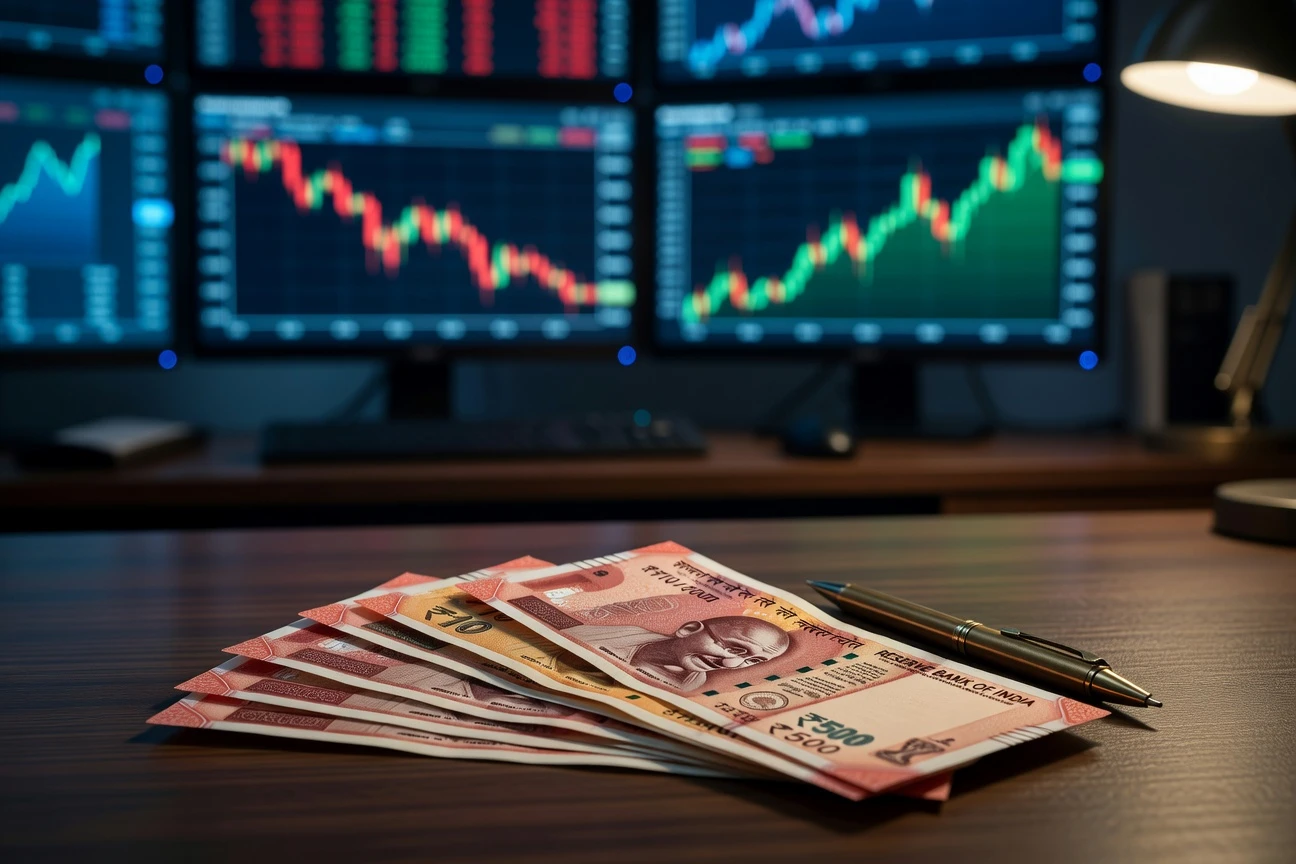
The rupee opened at 96.36 to the dollar, slipped to 96.40 in early trade, and clawed back a few paise through the morning. The currency has depreciated 7.1% so far in 2026, the worst run among Asian peers this year.
Indian IT exporters bill the majority of revenue in dollars. When the rupee weakens, every dollar of services revenue converts into more rupees on the income statement, and operating margin expands before pricing or volume even moves. Tuesday’s tape priced that math hard.
Coforge and Infosys Lead the Move
Coforge closed up 4.90%, Infosys gained 4.60%, and Persistent Systems advanced 4.31%. HCLTech added 3.84% and Mphasis 3.70%. The Nifty IT index touched an intraday peak around 29,609 before settling near 29,339.
How the Brokerages Are Reading It
Kotak Securities, in a Tuesday note on Tata Consultancy Services after meeting the company’s chief financial officer, kept a buy rating with a Rs 3,100 target. The note flagged that enterprise AI adoption remains early-stage, while vendor consolidation continues to benefit TCS against wage hikes and acquisition-led margin pressure.
Goldman Sachs held its neutral stance on Infosys with a Rs 1,290 target after meeting management, citing soft discretionary spending offset by BFSI (banking, financial services and insurance) and Europe deal momentum. The brokerage flagged AI-led pricing pressure that Infosys plans to absorb through new opportunities. Tuesday’s rally pushed the stock toward the upper end of that target band purely on currency, with no guidance revision behind it.
Financials and Metals Held Back the Tape
Nifty Financial Services led the day’s sectoral losses, and the Nifty Bank index extended its slide for a third straight session. Kotak Mahindra Bank fell 0.97%, the largest decliner among private lenders, with HDFC Bank, ICICI Bank, Axis Bank, and AU Small Finance Bank also closing red.
Public sector banks held up better. IDFC First Bank rose 0.93%, Punjab National Bank added 0.76%, and Canara Bank gained 0.61%. State Bank of India and Bank of Baroda also finished in green territory. That split inside the financials basket marks where foreign institutional investor (FII) selling is biting and where it is sparing the tape.
UBS turned the read into a call on the exchanges. The Swiss broker downgraded BSE Ltd to neutral from buy with a Rs 4,500 target, citing tighter Reserve Bank of India lending norms for capital market intermediaries from July 1, 2026, that could shave trading volumes by 5 to 10%. NSE sources separately said BSE is not part of the Nifty 100 index and therefore not eligible for inclusion in the upcoming Nifty 50 review, contradicting an earlier market expectation.
Metals offered no relief. The Nifty Metal index slipped 0.09% to record a third straight session of declines, with no clear catalyst beyond a firm dollar feeding back into industrial commodity prices. Riverdale Standard’s Monday breakdown of Nifty 50 support at the 23,400 mark framed the bank-led pressure that has carried into this week.
From BEL to Indian Oil, the Q4 Read
Tuesday’s earnings calendar was thick with full-year and Q4 March 2026 reports, and the dominant theme was consistent across defence, energy, and pharma: revenue growth running ahead of profit growth, with margins giving back ground.
Bharat Electronics Order Book Touches Rs 73,882 Crore
Bharat Electronics (BEL, the Navratna defence public sector company) reported Q4 consolidated profit up 4.6% year on year to Rs 2,225 crore on revenue up 11.7% to Rs 10,224 crore. The order book closed the financial year at Rs 73,882 crore, but operating margins slipped to 29.2% from 30.8% a year earlier. EBITDA (earnings before interest, taxes, depreciation and amortisation, a measure of operating cash generation) grew 5.9% to Rs 2,982 crore, lagging revenue growth by a clear gap.
Indian Oil and Indraprastha Gas Face Margin Pressure
Indian Oil’s Q4 net profit fell 6.2% sequentially to Rs 11,378 crore on revenue of Rs 2.08 lakh crore. The state refiner guided FY27 capital expenditure at Rs 32,700 crore, near flat versus Rs 32,405 crore in FY26, with Panipat refinery capacity set to expand to 25 million metric tonnes per annum (MMTPA) by December and Gujarat to 18 MMTPA by November.
Indraprastha Gas, the Delhi-area city gas distributor, took a harder hit. Q4 profit dropped 23% sequentially to Rs 277 crore as unit margins fell to Rs 4.8 per standard cubic metre on higher input gas costs. Management guided FY27 capital expenditure at Rs 1,400 to 1,500 crore and forecast piped natural gas demand growth of 20 to 30% over the medium term.
Dhanuka Agritech Rolls Back a Hike, Adds a Buyback
Dhanuka Agritech posted Q4 profit up 29.8% to Rs 97.5 crore but acknowledged the market did not accept its May price increases and rolled them back. The board approved a buyback of 5 lakh shares at Rs 1,400 each, a roughly Rs 70 crore commitment, alongside flags about a possible El Niño impact on the late Kharif season.
Trump’s Iran Pause and the Crude Reset
The macro overlay for Asian markets reset overnight. US President Donald Trump said he had called off a planned military strike on Iran after requests from leaders of Saudi Arabia, Qatar, and the United Arab Emirates, telling reporters the delay could last “two or three days” while diplomatic talks continued.
Crude reacted. Brent for July delivery fell 2.04% to $109.81 per barrel and West Texas Intermediate (WTI) for June declined 1.12% to $107.44. That eases immediate pressure on Indian airline fuel costs and on the trade deficit, even as crude stays stubbornly above the $100 line that keeps FX strain on the import bill.
HSBC estimated that a value-added tax cut on aviation turbine fuel (ATF) covering roughly 37% of domestic consumption could save IndiGo Rs 1,200 to 1,500 crore and Air India Rs 800 to 1,000 crore at current oil prices. Indian airlines, including Air India, IndiGo, and SpiceJet, separately asked state-run refiners to delay any further jet fuel price hike for domestic flights, with a decision expected before June 1.
The Iran reset also showed up in regional equity flows. Japan’s Nikkei added 0.68%, Australia’s ASX 200 climbed 1.08%, and South Korea’s Kospi was the regional outlier with a 1.06% slip. Riverdale Standard’s earlier coverage of the previous Iran-driven oil reversal tracked a near-identical Wall Street pattern when geopolitics softened weeks earlier.
Weekly Expiry and the F&O Map
Wednesday brings the weekly futures and options (F&O) expiry, and the positioning map drawn before the session points to a tight intraday range. The 23,800 strike carried the heaviest fresh Call writing, marking the day’s near-term ceiling, while the 23,700 strike held the largest Put open interest, anchoring the floor.
The wider picture is just as telling. Total derivatives open interest on Nifty 50 surged 215.93% since the previous expiry despite the index falling 8.62% in that window. Call open interest rose 208.23%, Put open interest climbed 242.59%, and Nifty Financial Services total open interest jumped a staggering 665.51%. Those numbers point to hedging activity rather than directional conviction.
Single-stock derivatives told a split-positioning story:
- Fresh longs: OFSS, Adani Power, HDFC AMC, PB Fintech (which operates Policybazaar), and Nykaa, with rising prices and rising open interest
- Fresh shorts: Astral, Amber Enterprises, Bajaj Auto, Jindal Steel, and Cipla, with falling prices and rising open interest
- Short covering: Suzlon, Motilal Oswal Financial Services, Indian Hotels, Dabur, IREDA, and SBI Cards, with rising prices on falling open interest
- Long unwinding: DMart, LIC Housing Finance, Hyundai Motor India, Bandhan Bank, Coal India, and ONGC, with falling prices on falling open interest
Two stock-specific filings sit alongside that map. Life Insurance Corporation of India received shareholder approval for a 1:1 bonus issue, clearing the way for allotment of one bonus share for every existing share held. Adani Green Energy said the US Department of Justice has decided to dismiss charges against the company, with the formal court order from the Eastern District of New York still awaited; the stock rose roughly 3% intraday to near Rs 1,417.
If Wednesday’s session breaks through the 23,800 Call wall, the same IT-led bid that drove Tuesday’s tape can extend, and the broader-market rotation that snapped a two-day decline turns into a fresh trend. If the 23,700 Put base cracks instead, the financials drag that kept benchmarks marginally red on Tuesday becomes the story of the week, with the rupee printing a fresh low on top of it. The first hour of the expiry session will pick the branch.
Disclaimer: This article is for informational purposes only and does not constitute investment advice. Equity and currency markets carry risk, and figures referenced reflect closing data and disclosures available on May 19, 2026. Readers should consult a SEBI-registered investment adviser before acting on any of the information above.