India is weighing more than ₹8,700 crore ($1 billion) in subsidies and lender support over a decade to push private operators of buses and trucks onto electric platforms, in deliberations the Prime Minister’s Office is set to refine this month. The talks have accelerated after oil supply disruptions tied to the Middle East crisis revived energy security worries in a country that imports roughly 89 percent of its crude.
The package on the table leans more on financing plumbing than on per-vehicle handouts. Officials are evaluating a partial credit guarantee for lenders alongside interest subvention worth up to ₹1.5 million ($17,500) per vehicle over its lifetime, according to people familiar with the deliberations as reported by Bloomberg. The combination targets the affordability gap that has kept nearly all of India’s 2 million-plus buses and almost every truck running on diesel.
What Delhi Is Putting on the Table
The proposed scheme would run for 10 years and direct the bulk of its support toward inter-city bus operators, according to people familiar with the discussions, who asked not to be named because the talks are private. Meetings with the Prime Minister’s Office and industry stakeholders are scheduled through May to refine eligibility, vehicle categories, and the subsidy taper.
Early sizing puts the first wave at 10,000 buses, scaling toward 40,000 to 50,000 commercial vehicles as the program matures. The Ministry of Heavy Industries (MHI, the central department that runs India’s electric-mobility incentive programs) chaired a stakeholder meeting on April 29 in New Delhi that pulled in the Department of Financial Services, the World Bank, public and private sector banks, NBFCs (non-banking financial companies that dominate commercial vehicle lending), SIDBI (Small Industries Development Bank of India), NIIF (National Investment and Infrastructure Fund), OEMs, and industry bodies including SIAM (Society of Indian Automobile Manufacturers).
- $1 billion-plus: headline outlay over a decade for private fleet electrification
- 10,000 to 50,000: commercial vehicles in scope across the program’s life
- ₹1.5 million: per-vehicle interest subvention being modelled, tapering over years
- 2 million-plus: buses on Indian roads, of which government controls roughly 5 percent
Industry has separately asked for charging parks, toll and tax waivers, and electricity concessions to bring operating costs lower. Those items remain on the table but are not the headline ask, the people said.
Why the Oil Bill Is Forcing the Decision
Energy security has framed the urgency the policy meetings have absorbed since April. India imports nearly 89 percent of its crude oil, and roughly 45 percent of those volumes transit the Strait of Hormuz, which has been disrupted this year by Iranian attacks on commercial shipping. Indian refiners have rerouted cargoes through the longer Cape of Good Hope path, lifting freight costs and complicating supply planning.
Diesel is where the bus and truck conversation lands. The transport sector consumes 70 percent of India’s diesel, and buses alone account for almost 10 percent of national diesel demand.
Trucks make up the lion’s share of the rest. Replacing even a slice of that fleet with electric units pulls the country’s exposure to oil price shocks down at the margin, while also addressing a domestic air-quality fight that has stretched on for two decades.
Vehicular emissions can account for as much as 38 percent of Delhi’s PM2.5 (fine particulate matter under 2.5 microns in diameter), according to ICCT-cited estimates, with peak-season shares running closer to 50 percent. The political backdrop is supportive: the Prime Minister’s Office has cleared time for the policy to land before the monsoon-session legislative calendar reopens.
The Credit Guarantee Does the Heavy Lifting
The per-vehicle subvention has dominated the public reporting on the package. Tucked further down in the proposal sits a partial credit guarantee for lenders, which several participants at the April 29 meeting described as the structural lever, according to the MHI summary of the discussion.
Why this matters: small bus and truck operators run thin margins and rarely qualify for the kind of asset-backed loan terms public transport undertakings can wave through. Lenders price that risk by demanding heavy collateral, short tenors, and high coupons. A government-backed partial guarantee resets the credit math, letting banks finance buyers who would otherwise sit out the transition.
The components under discussion include:
- Interest subvention of up to ₹1.5 million per vehicle across its life, with the support tapering over years to push lenders toward standalone underwriting
- A partial credit guarantee for commercial-EV loans, freeing public-sector and private banks to lend without full asset coverage
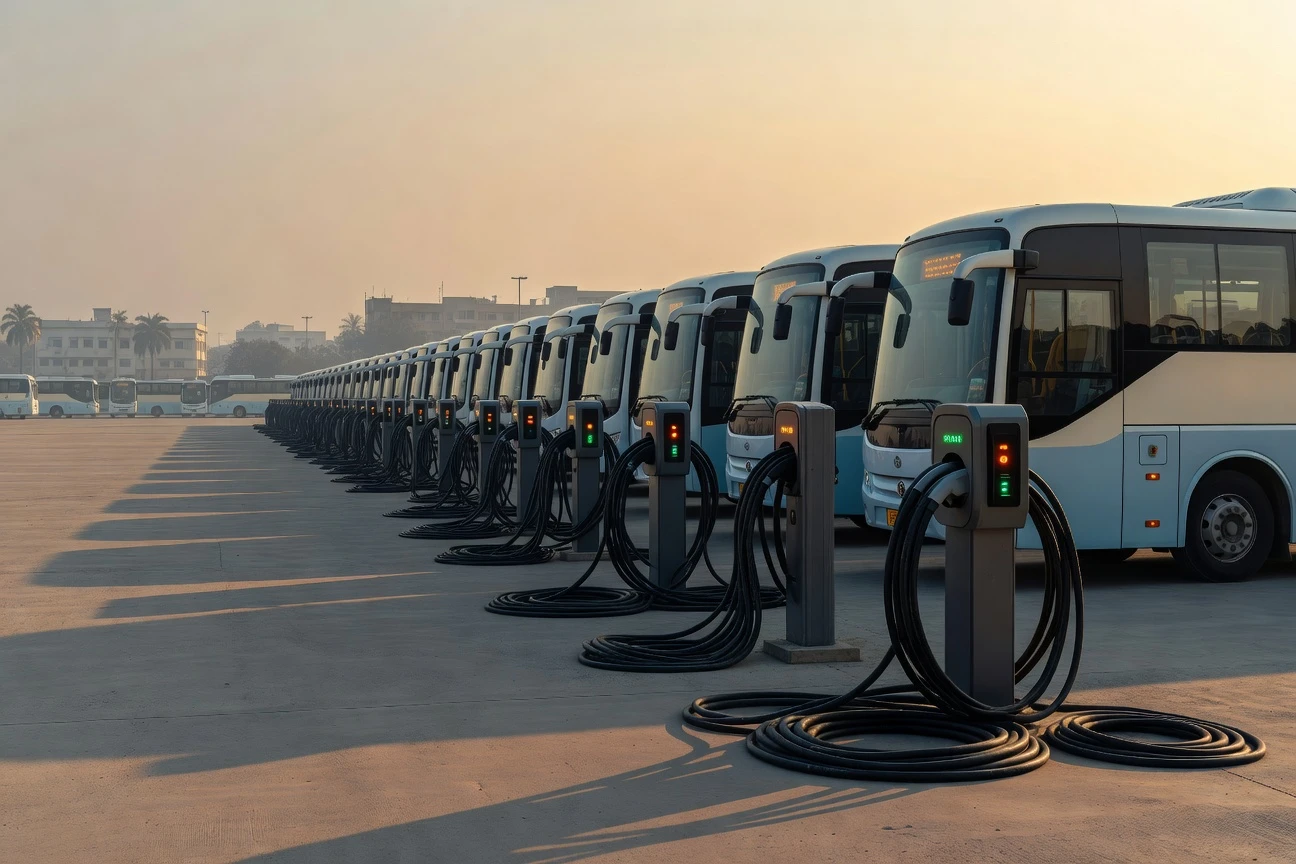
- Charging-park development at depots and along inter-city corridors, an industry ask the government has flagged as supplementary
- Toll and tax waivers plus discounted commercial electricity tariffs, the operating-cost levers that fleet operators say move payback math more than capex sticker prices
The April 29 session tested these pieces against feedback from lenders and guarantee providers including SIDBI and NIIF, alongside the World Bank’s India team. IEEFA’s analysis of a strategic financing facility for Indian e-buses argues that without exactly this kind of risk-sharing layer, lender appetite for private fleet paper stays effectively at zero. The proposal mix has not been finalized and the budget allocation may shift before the Prime Minister’s Office signs off.
How the New Scheme Stacks Against PM E-Drive
The proposed program would sit alongside, not replace, India’s existing electric-mobility flagship. The PM E-Drive Scheme (Prime Minister’s Electric Drive Revolution in Innovative Vehicle Enhancement) carries a total outlay of ₹10,900 crore through March 2028, with ₹4,391 crore earmarked for 14,028 e-buses procured by state transport undertakings and ₹500 crore for electric trucks. The PM E-Drive cabinet approval text set the parameters at launch.
| Feature | PM E-Drive (existing) | Proposed private-fleet scheme |
|---|---|---|
| Outlay | ₹10,900 crore (about $1.3 billion) | $1 billion-plus (about ₹8,700 crore) |
| Time horizon | Through March 2028 | 10 years |
| Target fleet | State-run public transport, urban buses | Private inter-city buses, commercial trucks |
| Bus count | 14,028 e-buses | 10,000 initial, scaling to 40,000 to 50,000 vehicles |
| Headline lever | Capital subsidy per kWh of battery | Partial credit guarantee plus interest subvention |
| Payment risk | CESL payment-security mechanism backstops state utilities | Partial credit guarantee backstops private lenders |
The structural gap the new program is built to close shows up in the bus count itself. India has more than 2 million buses on its roads, but the government controls only about 5 percent of the fleet. The existing scheme’s bus allocation, even at maximum draw-down, addresses less than 1 percent of the national fleet. Private operators were always the larger prize.
The Math on 50,000 Vehicles
Run the proposed numbers and a picture emerges of a deliberately concentrated bet. The headline outlay divided over the planned 40,000 to 50,000 vehicles works out to about $20,000 to $25,000 of public support per unit, comfortably within the per-vehicle subvention envelope being discussed. Layer the partial credit guarantee on top and the public exposure rises only if defaults exceed the loss-absorption tranche.
The volume is small against the existing diesel base. India sold 834,578 trucks in 2024, of which only 6,220 were electric, a 0.7 percent share. Adding 50,000 commercial EVs over a decade brings cumulative private-fleet electric penetration to perhaps 2 to 3 percent of new registrations, assuming the broader market stays flat.
The government’s actual ambition is larger. NITI Aayog’s transport-sector net-zero scenarios flag a goal of replacing 800,000 diesel buses by 2030, including 550,000 private buses, a target the current proposal does not approach. What the program is sized to do is prove the unit economics, not finish the job. If 10,000 electric inter-city buses run on private books with full lender support and acceptable default rates, the asset class becomes investable for non-bank financiers and securitisation players who currently sit out commercial EV paper entirely.
What Could Sink the Plan
Charging infrastructure is the first execution risk. The existing scheme earmarks ₹2,000 crore for public stations, including 1,800 fast chargers for buses, but inter-city bus operators run routes that demand depot charging at both ends plus mid-route options. The pipeline is thin, and corridor build-outs are a state-by-state negotiation.
Lender memory is the second drag on adoption. FAME-II (Faster Adoption and Manufacturing of Electric Vehicles Phase II, the predecessor scheme that ran through 2024) under-delivered against original bus targets after disputes between manufacturers and state transport undertakings over payment timelines. The new program addresses that with the credit guarantee, but private banks remember the write-offs and have signalled they will price guarantee-backed paper conservatively until default data accumulates.
Fiscal calendar pressure compounds both risks. India’s FY27 union budget allocated ₹1,500 crore to PM E-Drive in February. Any additional outlay for the private-fleet program would need to be carved out of the next fiscal cycle, meaning the announcement window and the disbursement window are likely separated by a year or more.
If the Prime Minister’s Office signs off this month and budget provisioning follows in the next fiscal cycle, the first tranche of credit-guaranteed bus financing could close by late 2026 or early 2027. If the package gets pulled apart in inter-ministerial review, the same energy-security argument that produced this draft gets to be made again next year, with a less forgiving oil-price backdrop.