Counterpoint Research clocked Meta Platforms Inc. at 82% of global smart-glasses shipments in the second half of 2025. At Google I/O 2026 on Tuesday, Google walked on stage with the first credible answer, and it is not a single product. It is Samsung Electronics Co. Ltd. building the hardware, Google supplying the software, and two fashion houses, Warby Parker and Gentle Monster, designing the frames.
The intelligent eyewear runs Android XR, ships in the fall, and arrived on stage without a price tag. That gap is what Google has to close before the holiday quarter when smart-glasses sales usually peak.
What Google Put on the Stage
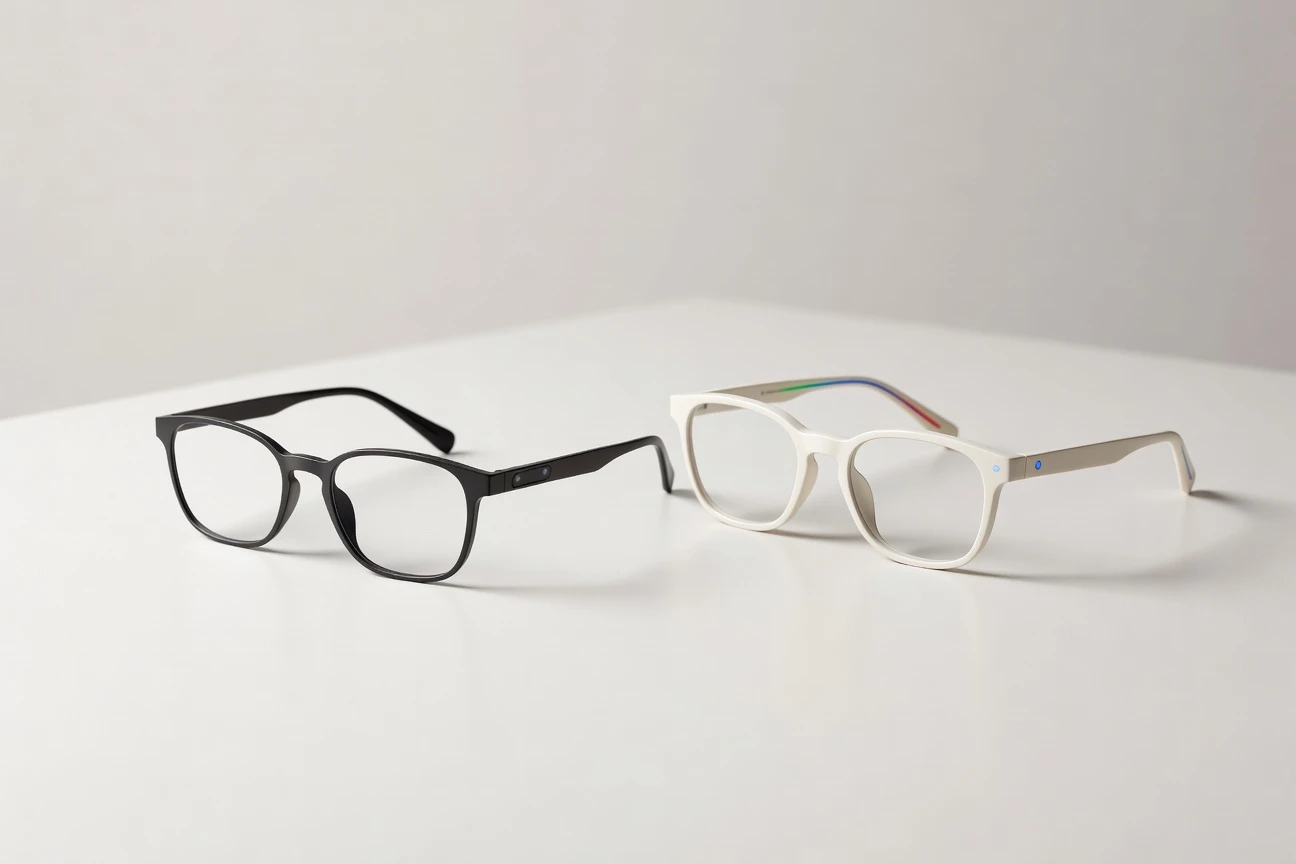
The keynote video showed two frame styles, one from each partner brand, worn casually rather than as engineering reference units. Both are audio-only on the inside, with over-ear speakers, an onboard camera, and a sensor stack that handles directional awareness. Google said the display version is a separate hardware track, no date attached.
The live demo leaned hard on Gemini. A wearer asked for walking directions and got them as audio cues. Another tapped the temple to summon a DoorDash voice order for coffee, three steps from request to confirmation. A third snapped a photo of a cloud bank and asked what it was looking at. Photos pushed automatically to the paired phone, or to a Pixel Watch if the wearer had one on the wrist.
Cross-platform compatibility was the line Google wanted carried out of the keynote. The frames work with both Android and iPhone, a choice that lowers the switching cost for the roughly half of premium smartphone buyers who sit on iOS. The competing Ray-Ban frames already pair with both, so Google was matching table stakes here, not raising them.
“Intelligent eyewear represents a powerful step forward in our shared vision with Samsung to make AI more helpful and accessible in everyday life,” said Shahram Izadi, Google’s vice president and general manager of Android XR, in the company’s official I/O 2026 Android XR blog post.
Meta’s 82 Percent Is the Number Google Is Aiming At
The market Google is walking into is not split. Counterpoint Research’s H2 2025 shipment data puts Meta at 82% of global smart-glasses shipments, up from roughly 73% in the first half of the same year. Shipments grew 139% year-over-year in that second-half window, a category accelerating faster than its largest player can absorb.
Ray-Ban Meta has crossed two million units sold since launch in October 2023, and EssilorLuxottica, the Ray-Ban parent, has told investors the smart-glasses business now drives more than a third of its revenue growth. The $800 Meta Ray-Ban Display variant had its international rollout paused in early 2026, with the company citing unprecedented demand and limited inventory.
- 82%: Meta’s smart-glasses shipment share in H2 2025, per Counterpoint Research
- 139%: year-over-year growth in category shipments in the same window
- $800: list price for the Ray-Ban Display variant whose international launch was paused
Google is therefore competing for the 18% slice that is not Ray-Ban, plus whatever demand the incumbent cannot fulfill at its current production cap. The latter is the more interesting pool. Reports in January suggest Meta is discussing doubling annual capacity to roughly 20 million units by year-end; until that capacity lands, there is a queue at the top of the market.
The Fashion Stack Behind the Frames
The three-way build is the structural difference between this announcement and a typical Google hardware reveal. Samsung designs and manufactures the actual frames around Qualcomm Inc.’s silicon. Google supplies Android XR and the Gemini integration. Warby Parker and Gentle Monster handle the part that decides whether anyone wears them in public.
| Partner | Role | What they bring |
|---|---|---|
| Samsung | Hardware OEM | Frame engineering, sensors, audio, integration |
| Software platform | Android XR operating system, Gemini assistant | |
| Qualcomm | Silicon | Chipset and connectivity stack |
| Warby Parker | Eyewear design | American optical brand, full collection |
| Gentle Monster | Eyewear design | Korean luxury house, full collection |
The two fashion partners do not overlap on customer or aesthetic. Warby Parker is an American direct-to-consumer optical brand built on prescription frames at $95 to $195 list, with roughly 270 US retail showrooms as of its last filing.
The Seoul-based luxury house is favored by K-pop talent and seen on red carpets, with frames typically landing between $300 and $500. Picking both, instead of building a single house brand, is a deliberate breadth play.
Both companies plan to launch full collections later this year, meaning multiple frame shapes, lens treatments, and color options rather than the single-SKU approach the Ray-Ban partnership took with Wayfarer. The pitch is closer to “buy your usual eyewear, in a smarter version” than “buy a smart-glasses product.”
What Gemini Does From a Glasses Frame
Wake the assistant with a “Hey Google” or a tap on the side of the temple. From there, Gemini sits between the wearer’s voice, the camera, the speakers, and the paired phone. Google’s demo broke the use cases into a handful of categories that map closely to what Ray-Ban Meta already does, with two genuine wedges of its own.
The shipping feature list, as described in the joint Samsung newsroom note on intelligent eyewear, breaks down like this:
- Visual recognition on whatever the wearer is looking at, from cloud formations to restaurant storefronts
- Turn-by-turn navigation as audio cues, walking or driving
- Real-time translation of text and speech in the wearer’s field of view
- Photo and short video capture, with edits handled by Google’s Nano Banana image model
- Third-party app launches by voice, demoed with DoorDash and Uber
- Multistep task chaining, like ordering a specific coffee from a specific shop in one phrasing
- Call routing, message summaries, and reply dictation for incoming notifications
- Music playback through the over-ear speakers, described as crisp and private
The two wedges that pull ahead are the multistep agent flow and the Nano Banana editing. The incumbent frames can take a photo and pass it to the phone; they cannot edit it on-glasses or chain a five-step DoorDash order from a single sentence.
What is still absent: any in-frame display. Without one, none of these features can show you a map, a preview of your photo, or a translation overlay. That gets you the audio assistant version of the product. The visual layer waits for the second generation.
The Platform Bet Inside Android XR
Android XR is the operating system, not the product. Samsung’s Galaxy XR headset shipped on it last year. XREAL’s Project Aura, teased at the same I/O, is built on it. The intelligent eyewear is the third device class to land on the same software base in roughly twelve months.
This is the original Android playbook, run again. Google does not need to win the glasses category outright; it needs the platform installed on enough hardware from enough partners that developers build for it first. The keynote arrived on the same morning Google announced its AI Mode search rebuild crossing one billion monthly users, a Gemini-distribution data point the eyewear pitch leans on.
Qualcomm’s co-development role matters here. The chipset designer has been working on the platform since 2023, and a reference design means smaller OEMs can ship Android XR glasses without rebuilding the silicon stack.
The contrast with the incumbent is structural. Meta builds its frames with EssilorLuxottica and runs its own Llama-driven assistant, locked to its own hardware. Apple’s reported entry, previewed in the lead-up to WWDC 2026’s AI-focused keynote, will likely follow the same vertical model. Google is the only one of the three offering its software to anyone who wants to build a frame.
That arithmetic has worked before. Android passed iOS in global smartphone share by 2011 by being on the cheapest handsets and the most flagships at once. Whether the same math holds for a category where the device sits on the wearer’s face is a different question. Form, fit, and brand carry more weight when a product is also a fashion accessory.
What Was Not on the Slide
No price. No launch date beyond “later this fall.” No firm spec sheet. No confirmed country list. The announcement was a forward-look in the strictest sense, closer to a roadmap commitment than a product launch.
The gaps matter because the holiday quarter is where the smart-glasses category does most of its volume. Ray-Ban Meta’s two-million-unit cumulative figure is heavily skewed to Q4 sell-through. Google needs the frames available, in inventory, and priced before mid-November to compete in the same window. A fall launch with no SKU specifics in late May leaves about six months for the Korean partner’s supply chain to deliver at scale.
The display question is the larger one. The first frames carry no in-lens screen, which puts them feature-for-feature against the standard incumbent at roughly $329 list, not against the $800 Display variant. Google’s display track was acknowledged on stage but not dated.
The first generation is audio-only with no built-in display in the lens, so all output runs through onboard speakers, and the camera handles visual input for the agent.
That was the operating description offered alongside the joint announcement. It is the right framing for an opening bid in a category that is still defining what “smart” means on a face. If Google ships the audio version on time, with both eyewear partners’ collections in stores by Thanksgiving, and at a price under the $329 incumbent floor, the share gap starts moving inside two quarters. If any of those three pieces slip, the first wave reads as a placeholder and the 2023 leader keeps the wedge it has built.