A Georgia wedding-night helicopter crash killed a groom and the aircraft’s pilot on Friday and left the bride trapped beside her husband’s body for roughly six hours, after their Robinson R66 went down in rain and fog in the woods of Dawson County. Dave Fiji, a commercial airline pilot himself, had warned before liftoff that the visibility was too poor to fly. His new wife, a nurse, survived with cuts and bruises and no broken bones.
The flight was meant to be the storybook send-off: a short hop from a 400-guest reception to an Atlanta hotel. What federal investigators are now examining is a scenario they have documented for decades, a helicopter flying under visual rules into weather built for instruments.
What Happened in the Woods Off Highway 53
The couple married at The Revere, a wedding venue near Dawsonville that hosted about 400 guests that evening. The helicopter ride was part of their wedding package. Sometime around 10:35 p.m. on Friday, May 29, the single-engine turbine aircraft lifted off bound for DeKalb-Peachtree Airport (PDK), the general-aviation field northeast of Atlanta where the newlyweds planned to transfer to a hotel.
It never made the airport. The helicopter struck tall trees and came down in a heavily wooded tract off Highway 53 East, near War Hill Park Road, on a 10,000-acre parcel owned by the City of Atlanta and managed by the state as a wildlife management area. There was no post-impact fire. Reaching the wreckage took crews hours; they needed off-road vehicles and chainsaws to cut a path through the timber.
Here is how the night unfolded, according to the family’s account to Atlanta News First (ANF, the local CBS affiliate) and statements from the safety board:
- The reception wrapped at The Revere, and the couple boarded the helicopter for a planned flight to PDK.
- The aircraft lifted off in rain and reduced visibility shortly before 10:35 p.m.
- It hit trees and crashed in dense woods; rescuers struggled for hours to locate it.
- The bride, knocked unconscious, came to on Saturday morning to find her husband’s body resting on her and roughly six hours gone.
The pilot, Nikhil Nargundkar, was killed alongside the groom, the Dawson County coroner confirmed. The bride is recovering in a metro Atlanta hospital.
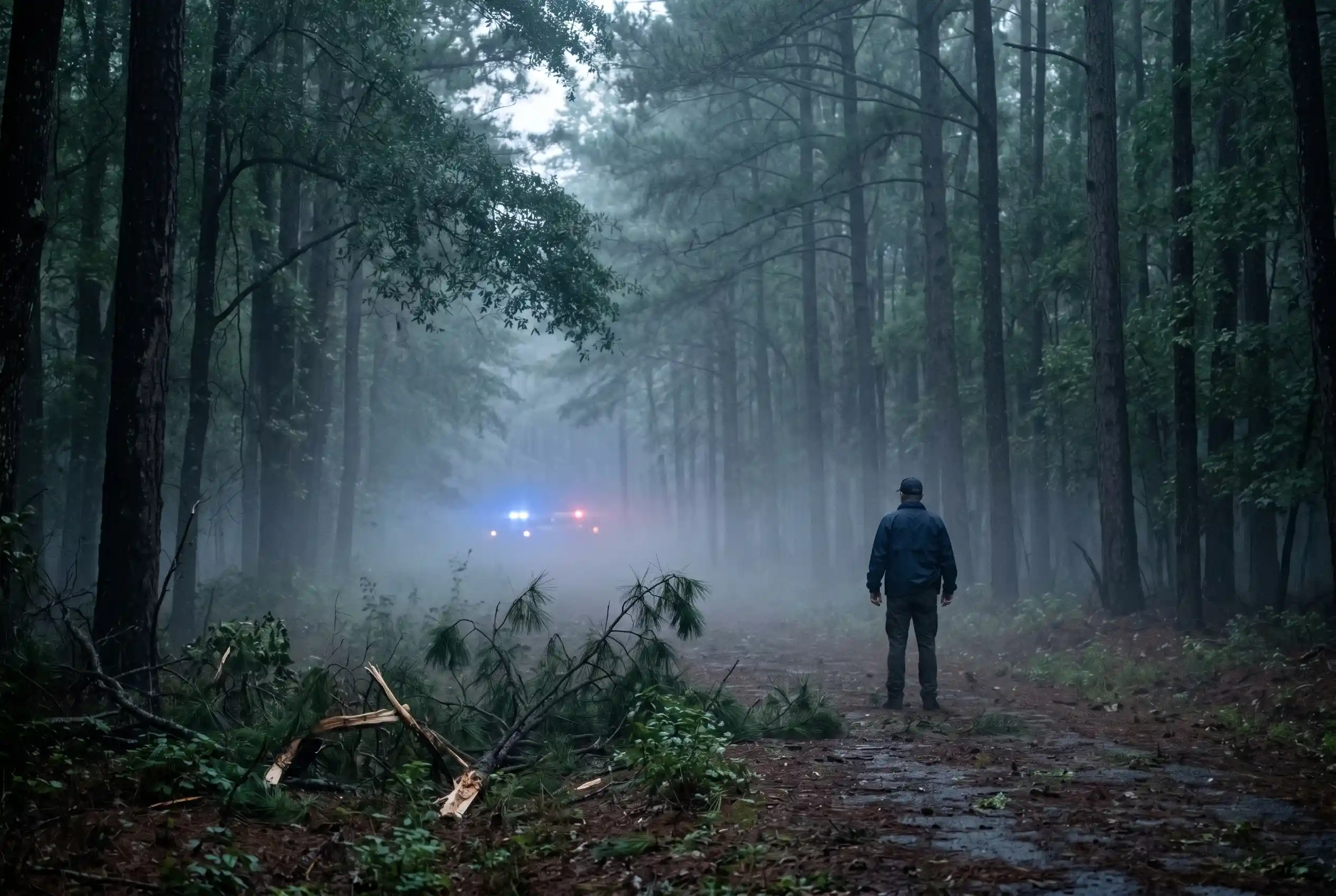
The Warning the Groom Gave Before Takeoff
The detail that has stayed with the family is that the groom saw it coming. Dave Fiji flew for a living, and he told his father he had questioned whether the conditions were safe before they ever left the ground.
Since my son was a pilot, he told the pilot that there is zero visibility and when there is zero visibility like this, we never fly.
That is George Fiji, the groom’s father, recounting the exchange to ANF through his widowed daughter-in-law. By the family’s account, the pilot answered the concern by saying they would simply fly at a higher altitude to get above the murk. The weather that night brought rain and fog across the north Georgia foothills.
Climbing higher does not fix the core problem in low visibility. Once a pilot loses sight of the horizon and the ground, altitude alone does nothing to keep the aircraft upright; the eyes stop giving reliable cues and the body starts inventing them. The groom’s instinct to stay grounded reflected exactly the call professional crews are trained to make. His father said the loss has been bearable only through the family’s faith, describing a perfect wedding that turned to catastrophe within hours.
What the NTSB Has and Hasn’t Determined
The National Transportation Safety Board (NTSB, the federal agency that investigates civil aviation accidents) is leading the inquiry, and as of its first update the work was still in the on-scene phase. Investigators said all major components of the helicopter had been located in the debris path, with documentation of the systems and engine still to come.
No cause has been assigned. The board has been explicit that the family’s reports of poor weather do not amount to a finding. A preliminary report is expected within about 30 days, with a final report assigning probable cause likely 12 to 24 months out, the timeline typical for fatal-crash investigations.
Several organizations are formal parties to the probe, each covering a piece of the aircraft and operation:
| Party | Role in the investigation |
|---|---|
| NTSB | Lead agency; determines probable cause |
| Federal Aviation Administration (FAA) | Airworthiness and flight-operations oversight |
| Robinson Helicopter Company | Airframe manufacturer |
| Rolls-Royce | Engine manufacturer |
| Prestige Helicopters | Operator of the flight |
| Dawson County Sheriff’s Office | Scene security and recovery |
Investigators will pull weather data for the route, any radar and recorded communications, the pilot’s qualifications and recent flight history, and the engine and rotor components once the wreckage is moved to a secure facility. Whether the helicopter carried the equipment and the pilot the ratings to legally fly in those conditions is among the first questions they will work.
A Pattern Federal Investigators Know Well
Strip the names away and the shape of this accident is one the safety board has seen many times: a helicopter cleared to fly only by outside visual reference, pushing into rain, fog or darkness where those references vanish. The aviation phrase is VFR into IMC, visual flight rules giving way to instrument meteorological conditions. It is one of the deadliest sequences in general aviation.
When the Horizon Disappears
Without a visible horizon, a pilot’s inner ear can feel level while the aircraft is banking, or feel a turn that is not happening. That is spatial disorientation, and it kills quickly. The numbers from the FAA and NTSB are blunt:
- 5% to 10% of general-aviation accidents involve spatial disorientation, and roughly 90% of those are fatal, per the FAA’s safety briefings on the specifics of pilot spatial disorientation.
- 184 deadly U.S. aircraft accidents were tied to spatial disorientation between 2010 and 2019.
- About two-thirds of general-aviation accidents in reduced-visibility weather end in death.
The most public example was the January 2020 crash that killed Kobe Bryant and eight others. The safety board found the pilot, flying under visual rules, became disoriented after entering clouds and lost control. In its finding on that disorientation-related helicopter crash, the board pressed again for better training and equipment on aircraft that fly visually into bad weather.
The R66’s Accident History
The aircraft itself is a workhorse of the charter and tour business. Robinson’s R66 is a five-seat turbine single, and the company’s technical specifications for the R66 Turbine show why it sells: it is comparatively cheap to buy and run. It also carries a teetering two-blade main rotor, a design that aviation databases and past NTSB work have linked to in-flight breakups when handled abruptly. Independent crash databases list more than 30 R66 accident investigations since the model entered service in 2011, with multiple fatal. None of that establishes a cause here. It is the backdrop against which this investigation will be read.
Who Dave and Jesni Fiji Were
The couple met through church connections between South Carolina and Georgia, friends who decided to become life partners, as the groom’s father put it. The groom had wanted to fly since he was 10. He went on to fly for Endeavor Air, the regional carrier that operates as a wholly owned Delta Connection subsidiary, joining in March 2025 as a first officer based in Atlanta.
In a note to staff, Endeavor said its first officer had died in a helicopter accident shortly after celebrating his wedding, and that the loss of a colleague would be felt hard by those who knew him. His wife, a nurse, knew at once on Saturday morning that her husband was gone; the family says she is slowly recovering.
For now the wreckage has been documented and the components catalogued, and the rest waits on lab work and weather records. The preliminary report, due within about a month, will lay out the facts the board has gathered without naming a cause. The answer to the question the bride asked when she woke, what happened, will take far longer than that.