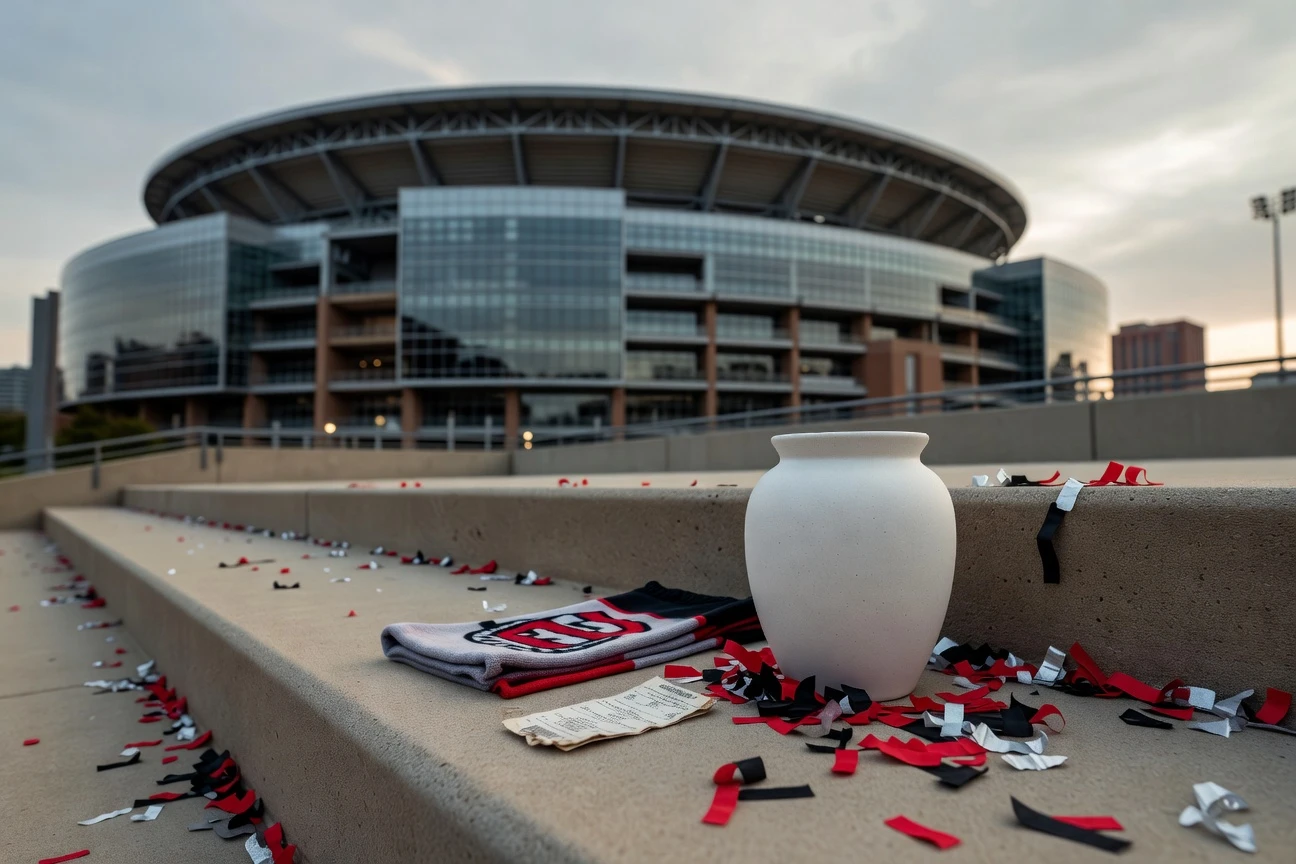
Mercedes-Benz Stadium ranked first in a Georgia stadium ashes survey that asked U.S. sports fans where they would want their cremated remains scattered if they could choose a venue. The national stadium ashes survey by SportsbookReview.com polled 3,000 fans and put Atlanta venues ahead of Sanford Stadium in Georgia.
The funny part is obvious. The useful part is harder. A wish like that turns fandom into a question for families, funeral directors, venue managers and lawyers, because the place fans love most is almost always private property with cameras, field rules and a game calendar.
Atlanta Venues Beat the College Shrine
Georgia’s list starts in downtown Atlanta, not Athens. Mercedes-Benz Stadium, home to the Atlanta Falcons and Atlanta United, topped the state ranking, followed by State Farm Arena, Sanford Stadium and Truist Park. That order says plenty about modern Georgia sports life: pro venues in the capital now compete with the older pull of college football.
The choices also cut across four different kinds of memory. One building carries Falcons Sundays and Atlanta United crowds. One holds Hawks seasons and concerts. One is tied to Georgia Bulldogs Saturdays. One is bound to Braves October baseball, including the title that ended a long wait for Atlanta baseball fans.
| Georgia Venue | Usual Home Team | Memory Cue | Why It Ranked |
|---|---|---|---|
| Mercedes-Benz Stadium | Falcons and Atlanta United | Big-event Atlanta | Retractable roof, soccer crowds, football Sundays and downtown visibility |
| State Farm Arena | Atlanta Hawks | City basketball | Downtown location, renovated arena feel and years of Hawks loyalty |
| Sanford Stadium | Georgia Bulldogs football | Between the Hedges | College tradition, family trips, rivalries and championship-era memories |
| Truist Park | Atlanta Braves | October baseball | Braves identity, The Battery and the club’s recent championship glow |
The surprise is not that Sanford made the list. The surprise is that two Atlanta buildings came before it. In a state where college football can feel like civic religion, the survey suggests that daily geography still matters. More people pass through Atlanta’s biggest venues for games, concerts and shared city rituals than make the drive to Athens.
The Rankings Follow Memory, Not Capacity
The survey did not ask fans to choose the best stadium architecture or the loudest crowd. It asked for a final symbolic location. That wording changes the answer. Capacity helps, but only if the building already carries memory. The venue has to feel like a place where a person’s family would understand the choice.
SportsbookReview.com reported that fans gave emotional reasons more often than practical ones. The top responses were about people and repetition, not seat width, parking or concessions. A field becomes powerful because a parent took a child there, a friend group met there every season, or a team got woven into a family’s calendar.
- 26% cited emotional memories tied to family, friends or childhood.
- 25% pointed to lifelong loyalty to a team.
- Almost two-thirds said they would choose the field or court itself if they could pick the exact spot.
That last detail is the operational headache. Fans are not imagining a quiet corner outside a gate. They are imagining the central stage, the turf, the court, the dirt, the place TV cameras point toward. Sentiment heads straight for the most protected part of the building.
Cremation Made the Question More Plausible
The poll works because cremation has moved into the American mainstream. The National Funeral Directors Association (NFDA, a trade group for funeral professionals) said the U.S. cremation rate was projected to reach 63.4% in 2025, more than double the burial rate of 31.6%, in its latest cremation and burial report.
The Cremation Association of North America (CANA, an industry group that tracks cremation data) gives the same broad direction. Its annual cremation statistics put the U.S. cremation rate at 61.8% in 2024 and project 67.9% by 2029. Once ashes are portable, families start thinking beyond cemetery rows.
That does not make a stadium request normal, but it makes it imaginable. Burial fixes a body to a plot. Cremation lets a family separate the ceremony, the storage and the final act. Some people keep an urn at home. Some divide remains into keepsakes. Some pick water, mountains, gardens or a place where the deceased felt most alive.
In that context, a stadium wish looks less like a prank and more like a modern memorial choice with terrible logistics. The fan is choosing a story. The family has to figure out whether the story can be told without breaking rules.
Venue Operators Inherit the Hard Part
Stadium managers spend their lives controlling access. They decide what bags enter, who gets field credentials, where cameras can go and how quickly a surface must be ready for the next event. Ash scattering adds a new category: private grief in a public entertainment building.
Mind Cron has covered other ways fan experience can collide with venue control, from live AI facial scans at football matches to policy fights that put spectators inside the business of college sports. This case is softer, but it still turns on the same gatekeeping power.
For a venue, even a sympathetic request creates several decisions at once:
- Access: Whether a family can enter a field, court, warning track or seating bowl outside normal public hours.
- Surface care: Whether ashes could affect turf, hardwood, grass, dirt, drainage systems or cleaning protocols.
- Precedent: Whether allowing one family creates pressure to allow many more.
- Public health and comfort: Whether other guests, workers or players would object to human remains in a shared space.
- Documentation: Whether the venue needs written permission from the person legally authorized to handle the remains.
There is also the awkward issue of secrecy. The survey found that nearly one in four respondents would consider scattering ashes at a stadium even if it was not allowed. That is a warning sign for venues. A hidden act may feel romantic to a family, but the same act can look like trespassing or contamination to the property owner.
Georgia Law Leaves Permission at the Center
Georgia does not offer fans a special sports exception. The state guide for consumers, published by Georgia’s Department of Human Services, lists several options for cremated remains, including urns, cemetery scattering gardens and scattering on private property if the owner gives permission. The same Georgia funeral and cremation guide also says remains scattered on private property must not be distinguishable to the public.
That puts stadiums in a simple legal category before the emotions start. Mercedes-Benz Stadium, State Farm Arena, Sanford Stadium and Truist Park may feel public because crowds gather there, but the relevant spaces are controlled by owners, operators, teams, universities and event contracts.
Permission is the hinge. A family that wants a legal, respectful ceremony should ask the venue, not rely on a quiet handful of ashes during a tour or after a game. If the answer is no, there are still ways to honor the same bond: a brick program, a scoreboard message, a memorial bench nearby, a tailgate gathering, a donation in the fan’s name or a family trip to a game with the urn left at home.
That may sound less dramatic than a scattering on the field. It is also far less likely to leave relatives carrying grief and a security dispute at the same time.
Sanford Stadium Shows the Old Pull
Sanford Stadium is the emotional counterweight to Atlanta’s big buildings. The University of Georgia says Dooley Field at Sanford Stadium opened in 1929, seats 93,033 and is known for the hedges that frame the football field. The school also notes that the venue has ranked among the country’s top college football attendance draws for decades.
That is why its third-place finish needs care. A statewide sample may place Atlanta first, but the depth of attachment in Athens is different. Georgia football is often inherited. Fans remember the drive, the tailgate, the walk through campus, the sound from the student section and the feeling of watching a season turn inside a single Saturday.
College sports also carry family identity in a way pro teams sometimes do not. A person may have attended the university, married into a Bulldogs household, or grown up with fall weekends organized around kickoff. Mind Cron’s coverage of the college sports bill debate involving fans showed how quickly policy can move from athletes and schools to the people in the stands.
That helps explain the survey’s wider Southern pattern. Alabama fans leaned toward Bryant-Denny Stadium. Tennessee fans also favored college football settings. In much of the region, the stadium is not a neutral arena. It is the family archive with a scoreboard.
The New Ritual Has Limits
The Georgia results catch a real shift in how Americans think about place, death and sports. Cremation gives families more choices. Modern venues give fans more shared experiences. Social media gives people more permission to say the morbid thought out loud.
But the cleanest version of the wish still needs consent. A stadium can be a symbolic home without becoming a cemetery. That distinction protects the family as much as the venue, because a memorial should not depend on sneaking past a gate, hoping a camera misses the act or asking survivors to handle a rule they do not understand.
If teams ever choose to create formal memorial programs, the demand is already visible. If they do not, Georgia fans still have plenty of legal ways to make a final game-day memory. The field may be the dream spot, but the bond was never only in the grass.