Georgia Southern University’s Division of Continuing and Professional Education (CPE) runs an adult travel program called Travel With Purpose that requires no university enrollment to join. In November 2025, it sent twenty participants to Tuscany for eleven days, including John Taylor of Savannah, who had already visited 33 countries and lived in Europe for three years before the trip. He came home and registered for the group’s Tuscany return this coming November.
The program, spanning day outings in Coastal Georgia and the Lowcountry up to multi-week international journeys, operates inside a global educational tourism market that IMARC Group, a market research firm, valued at $519.9 billion in 2025.
What Travel With Purpose Covers
Georgia Southern’s CPE structures the program across four tiers of travel access, each targeting a different geographic radius and level of commitment. All four are built for adult learners rather than students completing degree requirements, and no academic credit or university transcript entry comes with any trip.
| Tier | Geographic Range | Format |
|---|---|---|
| Local Day Trips and Cultural Outings | Coastal Georgia and the Lowcountry | Art exhibits, historical sites, culinary tours |
| Regional Getaways | Southeast United States | Weekend and multi-day trips to cities and cultural festivals |
| National Adventures | United States | Guided programs at iconic historical and cultural locations |
| International Journeys | Global | Curated multi-week experiences, including Rome and Tuscany |
A retiree, a first-time international traveler, and a Georgia Southern alumnus all sign up on the same terms. Upcoming departures are published on Georgia Southern’s CPE travel programs page and through the division’s email newsletter.
CPE’s program descriptions position Travel With Purpose within the division’s personal-enrichment offerings, which it runs alongside professional-development courses and workforce training. Over the past year, three distinct trips covered the program’s full range: a December holiday visit to Biltmore Estate in North Carolina, an April day route through three eastern Georgia counties following Sherman’s Civil War march, and the November Tuscany excursion.
A Gilded Age Holiday at Biltmore Estate
The December trip brought a CPE group inside Biltmore Estate, the 250-room French Renaissance chateau in the Blue Ridge Mountains outside Asheville, North Carolina. Completed in 1895 for George Washington Vanderbilt II (grandson of railroad magnate Cornelius Vanderbilt), it’s the largest privately owned home in the United States. Vanderbilt modeled it after three Loire Valley chateaux he had toured in France, commissioning architect Richard Morris Hunt to design the structure. Its 70-foot Banquet Hall ceiling and 10,000-volume Library sit improbably in the southern Appalachian landscape.
CPE organized the visit as a private tour and candlelit dinner of the chateau. Poinsettias and Victorian ornaments filled the rooms; singing carolers moved through the corridors. Travelers praised the tour guide’s historical knowledge and described the holiday atmosphere as the standout element of the evening.
Biltmore is open year-round to general admission through self-guided public ticketing. The private-dinner format CPE built into the December itinerary sits outside that standard access and required a group reservation the estate accommodates for private parties.
Tracing Sherman’s March Through Three Counties
April’s trip was a day route through Emanuel, Jenkins, and Burke Counties in eastern Georgia, following the actual roads used by Union forces during General William Tecumseh Sherman’s March to the Sea in late 1864. The guide was John Derden, Ph.D., professor emeritus of history at the East Georgia Campus, who led the group through authentic wartime landmarks and county roads still passable along their original alignments. Derden has studied the route for decades.
The tour concluded at the 42-acre Confederate prison at Camp Lawton in Jenkins County, now within Magnolia Springs State Park near Millen. Sherman’s advance forced the camp’s evacuation barely six weeks after it opened in October 1864.
- 42 acres: the stockade’s total area, making it the world’s largest prison during its brief 1864 operation
- 10,299+: Union prisoners held at peak occupancy, many transferred from the overcrowded facility at Andersonville
- ~200: Civil War artifacts recovered by Georgia Southern archaeology students during a single 2010 excavation at the site
That 2010 excavation used watercolor maps drawn in 1864 by Union prisoner Private Robert Knox Sneden to locate the stockade’s position underground. Georgia Southern’s Sociology/Anthropology Department has been excavating the site for years since, and the park’s History Center now displays artifacts the university’s teams recovered. The county roads through Emanuel and Burke that the CPE group drove in April are the same routes Sherman’s forces used in November 1864, a geographic continuity that few Civil War march corridors in the Southeast still offer intact.
Attendees cited Derden’s county-by-county historical command as the trip’s highlight.
Eleven Days in Tuscany
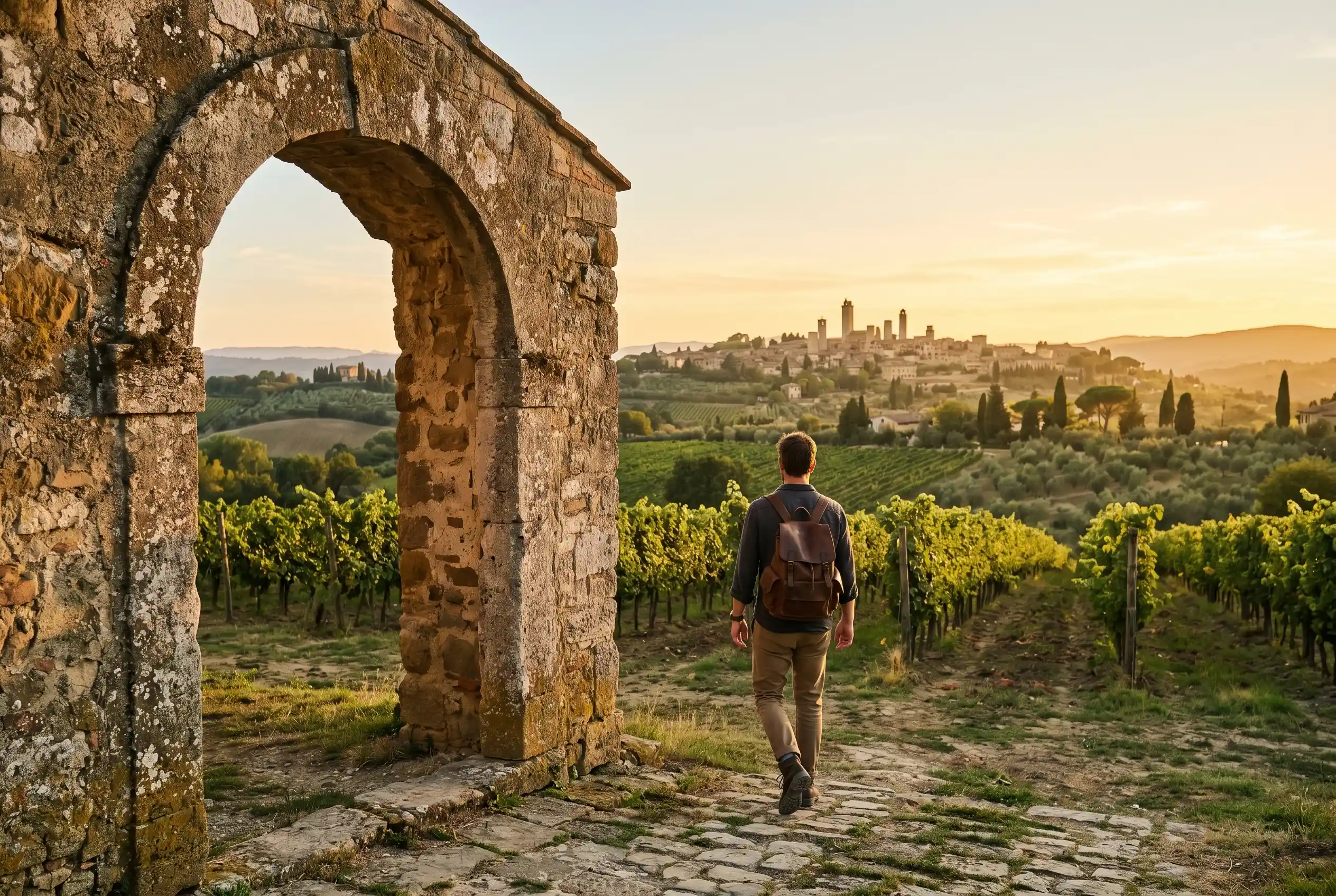
The November 2025 excursion, called “Taste, Tour, and Learn,” took twenty participants to Tuscany for eleven days. The region carries a specific historical density: Florence as the birthplace of the Renaissance, Siena as a surviving medieval city-state, and the Chianti hills as one of Europe’s oldest continuous wine-producing territories. CPE designed the itinerary around private access, the kind that commercial tour groups operating at scale rarely reach.
Included in the eleven days: a private tour and wine tasting at the Lornano winery, a family-owned Chianti Classico estate near Siena whose cellars date to the 15th century, and a private tour of the Santa Maria del Fiore Cathedral in Florence. Known informally as the Duomo, the cathedral’s dome was designed by Filippo Brunelleschi and completed in 1436. The group also attended Italian language lessons, Tuscan cooking courses, and guided visits to Siena and the surrounding countryside.
The Santa Maria del Fiore draws millions of visitors annually under standard touring conditions. Private interior access outside normal visiting-hour queues is the kind of arrangement that requires institutional contacts rather than a walk-up ticket window. The same logic applied to the Lornano estate: a dedicated private tour and tasting at a working 180-hectare vineyard rather than a standard public tasting room session.
Taylor, returning home after the November trip, offered a brief assessment:
Tuscany is one of the most beautiful places on Earth.
He said this having visited 33 countries. He’s going back with the CPE group this November.
Adult Educational Travel Is Growing Fast
The Market Behind the Numbers
Most coverage of educational tourism focuses on the 16-to-25 demographic: study-abroad semesters, language immersion courses, international internships. That bracket holds roughly 40% of global market volume, according to IMARC Group. The sector is large enough to hold multiple audiences simultaneously, and adult and lifelong learners are growing inside it as a distinct cohort, one that market research firms track separately in age-group segmentation analyses.
IMARC Group values the global educational tourism market at $519.9 billion in 2025 and projects it reaching $1.308 trillion by 2034, at a 10.48% compound annual growth rate. InsightAce Analytic, running a forecast window through 2035, puts the CAGR at 13.6%. North America holds a 28.8% global market share in 2025, which IMARC attributes to the region’s established education infrastructure and what the firm describes as a growing preference for experiential learning among adults.
Where University Programs Fit
Commercial tour operators build their economics around volume: standardized itineraries, large groups, high-traffic destinations. Private access to a chateau’s candlelit dinner, a working winery’s 15th-century cellar, or a battlefield’s active archaeological excavation doesn’t fit that model efficiently. University continuing-education divisions can negotiate that access through institutional relationships a travel agency typically can’t build from a booking catalog.
Georgia Southern’s CPE draws on its own faculty connections for on-site expertise. The April Sherman’s March trip was led by a historian who had studied that specific route and its wartime sites for decades. The Tuscany program ran through institutional contacts that produced private access to a cathedral and a working Chianti estate, experiences participants with extensive international backgrounds described as the itinerary’s differentiating element.
Per Georgia Southern CPE’s program descriptions, the program is open to any adult regardless of university connection or prior travel experience, a structural choice the division has built in by design.
Seville in 2027, Tuscany Again in 2028
CPE announced two further international departures following the Tuscany trip’s reception. Seville, Spain is scheduled for 2027; a return to Tuscany for 2028. Seville fits the pattern of historically layered destinations CPE has favored. The city’s monuments include the Alcázar palace complex, whose origins trace to a 10th-century Moorish palace, and the Cathedral of Seville, the largest Gothic cathedral in the world by floor area. The Alcázar, the cathedral, and the adjacent Archivo de Indias (which holds Spain’s primary documentary record of its Americas exploration) share a single UNESCO World Heritage Site inscription covering the city’s old quarter.
Both trips will be open to all adults through Georgia Southern’s CPE enrollment, with no university affiliation required. Taylor is already registered for the group’s Tuscany return this November, ahead of either future departure.