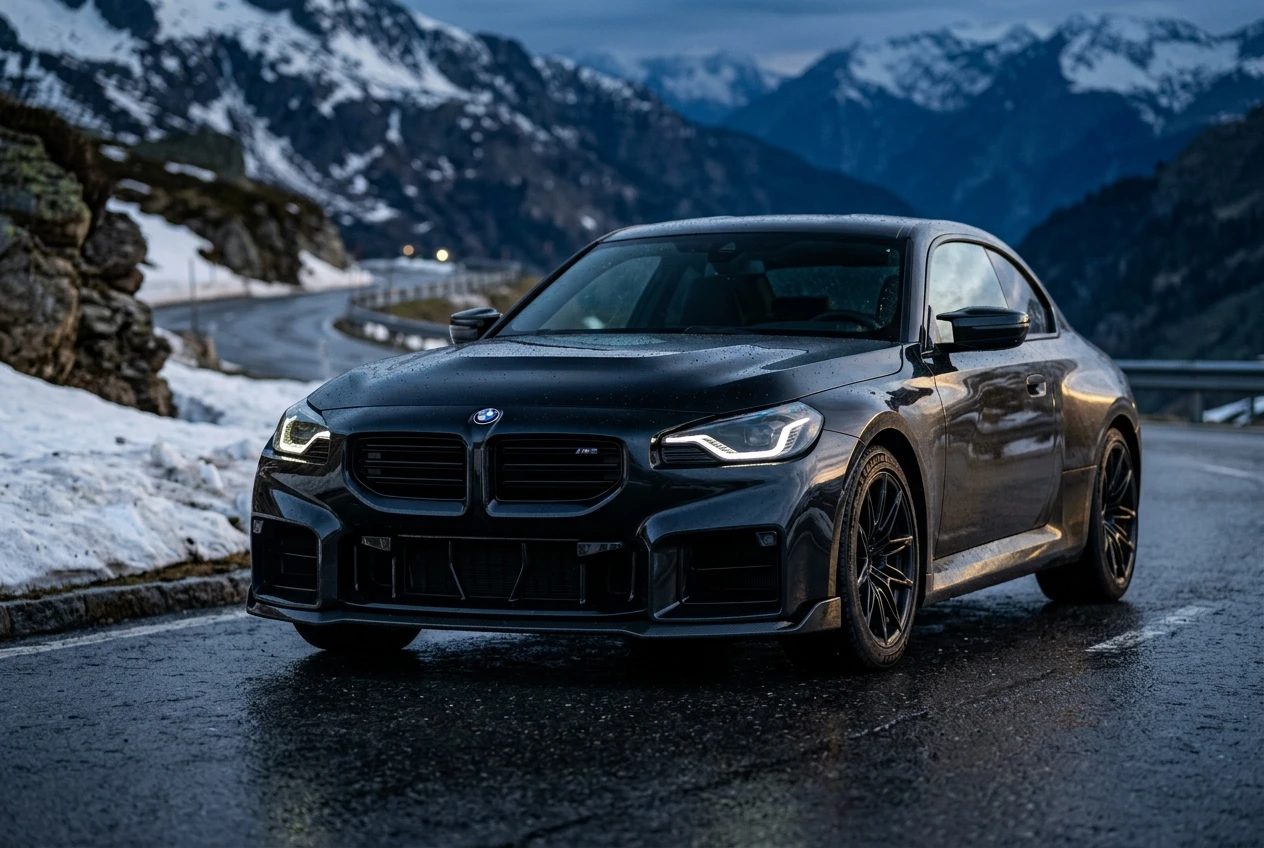
BMW M GmbH revealed the M2 with M xDrive on June 3, adding all-wheel drive to the compact sports coupe for the first time in its history. US base price is $73,600, the 0-60 mph time drops by 0.3 seconds to 3.6 seconds in US spec (3.7 seconds to 100 km/h in European trim), and production starts in August at BMW Group Plant San Luis Potosí in Mexico.
Until that announcement, the G87 M2 was the last BMW sold exclusively in rear-wheel drive. BMW M ruled out AWD for the G87 when it introduced the car in 2023. The xDrive variant arrives three years later anyway, equipped with a 2WD mode that routes all power to the rear axle and disables stability control on the driver’s command.
The xDrive Setup on the G87
The M xDrive system uses an electronically controlled multi-plate clutch in the transfer case to divide the 3.0-litre straight-six’s output between front and rear wheels. Rear bias is the default. Under normal conditions, all the torque goes rearward, and the front axle steps in only when the rears can’t put any more power down. That’s the same rear-biased architecture BMW M uses in the M3, M4, and M5.
The transfer case control unit is specific to the M2, developed separately from the M3 and M4 hardware, per the BMW Group Canada official launch press release. It manages wheel slip limitation independently of the central DSC (Dynamic Stability Control) management. When the rear wheels slip and the system needs to add front grip, the transfer case handles the request on its own rather than routing it through DSC. BMW says this makes the engagement process faster and keeps the car feeling settled in hard driving.
Three modes are available through the M Setup menu: 4WD, 4WD Sport, and 2WD. The 4WD Sport setting shifts more torque rearward and tolerates more rear slip before the front axle engages, making it the relevant choice on a track. In 2WD with stability control fully deactivated, all power goes to the rear wheels and the car operates exactly as the standard RWD M2 does. At the rear, the Active M Differential distributes torque variably between the rear wheels, the same unit that ships on the rear-drive car.
BMW developed a model-specific chassis tune for the M2 with M xDrive, adjusting the front-axle geometry to accommodate the driveshafts and tuning the springs and dampers separately from the rear-drive car. BMW says the revised setup was calibrated to preserve the compact, agile handling character despite the added weight.
- 480 hp (European spec): S58 3.0-litre straight-six output, unchanged from the rear-drive M2
- 3.7 sec (0-100 km/h): 0.3 seconds faster than the rear-drive automatic (3.6 sec to 60 mph in US spec)
- 3,988 lbs (US curb weight): roughly 174 lbs heavier than the manual rear-drive M2
- 2WD mode: routes all torque to the rear axle with DSC off, selectable from the M Setup menu
Two Spark Plugs per Cylinder
The xDrive system is the headline, but the engine is running a significant update alongside it. BMW M Ignite, a pre-chamber combustion process patented by BMW in 2024 and detailed on the official BMW M website, enters production with the new drivetrain. It’s being introduced across all straight-six M engines from mid-2026 onward: the M3 and M4 receive it in July, the M2 in August.
Each cylinder gets two ignition setups: a conventional spark plug in the main combustion chamber and a pre-chamber with its own dedicated spark plug and ignition coil. At low and medium revs, the standard plug leads. At high revs and under load, the pre-chamber takes over. The fuel-air mixture is channelled into the pre-chamber first, where it ignites. Those flames then exit the pre-chamber and strike the main combustion chamber from multiple directions simultaneously.
These ignition jets then ignite the mixture in the main combustion chamber above the piston at multiple points at the same time. The result is a significantly higher combustion speed.
BMW says the efficiency gain is most visible on track days, where drivers run the engine hard for extended stints. More laps per tank is the practical result. Alongside the pre-chamber ignition, the engine also receives a higher compression ratio and turbochargers with variable turbine geometry.
Euro 7 (EU7) emissions standards take effect in November 2026, and M Ignite is BMW’s mechanism for keeping the engine legal past that deadline without cutting power output. Pre-chamber combustion isn’t a BMW invention from scratch: Maserati’s Nettuno V6 has used a similar turbulent jet ignition system since 2020, and the concept traces to Formula 1’s hybrid era from 2014. BMW’s implementation carries its own patent, granted in 2024.
One significant caveat: US-market M2 xDrive models do not receive the M Ignite system. European buyers get the pre-chamber technology; American buyers receive the same engine tune the standard M2 carries, rated at 473 hp and 443 lb-ft of torque.
What the Specs Sheet Splits
The xDrive costs $4,225 more than the rear-drive M2 and is automatic-only.
| RWD M2 | M2 with M xDrive | |
|---|---|---|
| US Base Price | $69,375 | $73,600 |
| 0-60 mph (US) | 3.9 sec (auto) | 3.6 sec |
| Transmission | 6-speed manual or 8-speed auto | 8-speed auto only |
| BMW M Ignite | No (for now) | Yes (Euro spec) |
| Top Speed | 155 mph / 177 mph (M Driver’s Package) | Same |
The six-speed manual is absent from the xDrive car entirely. Per the official BMW USA M2 product page, the M2 M xDrive Coupe is available only with the 8-speed M Steptronic Sport automatic. Anyone who wants three pedals buys the rear-drive car. The BMW M3 CS Handschalter’s $107,100 send-off illustrated the same policy: BMW M reserves the manual option for rear-wheel-drive variants only.
The xDrive car is 0.3 seconds quicker to 60 mph than the RWD automatic and roughly 174 lbs heavier than the manual car in US spec. That weight sits primarily in the transfer case, the front driveshafts, and the revised front suspension. Top speed stays the same: 155 mph on the standard limiter, 177 mph with the optional M Driver’s Package on both variants.
The Last Pure M Car
The M2 was BMW M GmbH’s best-selling high-performance model in 2025, outselling the M3, M4, M5, and every M-badged SUV in the portfolio. In BMW’s global lineup, AWD has become the dominant drivetrain across most segments. The M2 was the deliberate exception, and its sales confirmed that a meaningful buyer segment still wanted a small, rear-wheel-drive sports car with a manual gearbox.
The lineage helped. The F87 M2, the first generation, launched in 2016 and sold more than 60,000 units over seven years, making it the best-selling M car in the company’s history at the time. The current model continued the run, again outselling every other M car. BMW M had built a formula: compact footprint, rear-wheel drive, twin-turbocharged straight-six, optional manual, and an entry price sitting below the M3. It worked, and the M2 became BMW M’s shorthand for compact rear-drive tradition, tracing back to the original 2002 Turbo and, more directly, the E30 M3.
When BMW M presented the G87 in 2023, executives told media the M2 would stay rear-wheel-drive only. Three years later, the company reversed that position without explaining why. The target markets for the xDrive car, USA, Germany, and China, suggest the answer. Cold-climate buyers in the US and Germany have historically chosen AWD out of practical necessity; China’s market shows a broad preference for all-wheel-drive across segments. The xDrive variant reaches all three buyer groups.
The timing also followed a catalogue change. Until spring 2026, the BMW Z4 G29 roadster shared the M2’s exclusively rear-wheel-drive status. When BMW discontinued the Z4, the M2 became the last BMW in any segment sold only in rear-wheel drive. The xDrive announcement followed within months.
The M3 and M4 Ran This Script First
When BMW M introduced xDrive for the G80 M3 Competition and G82 M4 Competition in late 2021, it was the first time either nameplate had offered all-wheel drive. The response from the enthusiast community tracked closely with what the M2 is hearing now: concerns about weight, authenticity, and whether a car built around rear-wheel dynamics should gain a front axle.
The outcome settled those concerns. Both RWD and xDrive versions of the M3 and M4 now sell, the manual option stayed on the rear-drive cars, and the xDrive variants found their buyers among cold-climate drivers who wanted all-season capability. Per the BMW Group’s official M3 and M4 xDrive launch release, the M3 Competition with M xDrive reached 100 km/h in 3.5 seconds, 0.4 seconds quicker than the rear-drive automatic, for a weight penalty of roughly 100 lbs. The M2 xDrive’s acceleration gain for a comparable weight cost follows the same engineering logic, at a smaller scale.
BMW has preserved manual availability in limited-edition form where demand supports it. The US-only M3 CS Handschalter, a high-specification manual M3 at $107,100, is one recent example. The rear-drive M3 and M4 remain in production, and nothing about those cars changed when the xDrive variants launched alongside them.
A MotoGP Stage and an August Delivery Date
BMW chose to reveal the M2 with M xDrive at the MotoGP Grand Prix of Hungary at Balaton Park Circuit on June 3, presenting it as the prize for the 2026 BMW M Award, the annual trophy BMW M has given to MotoGP’s fastest qualifier every year since 2003. Carlos Ezpeleta, MotoGP’s Chief Sporting Officer, and Zsuzsanna Pocs, Head of Marketing at BMW Group Hungary, introduced the car at the circuit. Content creator Becky Evans and MotoGP rider Jorge Martin then took the car on track for what BMW called the BMW M Racing Balance challenge.
- Production start: August 2026 at BMW Group Plant San Luis Potosí, Mexico
- Market launch: Late summer 2026
- Primary markets: USA, Germany, China
- US pricing: $73,600 base; $74,950 with the $1,350 destination charge included
- Standard wheels: 19-inch front, 20-inch rear M light-alloy; track tyres optional
- Brakes: M Compound with six-piston fixed callipers front, single-piston rear
- New colour: BMW Individual Borusan Turkish Blue, appearing on any M2 for the first time
Switch to 2WD with DSC deactivated, and the xDrive M2 sends all 480 horsepower to the rear wheels, exactly as every M2 has since 2016.