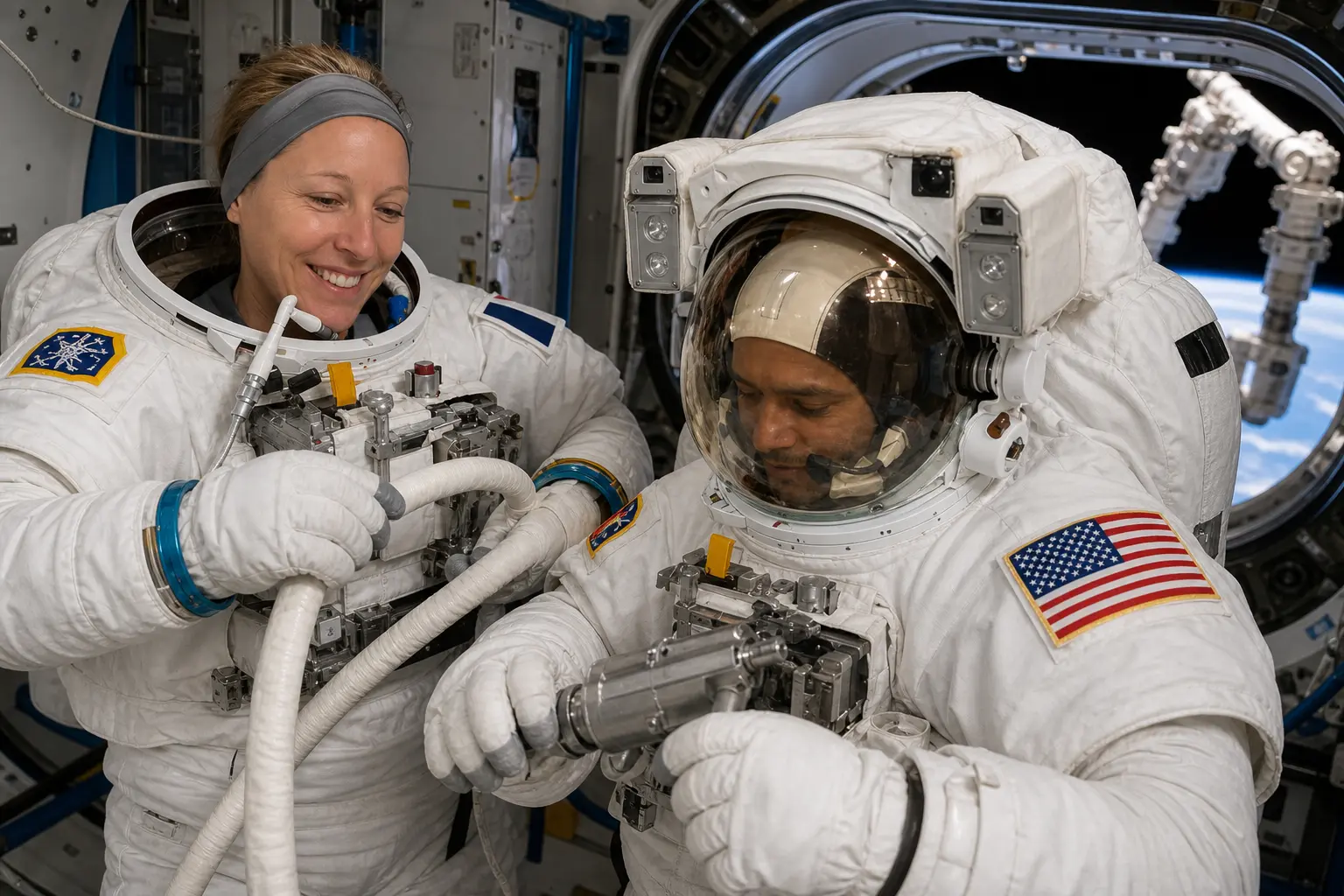
NASA astronaut Anil Menon and ESA astronaut Sophie Adenot will switch their spacesuits to battery power at 8:35 a.m. EDT on Tuesday, August 18, then exit the Quest airlock for a planned six-and-a-half-hour spacewalk to replace a failed high-speed space-to-ground antenna on the Z1 truss. The job, labeled U.S. Spacewalk 97, keeps Expedition 75’s focus on the external hardware that still holds the International Space Station together after more than a quarter-century of continuous occupation.
While the two spacewalkers finish final suit and tool checks, their Roscosmos crewmates continue virtual-reality balance tests and artificial-intelligence trials that look past the station’s current hardware toward longer missions.
How the Antenna Swap Will Unfold
Menon and Adenot will translate from Quest to the Z1 truss segment above the Unity module. They will remove the failed antenna, park it on an external stowage platform, retrieve the spare already waiting there, and bolt the new unit into place with its electrical and data connections.
- Menon rides the Canadarm2 latching end effector for part of the work.
- Adenot stays tethered to the truss and handles the bulk of the physical swap and connections.
- NASA astronauts Jessica Meir and Jack Hathaway support from inside, helping with suit donning and doffing and driving the robotic arm.
- Total planned duration is about six and a half hours.
The sequence matches the pattern used for earlier orbital replacement units: spare on the outside, failed unit returned to storage, new unit powered and verified before the hatch closes.
Each step depends on the one before it. The failed unit must be clear of the mount before the spare can seat. Electrical and data plugs go last so the crew can confirm a clean mechanical fit first. Only after power and signal checks does the team treat the swap as complete.
That order keeps the work site orderly and limits the time any connector sits exposed. It is the same logic that has governed external antenna and electronics swaps for years on the truss.
The Date Shift and the Antenna’s Job
Mission managers moved the excursion to August 18 after a carbon-dioxide sensor on Menon’s suit gave an unexpected reading near the end of the August 6 spacewalk he flew with Meir. That earlier outing lasted 6 hours 27 minutes and installed a modification kit on the Starboard 6 truss for a future roll-out solar array. Engineers cleared the sensor issue for the new date.
The antenna itself carries critical high-speed data and voice links between the station and Mission Control in Houston via the Tracking and Data Relay Satellite system. A failed unit slows science downlink, video, and real-time commanding. Spares have sat on external platforms for years precisely so crews can restore the link without waiting for a cargo flight.
Similar antenna work has appeared before. In late 2021 crews swapped an S-band antenna assembly under the same logic of pre-positioned orbital replacement units. The August 18 job is therefore less a crisis than the next scheduled chapter in the station’s external maintenance ledger.
The short delay between the two August EVAs also shows how managers weigh suit health against the communications backlog. Clearing the sensor first protected the crew. Moving the antenna job only twelve days still kept the high-speed link near the top of the external work list.
Two Firsts Outside the Hatch
For Adenot the spacewalk is her first. The French Air and Space Force colonel and helicopter pilot launched in February 2026 on her epsilon mission. When she steps outside she will become the first French woman to perform an EVA and only the second European woman after Samantha Cristoforetti in 2022. She will also be the first of those two to wear a U.S. Extravehicular Mobility Unit rather than a Russian Orlan suit.
Menon, an Indian-American physician-astronaut, already has one EVA under his belt from the August 6 power-system outing. Tuesday will be his second. Station commander Meir, a veteran of earlier spacewalks, and Hathaway will keep the internal choreography tight.
| Crew Member | Role on August 18 | Agency |
|---|---|---|
| Anil Menon | EV1, rides Canadarm2 LEE | NASA |
| Sophie Adenot | EV2, truss-tethered installer | ESA |
| Jessica Meir | IV support, suit help, robotics | NASA |
| Jack Hathaway | IV support, suit help, robotics | NASA |
On social channels Adenot has already framed the day simply: on 18 August it will be her turn to leave the Station. The French and European press have treated the milestone as national news while NASA has kept the tone operational.
The pairing pairs a second-time spacewalker with a first-timer on a well-rehearsed ORU swap. That mix lets Menon carry recent suit and truss familiarity while Adenot takes the primary installer role on the antenna itself.
Prep Week Inside the Station
Thursday brought the heaviest final checks. Menon and Hathaway confirmed suit function, refilled tanks, and topped off the liquid-cooling ventilation garment with water. Meir and Adenot studied the specialized tools required for the delicate electrical and data plugs. The four then held a call with mission controllers and robotics specialists covering safety, technical steps, and the fine points of arm motion.
Those Thursday spacesuit checks and tool reviews followed earlier tool organization inside Quest, cooling-loop cleaning, and procedure walkthroughs. On Wednesday the full seven-person crew ran emergency response training for pressure leaks, chemical leaks, and fire, using tablets and coordinating with the ground. The drill sits in the same family as the earlier Zvezda air leak shelter drill that sent crews into Dragon for contingency practice.
- August 6, Meir and Menon complete 6h 27m power-channel kit spacewalk; CO2 sensor anomaly noted.
- August 7, Managers slip the antenna EVA to August 18; third EVA still eyed for August 25.
- August 10-12, Tool staging, suit cleaning, procedure reviews, emergency drills.
- August 13, Final suit water fills, tool study, robotics coordination call.
- August 18, Target battery-power start 8:35 a.m. EDT.
The cadence is familiar to anyone who has watched the station’s external work calendar over the last decade: power upgrades one week, communications the next, always with spare ORUs already on the truss.
Suit water tops-offs and tool study on the same day keep the EVA crew synchronized. The joint call with robotics specialists then ties the internal support team to the same timeline the spacewalkers will follow outside.
VR Headsets and AI Tools on the Russian Segment
While the U.S. and European astronauts stayed locked on the EVA, flight engineers Pyotr Dubrov and Anna Kikina took turns in virtual-reality headsets. The long-running Virtual experiment presents computer-generated visual stimuli so researchers can measure how a crew member’s sense of balance and direction adapts to microgravity. Eye movements and responses feed data that will shape training and countermeasures for longer flights.
Kikina and Andrey Fedyaev also continued trials of artificial-intelligence tools intended to raise crew efficiency on future spacecraft. Dubrov ran an automated Earth-photography session during a sleep shift. The three cosmonauts rounded out the week with window inspections on Zvezda, Nauka, and Poisk plus routine maintenance.
The split schedule is deliberate. One half of the crew keeps the present station alive with wrenches and tethers. The other half collects the human-performance and autonomy data that will matter when the next stations are smaller, farther, or crewed by fewer people.
Last week’s spacewalk? Consider it a power-up for the Space Station. Up next: Another spacewalk is planned for Tuesday, Aug. 18. Astronauts will venture outside the orbiting laboratory to replace a space-to-ground communications antenna on the station.
NASA’s Johnson Space Center account put the back-to-back EVAs in those plain terms on X, drawing more than 500 likes and tens of thousands of views. The crowd reaction on the platform has been largely celebratory, especially around Adenot’s milestone and the rapid turnaround after the solar-array prep work.
Robotics and Ground Teams Close the Loop
Hathaway and Meir have spent hours studying the exact Canadarm2 robotic arm maneuvers that will place Menon at the work site and later help with stowage. Robotics specialists on the ground joined the Thursday conference to walk through every joint angle and translation path. The arm is both elevator and safety tether for the EVA crew.
Mission Control will watch suit telemetry, antenna signal strength after the swap, and the usual suite of station systems. Live coverage is expected on NASA and ESA channels beginning roughly an hour before the planned egress.
This is not exotic any longer. The station has flown hundreds of spacewalks. What still stands out is the steady pairing of heavy external work with the quieter internal experiments that keep feeding the design of whatever comes after.
- Canadarm2 places Menon at the Z1 work site and later assists stowage.
- Ground robotics specialists rehearse joint angles and translation paths with the IV crew.
- Mission Control monitors suit data and post-swap antenna signal strength in parallel.
- NASA and ESA channels plan live coverage from about an hour before egress.
How the August EVAs Compare Side by Side
The two spacewalks share a crew member, a support team, and a maintenance philosophy, yet they attack different systems on different truss segments. Laying the known details next to each other makes the turnaround clearer.
| Detail | August 6 EVA | August 18 EVA |
|---|---|---|
| Spacewalkers | Meir and Menon | Menon and Adenot |
| Duration | 6 hours 27 minutes | About six and a half hours planned |
| Work site | Starboard 6 truss | Z1 truss above Unity |
| Primary task | Modification kit for future roll-out solar array | Replace failed high-speed space-to-ground antenna |
| Internal support | Station team | Meir and Hathaway on suits and robotics |
Menon carries direct suit experience from the first outing into the second. Meir shifts from EV crew to IV lead. Adenot steps into the installer role on a task whose spare has already waited on an external platform. The third EVA still eyed for August 25 would extend the same external tempo if managers keep that date.
Power work one week and communications the next is the station’s long-running pattern. Pre-staged ORUs make that pace possible without a cargo flight between jobs.
What Continuous Repair Looks Like at 25-Plus Years
The International Space Station has never been a static outpost. Solar arrays have been added and rewired, pumps replaced, cooling loops patched, and antennas swapped whenever a unit ages out or fails. The August 18 job sits inside that same historical pattern: identify the failed ORU, pull the spare from external storage, install, verify, stow the old unit. Crews train for it on the ground for months and then execute it in six-hour blocks of careful motion.
At the same time the VR and AI sessions show the other half of the ledger. Balance data and efficiency algorithms matter more as planners look toward Artemis lunar missions and eventual Mars transit habitats. Long-duration ISS veterans moving to Artemis carry exactly this dual experience: they know how to fix the station that exists and how the next generation of tools will change the work.
By the time Menon and Adenot close the Quest hatch on Tuesday the station should again have a full high-speed link to the ground. The cosmonauts will keep logging VR trials and AI runs. And the external work list will already contain the next item, whether it is the eyed August 25 EVA or a later power or thermal task. That is how a laboratory this old stays useful: one carefully planned spacewalk and one quiet experiment at a time.