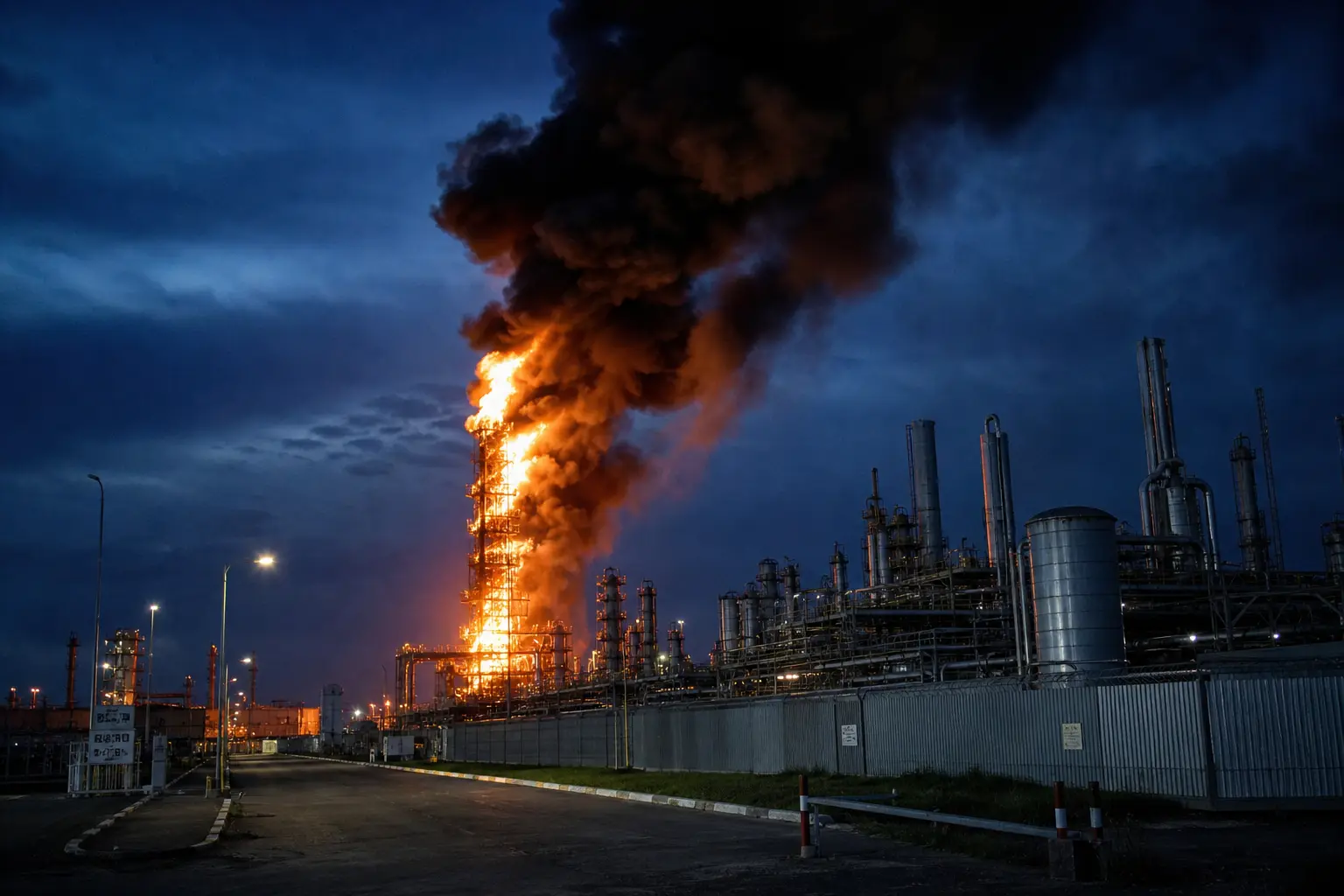
Ukrainian drones reached Russia’s Bashkortostan Republic on the morning of August 13, 2026, igniting fires at the Gazprom Neftekhim Salavat petrochemical complex and a Wildberries logistics facility more than 1,300 kilometers from the border. Local head Radiy Khabirov said debris from one drone fell in Salavat’s industrial zone and started a blaze. Independent outlet ASTRA and OSINT channel Exilenova+ identified the Gazprom site; Wildberries itself confirmed the second fire.
The same day paired a repeat strike on a major fuel and chemicals producer with another blow to a retail logistics network already missing roughly a fifth of its warehouse space. Both targets sit deep in the Russian rear.
That pairing matters because the two fires land on different parts of the same wartime economy. One site feeds fuel and chemical intermediates. The other moves consumer goods through a thinned warehouse web. Distance no longer keeps either category safe.
Fires Confirmed Across Two Industrial Sites
Bashkortostan authorities reported a Ukrainian drone attack and air-defense activity. Khabirov noted wreckage in the Salavat industrial area without naming the plant. ASTRA cited eyewitnesses and analyzed circulating video to place the fire at Gazprom Neftekhim Salavat. Exilenova+ posted images showing flames and smoke at the complex.
A separate strike hit a Wildberries site in the Chishminsky (Chishmy) district, inside an agro-park industrial zone. The company stated that an air attack caused a fire, that crews were on scene, and that the facility had been evacuated in advance. It added that no goods were stored there at the time.
No deaths were immediately reported at either location. Two civilians were later said to have been wounded in the broader incident according to some regional accounts. Footage circulated of multiple impact points and thick black smoke.
| Site | District detail | Immediate public status |
|---|---|---|
| Gazprom Neftekhim Salavat | Salavat industrial zone | Confirmed blaze; damage assessment open |
| Wildberries hub | Chishminsky agro-park zone | Fire; evacuated; no goods on site |
Local officials described air-defense work even as wreckage and successful impacts produced the fires on camera. The split between official caution on naming plants and open-source identification of both sites repeated a pattern already familiar from earlier deep raids.
Salavat’s Repeat Hits and What the Complex Makes
Gazprom Neftekhim Salavat is one of Russia’s largest integrated oil-refining and petrochemical sites. Design capacity is commonly cited near 10 million tons of feedstock per year; actual recent volumes have run lower, around 6.8-7.5 million tons in some reports, or roughly 2.7 percent of national refining. It turns out gasoline, diesel, jet fuel, fuel oil, bitumen, polyethylene, ammonia, urea and more than 150 other products.
The complex has faced Ukrainian long-range drones before. September 2025 brought two strikes within a week that damaged primary crude units. On July 14, 2026, another attack hit the main distillation installations, prompting a full halt of primary refining according to industry sources cited by Reuters and Ukrainian outlets. Secondary units and piping also suffered damage.
| Date | Target detail | Reported effect |
|---|---|---|
| May 2024 | Industrial zone, Salavat | Smoke, plant said operating normally |
| 18 Sept 2025 | ELOU-AVT-4 primary unit | Fire, unit damaged |
| 24 Sept 2025 | CDU-6 / primary unit | Fire, major capacity hit |
| 14 July 2026 | AVT-6 and AVT-4 units | Primary refining halted |
| 13 Aug 2026 | Industrial zone fire | Confirmed blaze, damage assessment open |
The plant’s structure includes a refinery, a monomer plant and a gas-chemical plant. The plant’s full hydrocarbon processing cycle feeds both domestic fuel markets and chemical intermediates. Repeated hits on primary distillation therefore cut more than one product stream at once.
Primary units sit at the front of that cycle. When they stop, downstream lines that make fuels and chemical feedstocks lose input even if those lines themselves escape direct fire. That is why successive strikes on AVT and related distillation gear matter more than a single storage-tank blaze would.
August 13 adds a fifth dated entry to a ledger that already runs from early industrial-zone smoke to repeated primary-unit damage. Open reporting has not closed the latest damage picture, yet the site’s history shows how quickly a confirmed fire can translate into constrained output.
Wildberries Network Already Thinned
Wildberries, Russia’s largest online marketplace, has absorbed a sustained drone campaign since mid-July 2026. More than 20 facilities across multiple regions have been reported hit. The company processes trillions of rubles in annual gross merchandise value and operates tens of millions of square meters of logistics space.
- Campaign start commonly dated to 18 July 2026
- Estimates of warehouse space damaged or out of service range from 17 percent to more than 25 percent of the reported total
- Fourteen or more large hubs totaling over 1.5 million square meters cited out of action in early August tallies
- Sellers’ goods stored in the network form a large share of the physical loss
The Bashkortostan strike adds another node roughly 1,300-1,400 km from Ukraine. OSINT accounts posted video of successive impacts and a large fire at the Chishminsky hub. Wildberries’ own statement confirmed the air attack and evacuation while remaining silent on the precise extent of structural damage.
Wildberries confirmation of the Bashkortostan fire matched the pattern seen at earlier sites: rapid evacuation claims, limited public detail on inventory, and visible flames captured by locals and monitoring channels.
A network that already reports roughly a fifth of its warehouse space damaged or offline cannot treat each new hub fire as an isolated local problem. Capacity lost in one region tightens routing options everywhere else the company still operates.
Sellers Carry the Bill
Direct reconstruction costs for damaged warehouses have been estimated by Forbes Russia analysts at roughly 70,000 rubles per square meter. Applied to more than a million square meters of affected space, rebuild figures climb into the tens of billions of rubles. The larger immediate hit falls on the thousands of third-party sellers whose stock sits in those halls.
Data Insight figures shared with Forbes put sellers’ potential losses from destroyed goods in the range of 215-280 billion rubles. That calculation drew on compensation patterns after earlier fires. Wildberries CEO Tatyana Kim has said the company is discussing voluntary assistance even though it may not be legally required to cover war-related losses. The Russian government has floated support measures for affected merchants.
Stats snapshot
- 215-280 billion rubles, estimated seller inventory losses (Forbes/Data Insight)
- 17-27 percent, range of Wildberries warehouse capacity reported damaged or offline
- ~1.5 million m², space cited out of operation in mid-campaign tallies
- 6+ trillion rubles, recent annual turnover scale of the combined RWB group
A detailed estimate of warehouse capacity lost underscores that the campaign is already large enough to force rerouting, longer delivery chains and higher insurance or rental costs. Competitors such as Ozon have adjusted contract language to limit their own liability for similar events. The retail backbone that filled the gap left by departing Western brands now operates under constant deep-rear risk.
Rebuild math and inventory math pull in different directions. Concrete and roofing can be priced per square meter. Goods already on pallets cannot. That gap is why seller losses dominate the headline range even when the platform stresses evacuation and empty halls at a given site.
Distance Changes the Map
Salavat and the Chishminsky district lie well beyond the ranges once considered practical for mass drone raids. Ukrainian forces have used long-endurance models, including Liutyi-type systems according to some monitoring reports, to reach Bashkortostan. The same overnight wave produced fires at both the energy complex and the retail hub.
Exilenova+ published Salavat oil refinery fire footage that spread quickly among open-source accounts. Other posts showed the Wildberries blaze from multiple angles, including views described as visible from space in later commentary. Russian air defenses claimed intercepts; debris and successful strikes still produced the confirmed fires.
Because of an air attack in Bashkiria, a fire broke out in the industrial zone where one of the company’s facilities is located. Fire crews are working at the scene. The facility was evacuated in advance in accordance with safety requirements. No goods are stored at the facility in question.
Wildberries said in its statement. The wording left open how much infrastructure itself was lost while emphasizing the absence of stock on site that morning.
On X, observers noted the sheer distance and the shift from pure energy targets to consumer logistics. Some pointed out that fiber-optic and related components still appeared available on the platform itself, an irony absorbed into wider discussion of dual-use supply chains. The cumulative effect is a rear-area war that reaches both the fuel that moves the army and the warehouses that move everyday goods.
Each kilometer of added reach widens the set of sites that must be watched, hardened, or repaired. Air-defense batteries and repair crews then face a longer list of priorities spread across republics once treated as deep sanctuary.
Why Distillation Damage Ripples Outward
Salavat’s product slate shows why primary-unit trouble does not stay inside one workshop. Gasoline, diesel and jet fuel share the front end of the same processing chain with polyethylene, ammonia, urea and scores of other outputs. A halt at distillation starves more than one market at a time.
Earlier waves already illustrated the mechanism. The September 2025 pair of strikes damaged primary crude units within a single week. The July 14, 2026 attack on AVT-6 and AVT-4 brought a reported full stop to primary refining, with secondary units and piping also hurt. August 13 reopens that pressure before public assessments have closed.
- Design scale near 10 million tons of feedstock per year
- Recent throughput cited around 6.8-7.5 million tons
- Share of national refining put near 2.7 percent in some reports
- Integrated chain linking fuels to chemical intermediates
Those figures frame the plant as both a regional employer and a national-system node. Even partial constraints matter when the same complex has already absorbed multiple long-range hits inside a year.
Repair timelines remain opaque in open sources. What is clear is the repeated focus on the units that unlock the rest of the site. That focus turns each confirmed industrial-zone fire into a question about gasoline, diesel and feedstock availability, not only about local smoke.
Retail Logistics Now Share The Rear Risk
The Wildberries campaign compresses a different kind of pressure into the same deep map. More than 20 facilities hit since the mid-July start have removed a material slice of floor space from a marketplace measured in trillions of rubles of gross merchandise value and tens of millions of square meters of logistics area.
Bashkortostan’s Chishminsky hub extends that list past the 1,300-kilometer mark. Company language stressed advance evacuation and empty storage on the morning of the fire. Structural loss still has to be counted later, and sellers elsewhere in the network already carry inventory risk measured in the hundreds of billions of rubles.
- 18 July 2026 – campaign start commonly dated in open tallies
- Early August 2026 – fourteen or more large hubs and over 1.5 million square meters cited out of action
- 13 August 2026 – Chishminsky agro-park site burns after an air attack
Ozon’s contract changes and talk of voluntary assistance from Wildberries leadership both signal how fast liability questions follow physical damage. Government support measures floated for merchants underline the same point: losses do not stop at the warehouse wall.
Consumer logistics once looked like a civilian cushion behind the energy war. The August 13 pairing with Salavat shows that cushion now burns on the same nights, under the same long-endurance threat, with costs split between platform infrastructure and the sellers who fill it.
What the Strikes Leave Unsettled
Damage assessments at Salavat remain incomplete in open reporting. Prior July strikes forced a temporary shutdown of primary units; any fresh impairment to distillation or utilities would again constrain output of gasoline, diesel and petrochemical feedstocks. Wildberries has not released a full inventory of structural losses from the latest hub. Sellers continue to face uncertain compensation timelines.
The pattern is now clear enough. Energy sites that once sat beyond practical reach have been hit multiple times. A private retail network that grew rapidly after 2022 has lost a material share of its logistics floor in a matter of weeks. Each successful deep strike forces Russia to divert air-defense resources, accelerate repairs, and absorb costs that fall on both state-linked industry and private merchants.
Bashkortostan’s fires on August 13 add another data point to that ledger. The refinery that processes millions of tons and the marketplace that serves millions of orders both burned on the same morning, more than a thousand kilometers from the front.