Five people died and ten were injured when drones struck a warehouse complex in Chekhov, Moscow Oblast, on the night of 3-4 August 2026. Fires also erupted at Wildberries logistics sites in Krasny Bor, Leningrad Oblast, after air defenses downed 17 drones there.
The hits form the latest wave in a three-week Ukrainian campaign that has already disabled most of the retailer’s largest distribution hubs and wiped out inventory for hundreds of thousands of sellers.
Fires and Casualties Overnight Near Two Capitals
Leningrad Oblast Governor Aleksandr Drozdenko reported that air defenses shot down 17 unmanned aerial vehicles over the region. Damage was recorded in the warehouse area of Krasny Bor, southeast of St. Petersburg. Eyewitness videos showed flames and heavy smoke from the grounds of logistics centres that house Wildberries and Lenta facilities. The Wildberries site alone covers about 154,000 square metres.
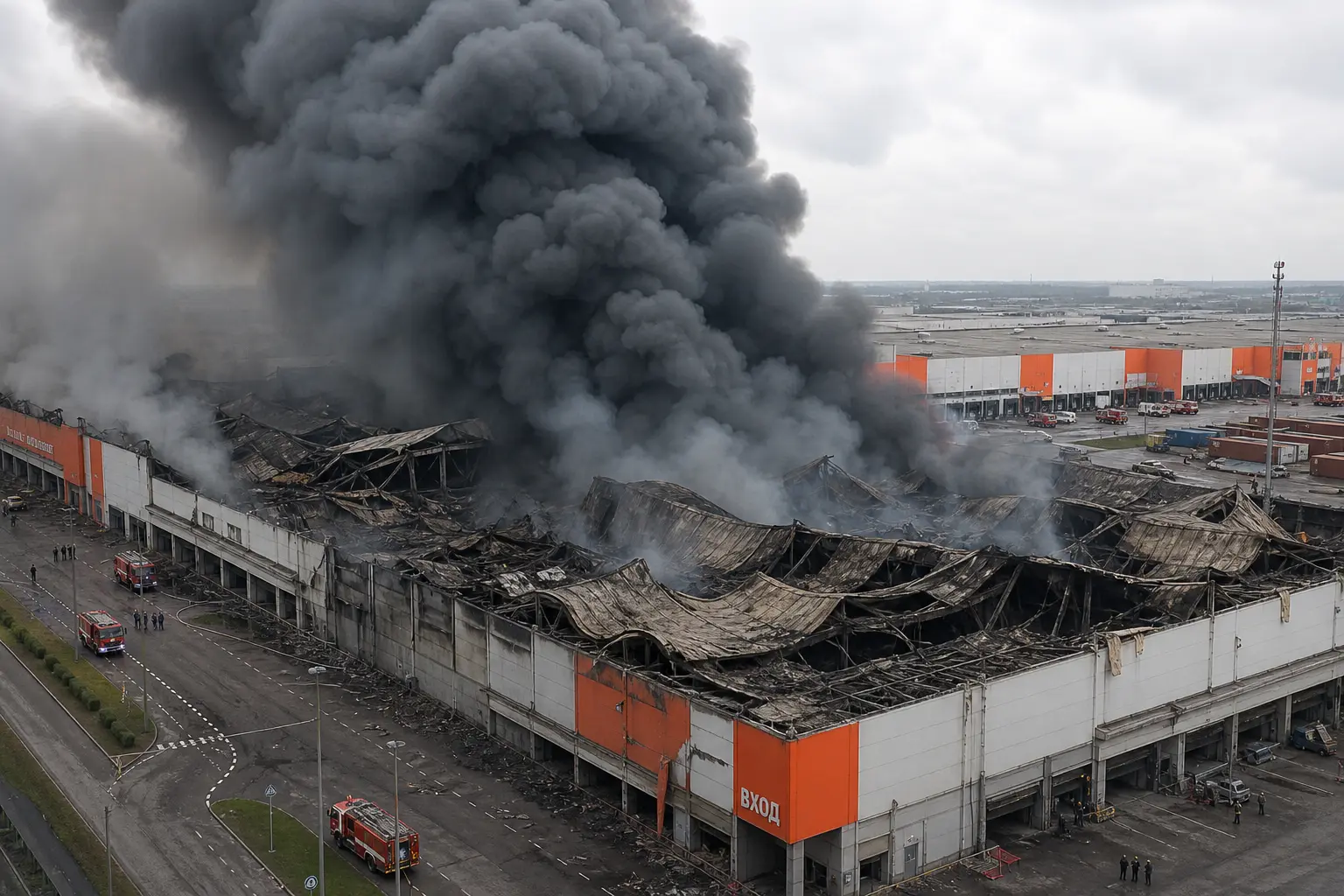
In Moscow Oblast, Governor Andrei Vorobyov said several fires broke out in the Novoselki industrial zone of Chekhov after a UAV strike. The largest blaze was at a warehouse; an electrical substation and an office building were also damaged. Preliminary figures put the toll at five killed and ten injured. Russian channels and monitoring accounts identified the main target as a Wildberries warehouse. Firefighters extinguished the open flames.
Wildberries confirmed fires at facilities near St. Petersburg and in the Tver region the same night, with no casualties reported at those two sites. Staff were evacuated and orders rerouted. The pattern of simultaneous hits near both capitals underscored how far the campaign now reaches inside Russia’s core logistics belt.
- Chekhov, Moscow Oblast: 5 killed, 10 injured; warehouse, substation and office hit
- Krasny Bor, Leningrad Oblast: 17 drones downed; fire and damage at logistics area including Wildberries
- Tver region: Wildberries facility damaged, no casualties
Air defenses claimed most of the inbound drones over Leningrad Oblast, yet fire still took hold on the ground. That gap between interception tallies and physical damage has repeated across earlier waves of the same campaign.
Three Weeks of Strikes on Russia’s Top Retailer
Since 18 July, Ukrainian long-range drones have hit close to 20 Wildberries sites stretching from the Moscow region to Samara, Vladimir, Tambov and occupied Crimea. The company, often called Russia’s answer to Amazon, processes hundreds of thousands of daily orders through a national network of warehouses.
One Samara-region warehouse lost virtually all stock after a fire consumed 160,000 of its 180,000 square metres. In Vladimir Oblast a separate 100,000-square-metre blaze required more than 200 firefighters. Earlier strikes in Elektrostal and Kotovsk produced the first large casualty counts among warehouse workers.
| Location | Date (approx) | Key impact |
|---|---|---|
| Elektrostal / Tambov | 18 July | Multiple deaths and dozens injured; first major wave |
| Samara region | 2 August | 160,000 sq m burned; all stock destroyed |
| Vladimir (Khryastovo) | 3 August | 100,000 sq m fire; partial stock saved |
| Chekhov / Krasny Bor / Tver | 3-4 August | 5 dead, 10 injured; additional fires |
Ukrainian Unmanned Systems Forces figures and open-source tallies put the number of major hubs struck still higher as of early August. The pace has been steady rather than sporadic: opening blows in mid-July, a massive single-site loss in Samara at the start of August, then back-to-back fires in Vladimir and the overnight cluster near Moscow and St. Petersburg.
- 18 July: Opening wave hits Elektrostal and Tambov, producing the first major casualty counts
- 2 August: Samara-region warehouse loses 160,000 of 180,000 square metres and virtually all stock
- 3 August: Vladimir Oblast blaze engulfs 100,000 square metres; more than 200 firefighters respond
- 3-4 August: Chekhov, Krasny Bor and Tver struck in a single night; five killed and ten injured at Chekhov
Each successive wave has targeted high-volume nodes rather than scattered small depots. That focus multiplies the effect on order flow even when the raw count of facilities hit remains a minority of the full network.
Why the Marketplace Became a Priority Target
Kyiv frames the warehouses as legitimate dual-use nodes. President Volodymyr Zelenskyy has said the sites were involved in supplying Russian forces with drone components, navigation equipment and other military-related goods. Ukrainian commanders have pointed to post-strike rationing of drone parts by Russian units as evidence the hits bite into frontline stocks.
The campaign also aims to make the cost of the war visible to ordinary Russians who rely on the platform for everyday goods. Tens of millions use Wildberries daily. Pro-Russian military bloggers have long described the marketplace as a routine source for volunteer kit headed to the front. The Kremlin denies that commercial platforms serve as military supply lines.
- Claimed storage of sanctioned drone and navigation components
- Disruption of consumer logistics that underpins wartime normalcy
- Pressure on small businesses and bank balance sheets tied to the platform
- Forced redistribution of remaining stock and higher insurance and security costs
A Zelenskyy remarks on dual-use components summary captures the official Ukrainian rationale that has guided the target set since mid-July. The dual track, military supply disruption paired with civilian economic friction, explains why the same company has absorbed repeated waves rather than a single symbolic strike.
By forcing redistribution of stock and raising insurance and security costs, the campaign turns a commercial network into a recurring drain on both public attention and private balance sheets. That pressure compounds with every additional hub that goes offline.
Sellers Absorb the Inventory Shock
Wildberries sits at the centre of Russian e-commerce. Independent tallies credit it with roughly half of online orders and annual turnover in the tens of billions of dollars. Hundreds of thousands of active sellers, some estimates exceeding one million registered, depend on its fulfilment network. Many are small businesses whose entire stock sat in the struck hubs.
Russian Forbes and other business reporting put seller losses from the July-August fires in the range of several billion dollars. One early figure circulating was approximately $3.5 billion. Just before the first large strikes the company updated its vendor contracts to classify drone attacks as force majeure events for which it bears no liability. Compensation has been partial and staggered: storage-fee discounts, free transfers to other sites, and limited cash reimbursements announced by founder Tatyana Kim. Families of the dead received 2 million rubles and seriously injured staff 1 million rubles in earlier rounds.
- Storage-fee discounts at surviving facilities
- Free stock transfers to undamaged sites
- Limited cash reimbursements for lost inventory
- 2 million rubles to families of the dead; 1 million rubles to seriously injured staff
Crowd discussion on X and Russian channels has focused on the mismatch: sellers who lost everything face delayed or incomplete payouts while the platform continues to operate on surviving nodes. Some warehouse workers report new restrictions such as bans on smartphones inside facilities.
The force majeure clause shifted legal risk onto vendors at the precise moment inventory destruction accelerated. Sellers whose goods burned in Samara or Vladimir now navigate partial recovery tools rather than full replacement of stock. That gap between total loss and staggered relief keeps commercial anger high even as the company restores dispatch routes.
Kim Calls the Strikes Terrorism
Wildberries founder and CEO Tatyana Kim has described the attacks as acts of terrorism aimed at civilians and at destabilising millions of people across Russia and neighbouring markets. In a late-July video address she said businesses in ten countries had suffered significant losses and that the company was working with the Russian government on a broader support scheme.
For nearly two weeks now, our company’s warehouses have been under terrorist attack. Why our warehouses, of all places?
Kim said the real purpose was to exert pressure, cause panic and shock. The company has repeatedly confirmed evacuations, firefighting and the rerouting of acceptance and dispatch to undamaged facilities. It is also expanding warehouse space in Kazakhstan.
Her framing rejects the dual-use argument outright and casts the campaign as an assault on civilian commerce. The reference to losses across ten countries signals how far the seller base and supply chains extend beyond Russia’s borders. Expansion in Kazakhstan offers one geographic hedge, yet it cannot instantly replace the high-volume hubs already disabled inside Russia.
Most Large Hubs Already Offline
Open-source analyst DroneBomber assessed that by 2 August roughly 16 of Wildberries’ 26 largest logistics complexes (those exceeding 15,000 square metres) had been put out of operation. That is about 62 percent of the major hubs even if the damaged sites represent a smaller share of the company’s overall 200-facility network. The concentration on high-volume centres produces outsized disruption to cargo flow.
Russian Forbes calculated that facilities covering 1.21-1.47 million square metres came under attack by early August, with 893,000-1.154 million square metres damaged-between 17 and 22 percent of declared logistics space. An assessment of 16 major hubs disabled underlines how the loss of the biggest nodes outweighs the raw facility count.
| Metric | Figure |
|---|---|
| Major hubs (>15k sq m) disabled | 16 of 26 (~62%) |
| Total logistics facilities | ~200 |
| Damaged space (Forbes range) | 893k-1.15M sq m |
| Share of warehouse space hit | 17-22% |
The platform still moves goods, but delivery times lengthen, regional stock imbalances grow, and the cost of security and insurance rises. Wildberries seller and order statistics from recent years show the scale of daily volume that now runs on a reduced backbone.
Disabling roughly three-fifths of the largest hubs while damaging under a quarter of total warehouse space illustrates the logic of the target set. Volume, not footprint alone, determines how hard the network feels each loss. Surviving smaller sites cannot fully absorb the throughput once handled by the biggest complexes.
Fire Footprints Reveal Uneven Warehouse Losses
Individual blaze sizes already on record show why some nights erase entire regional stocks while others leave partial inventory recoverable. The Samara fire alone consumed 160,000 of 180,000 square metres. Vladimir’s Khryastovo site lost 100,000 square metres. The Krasny Bor Wildberries facility spans about 154,000 square metres and took fire damage even after 17 drones were downed overhead.
| Site | Scale recorded | Stock outcome |
|---|---|---|
| Samara region | 160,000 of 180,000 sq m burned | Virtually all stock destroyed |
| Vladimir (Khryastovo) | 100,000 sq m fire | Partial stock saved |
| Krasny Bor Wildberries | ~154,000 sq m facility | Fire and damage after 17 drones downed |
Those figures sit inside the wider Forbes range of 893,000 to 1.154 million square metres damaged nationwide. A handful of very large burns accounts for much of the commercial shock. Smaller depots still operating cannot replace the fulfilment capacity once concentrated in the lost halls.
Chekhov added human cost on top of floor-space loss: five killed, ten injured, plus damage to a substation and office building beside the main warehouse fire. Earlier waves in Elektrostal and Kotovsk had already shown that night-shift warehouse crews bear the direct casualty risk when drones reach the loading bays.
Rerouting and New Capacity Strain the Network
After each wave the company has evacuated staff, fought fires, and shifted acceptance and dispatch onto undamaged nodes. Orders continue to move, yet every reroute lengthens delivery windows and deepens regional stock imbalances. Security and insurance costs climb in parallel as the remaining hubs become more valuable and more exposed.
Expansion of warehouse space in Kazakhstan is one longer-term answer. It places capacity outside the regions that have absorbed the heaviest strikes since mid-July. Building and stocking new halls, however, takes time that sellers short of inventory do not have. Interim tools such as free transfers and storage-fee discounts bridge only part of the gap.
Workers at surviving sites now face tighter internal rules, including bans on smartphones inside facilities. Those measures aim to limit information leaks and secondary risks, yet they also signal how the operating environment inside the network has hardened. The platform’s daily volume, once spread across a fuller set of major hubs, now funnels through a narrower set of doors.
Pressure Builds on a Wartime Consumer Pillar
Wildberries grew into a cornerstone of Russian retail after 2022, absorbing demand as international brands exited and consumers shifted online. Its warehouses and pickup points employ tens of thousands directly and support millions more through the seller ecosystem. Hitting that network does not stop the Russian army overnight. It does raise the financial and psychological price of prolonged conflict for businesses, banks holding related debt, and households that treat next-day delivery as normal.
Further strikes continue; additional fires were reported at other sites within hours of the Chekhov and Krasny Bor attacks. The company keeps redistributing stock and seeking new capacity outside Russia’s most exposed regions. Sellers keep pressing for fuller compensation. The second-order bill-lost inventory, strained credit lines, slower consumer goods flow and eroded confidence-keeps accumulating with every warehouse that burns.