
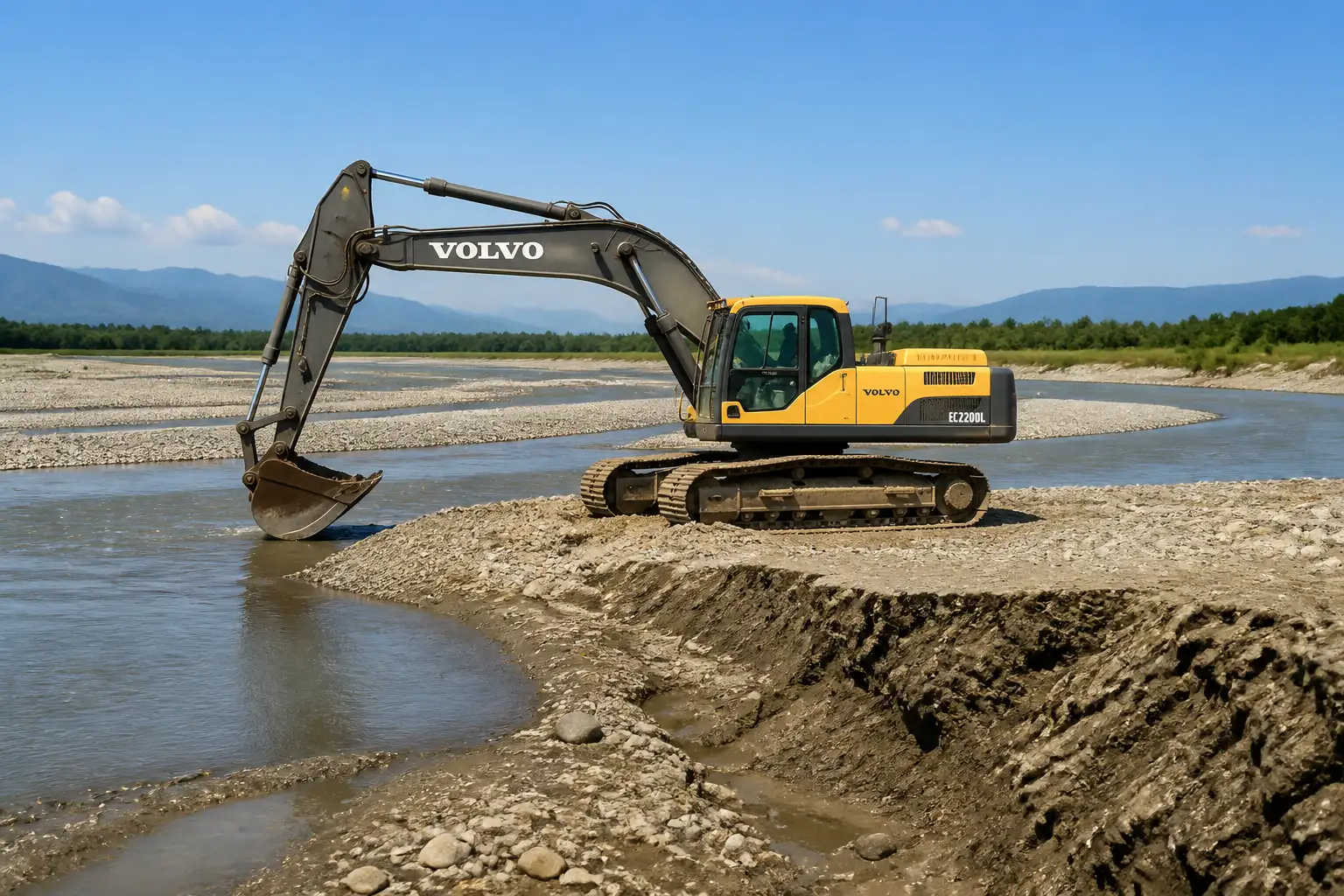
Four people were arrested in Georgia on charges of illegal business activities and money laundering tied to the unlicensed extraction of 343,608 cubic meters of inert materials from the Mtkvari River. The Investigation Service of the Ministry of Finance valued the haul at GEL 2,138,771 and put environmental damage at GEL 2,235,507.
Charges also hit three more individuals and three legal entities. The material, mainly sand and gravel, came from the Kvemo Kartli stretch and went to other businesses. Detainees face nine to 12 years if convicted.
The Scale of the Unlicensed Haul
Investigators say the group worked systematically without any license. They pulled inert material from the river bed and banks, then sold it into the supply chain. The Financial Police statement put the volume at 343,608 cubic meters and the market value at GEL 2,138,771.
- Volume extracted: 343,608 m³ of sand and gravel
- Stated market value: GEL 2,138,771
- Estimated environmental damage: GEL 2,235,507
- Income allegedly laundered: GEL 2,138,771
At recent rates near 0.38 USD per lari on the official lari exchange rates, the value figure sits around $814,000. The service cooperated with Kvemo Kartli regional units. The same income total appears in both the extraction value and the laundering count, showing how the proceeds were treated as legitimate once sold.
| Metric | Amount | Notes |
|---|---|---|
| Inert material volume | 343,608 m³ | Sand and gravel from Mtkvari |
| Market value claimed | GEL 2,138,771 | Distributed to businesses |
| Environmental damage | GEL 2,235,507 | Agency estimate |
| Potential prison term | 9-12 years | For the four detainees |
The numbers match across multiple Georgian outlets that carried the Investigation Service release on 4 August 2026.
Licenses Run Through One Agency
Legal extraction of sand and gravel requires a license. The National Agency of Mineral Resources licensing role covers mineral use outside oil and gas. It sits under the Ministry of Environmental Protection and Agriculture and runs auctions for defined volumes and terms.
A 2023 example on the Kvirila River offered a five-year license for roughly 205,000 m³ with a starting auction price of GEL 206,000. Winners pay for the right, then face reporting and technical conditions. The Mtkvari operation skipped that step entirely.
- Agency issues licenses under the Law on Licenses and Permits
- Volumes and locations are specified in each grant
- Holders file periodic reports on extraction
- Field checks and environmental rules apply, at least on paper
Without a license the entire chain becomes illegal business activity under Georgian criminal law, which is the charge now filed.
What River Beds Lose When Material Leaves
Inert materials from active channels support construction, roads and concrete. Taking them without controls changes the river. Channel incision can travel upstream and downstream. Banks erode. Habitat for fish and invertebrates shrinks. Flood patterns shift.
Global reviews of global sand mining environmental impacts list exactly these effects: loss of sediment that once protected against floods, damage to water supply and fisheries, and biodiversity drops. The Georgian damage figure of GEL 2.2 million is the state’s first-cut accounting for one site. It does not capture longer-term changes to the Mtkvari corridor that runs through Kvemo Kartli toward Tbilisi.
Local media noted the arrests with little public outcry. That muted response itself suggests river extraction is often treated as ordinary commercial risk rather than a fresh scandal.
Oversight Has Long Lagged the Licenses
A 2022 Social Justice Center study mapped the same sector. It found the control system prioritizes license paperwork over environmental outcomes. After the mining regulator moved under economic structures years earlier, checks focused on volumes and technology rather than river health.
Key findings from the 2022 report on mining oversight gaps included:
- Only a fraction of sand-gravel licenses received field inspections (31 of 128 in one sample)
- Annual reports from holders stay limited to license conditions, not real environmental effects
- Fines stay too low to deter high-volume operators
- Communities struggle to trigger agency visits when damage appears
The Mtkvari case fits the pattern the report described: large volumes moved for years, then a criminal case after the fact. The Investigation Service acted once money-laundering and unlicensed business evidence lined up. Prevention through routine checks remains thinner.
Construction Demand Absorbs the Flow
Investigators say the material went to other businesses. Georgia’s building and infrastructure work needs steady sand and gravel. Licensed auctions set a legal supply, yet the black-market volume in this single case already rivals some multi-year licenses. Buyers who take unlicensed loads gain cheaper or faster material. They also become the demand side that keeps the extraction running.
No names of the receiving firms have been released. The three legal entities charged sit on the extraction and distribution side. Downstream users face their own exposure if invoices or trucking records later surface in court.
How the Figures Stack Against Earlier Cases
The Investigation Service has run similar files. One earlier 2026 matter involved far smaller totals, around 33,000 m³ and under GEL 400,000. The Mtkvari numbers dwarf those. They also sit in the same legal frame: illegal entrepreneurial activity plus legalization of illicit income.
| Case feature | Mtkvari 2026 | Earlier 2026 example |
|---|---|---|
| Volume | 343,608 m³ | ~32,957 m³ |
| Value | GEL 2.14 m | GEL 0.38 m |
| Damage estimate | GEL 2.24 m | Comparable scale to value |
| People detained | 4 (+3 charged) | 2 |
The jump in scale shows how quickly an unmonitored stretch of river can feed the market once equipment is in place.
The Bill the State Has Started to Count
The arrests close one operation. They leave the structural questions open. License auctions generate revenue and set rules, yet inspection capacity and fine levels have not kept pace with demand for aggregates. Environmental damage tallies now appear in the charging documents, which at least prices the harm in the same currency as the profit.
Whether courts convert the 9-to-12-year range into final sentences, and whether the three companies lose assets, will set the next signal. For the Mtkvari itself, the cubic meters already removed will not return. The second-order cost sits in a river system that must still carry water, sediment and life after the trucks have gone.