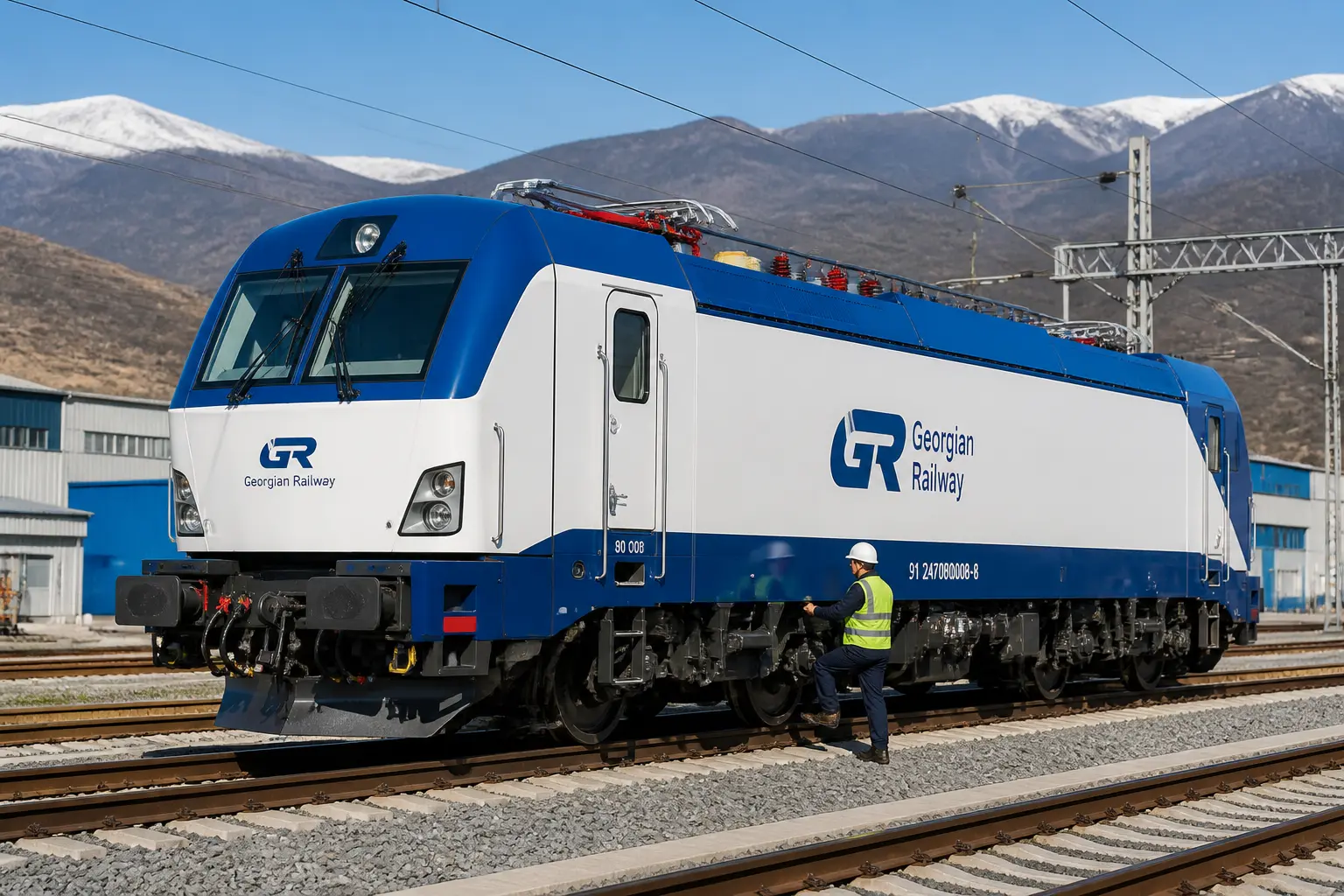
Georgian Railway opened an international tender for 45 new mainline freight electric locomotives valued at about EUR 325 million, the first purchase of its kind in the history of independent Georgia. The deal sits inside the larger Trans-Caspian Transport Corridor Georgia Accessibility and Transport Enhancement Project and includes a new maintenance depot plus long-term technical services.
Bids are due 30 October 2026 under World Bank procedures with Asian Development Bank co-financing. The package is built to fix a rolling-stock shortage that has limited corridor throughput.
What the Full Contract Requires
Bidders must supply one of two Bo-Bo configurations only: 45 integrated locomotives or 90 separate units that form 45 operational pairs. All units are mainline DC electric freights. The first locomotive must arrive at the Khashuri depot within 27 months of contract effectiveness; the full set within 55 months under CIP terms.
Scope covers design, manufacture, delivery, testing, commissioning and a minimum two-year warranty. The same supplier then provides full technical maintenance (excluding major overhauls) from the first unit’s operational acceptance through a ten-year post-warranty period for every locomotive. Performance is measured by KPIs, with payment tied to results.
| Element | Detail |
|---|---|
| Quantity options | 45 integrated or 90 paired Bo-Bo units |
| Delivery window | First unit 27 months; all within 55 months |
| Evaluation split | 60 percent price, 40 percent technical |
| Financing | 50/50 World Bank and ADB for locomotives |
| Depot | Supplier designs, builds and equips new facility on GR land in Khashuri |
| Maintenance term | Warranty plus 10 years post-warranty per unit |
The supplier builds the depot at its own cost on land Georgian Railway provides free under a right-of-superficies arrangement. The supplier owns the facility during the maintenance term and may use spare capacity for third-party work, but GR needs always come first. The depot must be ready before the first locomotive is accepted.
Qualification bars are high: at least two prior contracts for ten or more similar mainline electrics, one substantial maintenance contract for twenty or more units, proven mature technology in revenue service, and cyber-security certifications such as IEC 62443 or ISO 27001.
The Fleet Numbers That Forced the Move
Georgian Railway’s freight locomotive fleet has shrunk sharply. From 168 units in 2015 it fell to about 90 by 2023, a 46 percent drop. Electric units declined 36 percent; diesels fell harder. 62 percent of the locomotive fleet over 35 years old and 64 percent of freight wagons sit in the same age band. All roughly 91 current locomotives were built more than 30 years ago.
- 90 locomotives remain in the freight fleet after a decade of attrition
- 46 percent drop in total locomotives from 2015 to 2023
- No major renewal investment occurred in that period
- WB study flagged locomotive shortage as the corridor’s Georgian bottleneck
A World Bank analysis along the Middle Corridor listed ten priority actions and singled out Georgia’s rolling-stock gap. Without more locomotives the route cannot absorb the expected threefold rise in freight turnover by 2030. Earlier plans for only ten new units were judged insufficient once Baku-Tbilisi-Kars volumes began climbing.
Daily operations already show the strain. Temporary disruptions and capacity squeezes appear regularly, including temporary service changes on the Tbilisi-Batumi line that ripple into freight paths.
Volumes Rising Faster Than Traction Can Handle
Middle Corridor cargo crossed 4.1 million tons in the first eleven months of 2024, up 63 percent year on year. Container traffic multiplied 2.6 times. Full-year 2024 figures reached roughly 4.5 million tons. Projections put 2025 near 5.2 million tons and longer-term capacity targets at 10 million tons or more once ports and rail links keep pace.
The Baku-Tbilisi-Kars railway section in Georgia was upgraded to five million tons annual capacity. That figure remains theoretical if motive power cannot pull the trains. Georgian Railway must supply traction for its own network and for the joint Marabda-Kartsakhi operations. Reliability of mainline electric power is now the binding constraint on hub status.
Shippers and Central Asian exporters already treat transit time and schedule adherence as decisive. Dry-port expansions, Anaklia deep-sea plans and new Uzbekistan logistics stakes all assume the Georgian rail spine can move cargo without multi-day waits for locomotives. The tender is the direct response to that assumption.
How Multilateral Money Shapes the Rules
The World Bank Group approved $372 million for the TC-GATE project in June 2026. Total project cost exceeds $750 million once AIIB and ADB co-financing is counted. Rail components cover the locomotives, power-substation upgrades and institutional strengthening at Georgian Railway. Road works in Kakheti form the other half.
The upgrades are expected to improve locomotive availability to 95 percent, improve service reliability for shippers, and support a 20 percent increase in revenues, while also resulting in a reduction in net emissions of more than 2.3 million tons.
Rolande Pryce, World Bank Regional Director for the South Caucasus, framed the investment as helping Georgia realize its role as a transit hub while answering diversified supply-chain demand. Georgia’s Finance Minister Lasha Khutsishvili called the package essential for both domestic opportunity and regional corridor resilience.
Procurement follows World Bank regulations. Payments for the locomotive contract use direct disbursement. The maintenance agreement itself is financed from Georgian Railway’s own resources and can be extended on performance. Beneficial-ownership disclosure is required at award.
These rules tilt the field toward established global manufacturers who already run mature fleets and long-term service contracts. Smaller or unproven suppliers face steep documentary hurdles on experience, production capacity (at least 18 similar locomotives in any of the last ten years) and cyber-security practice.
Passenger Side Stays at Market Survey Stage
Separately, Georgian Railway launched an international market survey for ten new passenger electric multiple units with ADB support. This is not a tender. The survey collects feedback on technical specs, qualification criteria, delivery times and procurement conditions so that a later ADB-ruled procurement can be designed cleanly.
Once feedback closes, GR plans to move to full international bidding. The parallel track shows the same multilateral preference for structured, transparent rolling-stock renewal on both freight and passenger sides. Freight moved first because the corridor bottleneck was more acute and the World Bank project already had the financing line ready.
Passenger fleet needs remain real. Older EMUs still carry domestic services, and extra seasonal demand has already forced extra trains added on the Tbilisi-Batumi route. The ten-unit survey is the preparatory step, not the final order.
What Changes Once the Depot and KPIs Arrive
The second-order effect sits in the maintenance model. Georgian Railway is not simply buying locomotives. It is importing a decade-plus operational system that includes a purpose-built service center, spare-parts logistics, KPI-driven payments and the right for the supplier to keep the depot busy with outside work after GR needs are met.
Availability targets of 95 percent become contractual rather than aspirational. Revenue gains of 20 percent and emissions cuts above 2.3 million tons rest on that availability. The supplier’s skin in the game runs far beyond handover. Tech transfer and local skills development are baked into the depot construction and long-term presence.
For manufacturers the prize is a multi-year foothold in a strategically located railway that sits on a growing Eurasian route. For Georgia the prize is motive power that no longer acts as the limiting factor when Central Asian, Chinese and European shippers choose the Middle Corridor over longer or sanctioned alternatives.
Bids close at the end of October. Evaluation, award and contract effectiveness will set the 27-month clock for the first unit. By the early 2030s the full fleet of 45 should be in revenue service with the Khashuri depot already running. That timeline matches the window in which corridor volumes are projected to keep climbing. The hardware is the visible half. The reliability system is the half that lasts.