Nestle India shares fell as much as 4.9% to ₹1,455 on Tuesday after management flagged near-term moderation in food and beverage consumption. Geopolitical costs from the West Asia conflict and El Nino monsoon risks are the drivers, even as the company posted a strong June quarter and vowed to keep investing.
Chairman and managing director Manish Tiwary called the pressures short-term blips. The market reacted first to the demand watchout.
Dual Headwinds Hit Costs and Demand Together
The company described geopolitical disruptions as dual headwinds: supply continuity and cost inflation. Shipping route delays, higher freight, and volatility in energy, packaging and edible oils all feature in the list. Currency moves add another layer.
Tiwary told analysts the firm is already seeing a little bit of slowdown in market growth, as reported by Nielsen, plus some impact on food inflation. Overall consumption and F&B growth sit as a near-term watchout because raw-material inflation is hit by the West Asia conflict and monsoon expectations tied to El Nino.
- Energy, packaging and edible oil price spikes raise input bills
- Shipping disruptions delay materials and lift freight
- Currency volatility complicates import costs
- Possible weaker monsoon threatens rural demand and farm output
A sustained rise in crude can lift transportation and packaging across the FMCG chain. Food companies face the choice of absorbing the hit to margins or passing it on, which can slow volumes in a price-sensitive market. Nestle India’s own presentation links the two risks directly.
Strong June Quarter Still Fresh
The caution arrived right after solid numbers. Revenue from operations rose 25.1% year-on-year to ₹6,378 crore in the June quarter (Q1FY27). Standalone net profit climbed 47.9% to ₹975 crore. Consolidated figures showed net profit up 48.26% to ₹958.68 crore and product sales up 25.4% to ₹6,363.27 crore.
Key quarter markers
- Revenue growth: above 25% on both reported bases
- Profit jump: nearly 48% year-on-year
- Share reaction: intraday drop of as much as 4.9%
- Prior analyst note: PL Capital had already flagged limited margin upside from coffee, cocoa and palm oil volatility under super El Nino
Investors had bid the stock higher on the results. The outlook language reversed that move in a single session.
Two Growth Engines Stay Front and Centre
Nestle India rests its strategy on the core portfolio plus premium products. Penetration-led volume growth and premiumisation sit as main priorities, alongside cost optimisation. The premium portfolio has delivered a compound annual growth rate of about 17% since 2021. It now accounts for 14% of the portfolio in FY26, up from 11% in 2021. Premium growth has run roughly 500 basis points ahead of the overall rate.
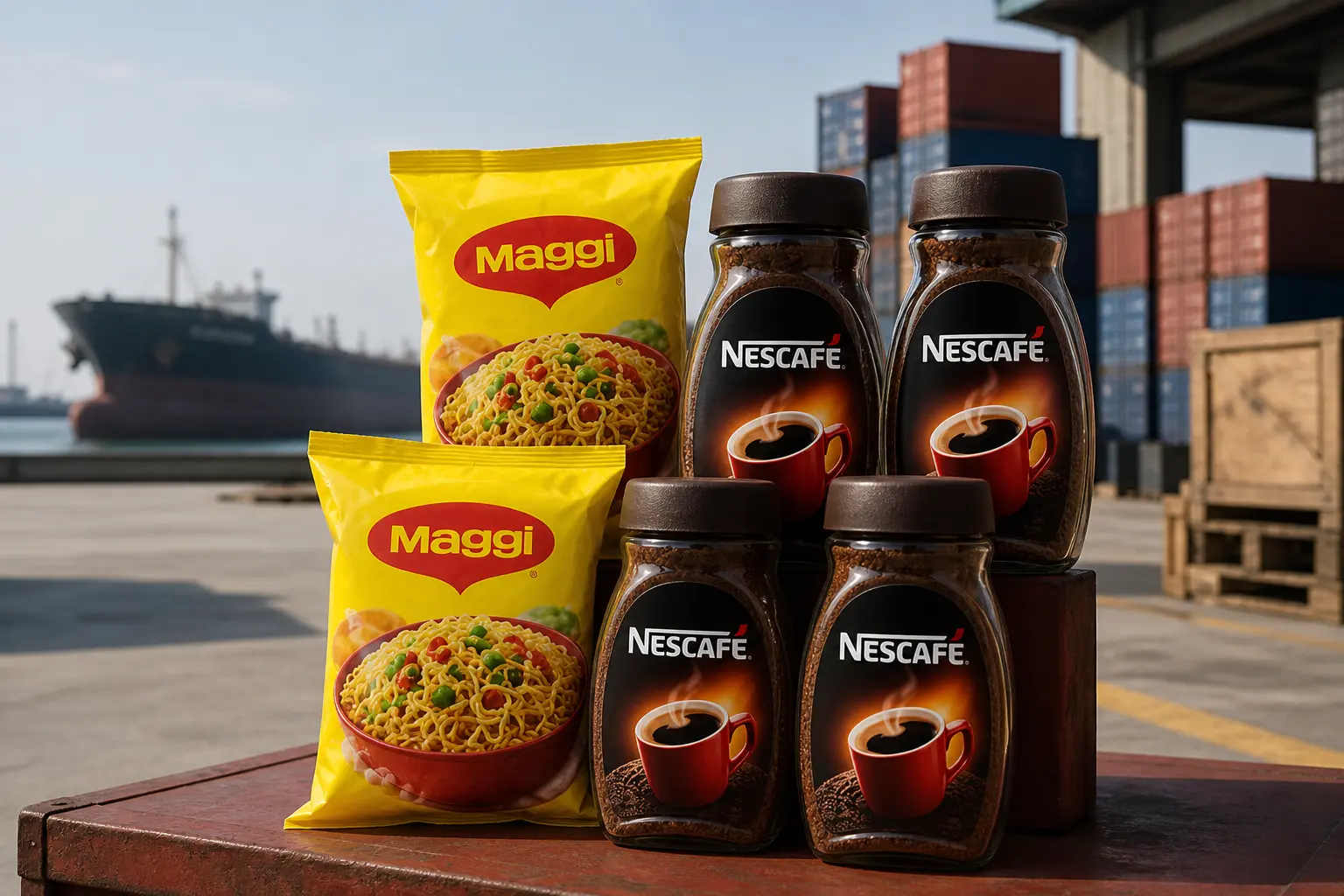
Nescafe logged its 20th consecutive quarter of double-digit growth. Coffee penetration stands at 33% against 91% for tea, leaving clear headroom. Household penetration for Maggi, Nescafe and KitKat sits in the mid-50% range. Tiwary stressed the company keeps packs at ₹5 and ₹10 price points for affordability while still pushing premium lines and newer categories such as breakfast cereals and Nespresso.
E-commerce contribution has doubled since 2021. Premium products contribute twice as much through emerging channels as through traditional ones. Out-of-home meals per household could rise to eight a month by 2030 from five in 2025. India is already Nestle’s second-largest out-of-home market in its Asia, Oceania and Africa zone.
Distribution Reach Keeps Expanding Fast
The company has added scale that few peers match in recent years. Total retail outlet reach hit 6.2 million as of June 2026, up from 5.7 million in 2023, with more than 500,000 outlets added in the period. Village coverage rose to 219,700 in FY26 from 110,200 in 2021. Tiwary said the distribution network has expanded nearly fourfold since 2021 and delivered the highest-ever outlet expansion in the peer group. Rural remains about half the reach of some competitors, so the runway continues.
| Metric | Recent Figure | Earlier Benchmark |
|---|---|---|
| Retail outlets | 6.2 million (June 2026) | 5.7 million (2023) |
| Villages covered | 219,700 (FY26) | 110,200 (2021) |
| Premium share of portfolio | 14% (FY26) | 11% (2021) |
| Premium CAGR | ~17% since 2021 | – |
| Noodles/coffee/chocolate capacity | +41% since 2020 | – |
| Cumulative capex | More than ₹6,400 crore | – |
Tiwary noted rural has been one of the more resilient parts of the market compared with urban. That resilience may face the next test if monsoon risks materialise.
Capacity, Costs and Technology Run in Parallel
Nestle India plans to keep expanding manufacturing capacity for volume growth. Capacity for noodles, coffee and chocolates is already up 41% since 2020 after more than ₹6,400 crore of capital expenditure. At the same time the company stresses disciplined margins, cash generation and cost control across the value chain. Brand and capacity investment continues alongside those measures.
Technology supports the effort. The firm uses artificial intelligence in forecasting, planning, manufacturing, replenishment and sales. More than 3,500 employees use Microsoft 365 Copilot, freeing about 18,000 working hours a month. Broader Nestlé work with Nestlé global AI and Dynamics tools shows the same productivity direction.
Value-chain productivity initiatives are the main near-term shield against the cost spikes Tiwary listed.
Who Feels the Pressure First
Price-sensitive households and rural buyers sit closest to any inflation pass-through. Urban premium buyers have more buffer, which is why the 14% premium slice and e-commerce push matter. Competitors with thinner rural networks or less premium mix face a similar or sharper squeeze. Suppliers of packaging, oils and freight feel the upstream volatility first.
While these are headwinds, inflation would be of concern, given where we are on this journey in terms of penetration, in terms of the rural consumer, in terms of premiumisation, I remain quite confident of our ability to handle these short-term blips.
Manish Tiwary said that during the analyst call. He added that the medium- to long-term growth story does not get impacted and the team has the resilience to work around the challenges. Full analyst and institutional investors meet materials are posted on the company site.
India’s retail inflation had already accelerated to 4.38% in June 2026 from 3.93% in May, moving above the RBI’s 4% midpoint. Higher crude linked to the West Asia situation feeds packaging and transport costs. The same conflict has driven oil prices surge on geopolitical risks and broader Middle East conflict oil supply fears. Those moves sit behind Nestle’s dual-headwind language.
The Buffer Meets the Shock
Nestle India enters the watchout period with fresh distribution scale, a faster-growing premium layer, repeated double-digit coffee momentum and recent profit leverage. The same presentation that lists the risks also lists the two engines that are supposed to absorb them: higher penetration volumes and premium mix. Cost productivity and AI hours give incremental room.
Whether the dual headwinds stay short-term depends on how long freight and energy stay elevated and whether the monsoon holds. For now the company is treating the moderation risk as real enough to flag, while still committing capital and brand spend. Investors priced the demand channel of the shock within hours of the slides.