Beka Shonia told Georgia’s Court of Appeal on July 21 that he needs a working ventilator and a nurse who can reach his apartment. Judges are due to rule this week, five years after Duchenne muscular dystrophy sealed him inside his home in Tbilisi. A tracheostomy tube cut his testimony into fragments as he spoke.
Georgia rewrote its state health program in April after weeks of street protest over Duchenne medication. Ventilators and home care for the most disabled patients never made it into that rewrite, according to the Partnership for Human Rights (PHR), the group representing Shonia in court.
Five Years Behind One Door
Duchenne muscular dystrophy is a genetic disorder that progressively weakens skeletal and breathing muscles, almost always in boys, and it eventually reaches the muscles that keep a person breathing on their own. Shonia’s case reached that stage years ago.
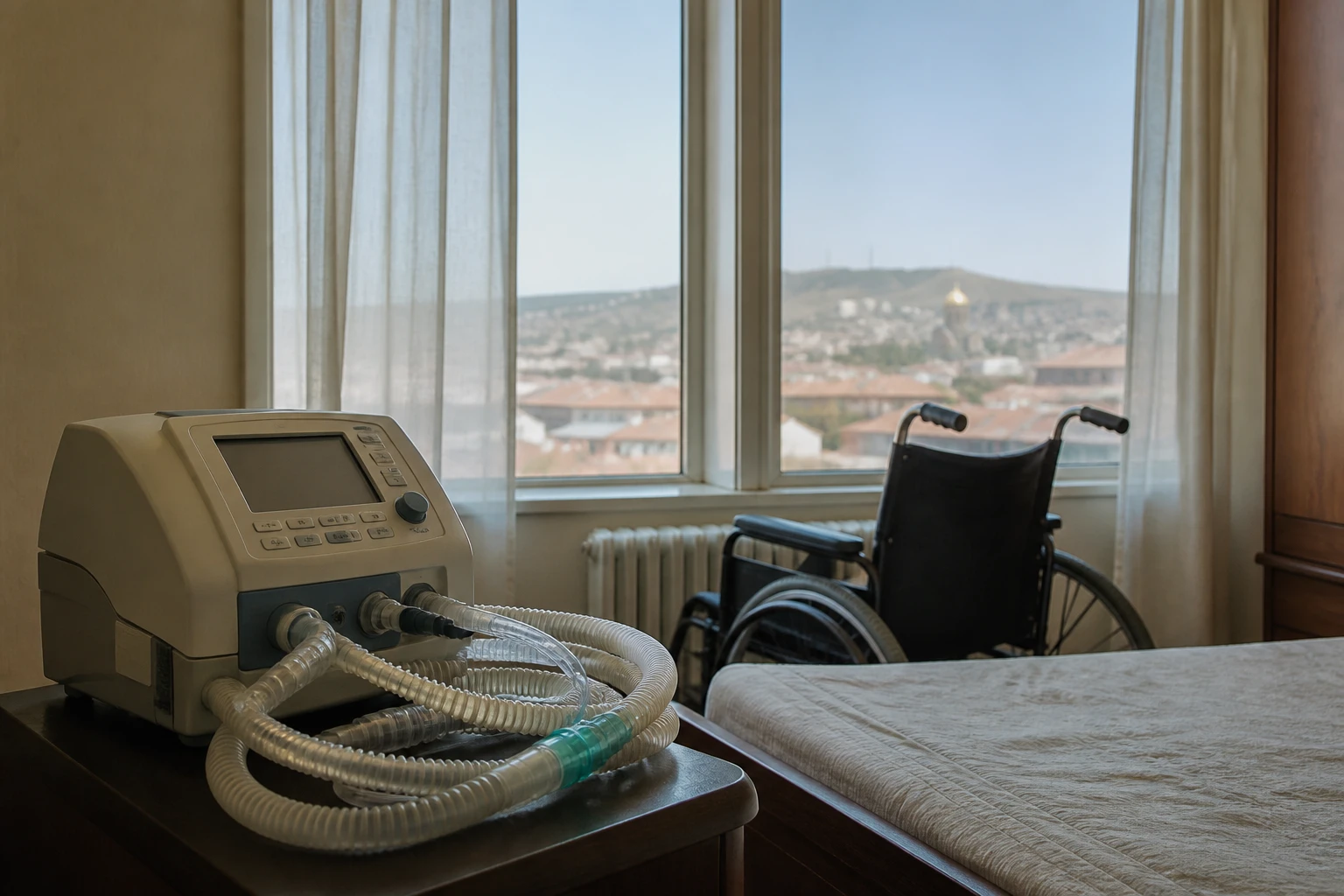
He has not left his home in more than five years, according to PHR. A tracheostomy keeps his airway open. A ventilator does the breathing his own muscles no longer manage.
His mother sold the family house to buy that ventilator. It is wearing out now, and nothing in Georgia’s state health program currently pays to replace it, PHR says.
My mother had to sell her house so I could breathe, and I do not want anyone else to have to do the same. This is worth fighting for, and I hope I achieve a result.
Shonia said that after the July 21 hearing, adding that he wanted other Duchenne children and their mothers spared what his family went through.
The Court of Appeal Rules This Week
PHR, a Tbilisi-based human rights group founded in 2012, brought Shonia’s case to the Court of Appeal on his behalf. Tamara Gabodze, a criminal defense lawyer who became the organization’s chairperson in November 2023, told the court the state’s obligation does not end at diagnosis.
“We work to ensure that all children and adults with disabilities receive the services they are entitled to from the state,” Gabodze said at the hearing. “They are not asking for charity, but for the state to fulfill its obligation to protect human rights.”
The ask in front of judges is narrow. Shonia wants a functioning ventilator and home-based medical staff who can treat him without requiring travel he cannot make. The ruling, expected July 29, will say whether Georgia’s health program has to cover both.
The Program Rewrite That Skipped the Sickest
The gap Shonia is fighting traces back to how Georgia rewrote its State Health Protection Programs this spring. Parents of children with Duchenne muscular dystrophy had spent weeks camped outside the Government Administration building in Tbilisi, demanding the state fund imported medication that slows the disease.
Two days into that pressure, on April 22, the government issued its amendment. PHR says it left out ventilators and home medical services for Duchenne patients with limited mobility, the exact category Shonia falls into.
The sit-in itself did not end for another six weeks. It ran 45 days before Prime Minister Irakli Kobakhidze agreed to set up a standing working group on medicine procurement.
- April 20, 2026: Parents of children with Duchenne muscular dystrophy begin a sit-in outside Georgia’s Government Administration building in Tbilisi, demanding state-funded imported medication.
- April 22, 2026: The government amends its State Health Protection Programs. PHR says the update excludes ventilators and home medical services for Duchenne patients with limited mobility.
- Early June 2026: The 45-day sit-in ends after Prime Minister Irakli Kobakhidze agrees to a standing working group on medicine procurement.
- July 21, 2026: Beka Shonia addresses the Court of Appeal, asking for a ventilator and home medical services.
- July 29, 2026: The Court of Appeal is expected to rule.
Medication and mobility equipment moved onto the government’s agenda that week in April. Home ventilation for patients too disabled to leave their beds did not, which is the narrower fight now sitting with the appellate judges.
How Many Families Are Waiting on This Ruling?
About 100 children are registered with Duchenne muscular dystrophy in Georgia, according to the advocacy group Together Against Duchenne Muscular Dystrophy, and most face the same eventual need for ventilation and home nursing that Shonia is fighting for now. The group has said one to three of those children die each year from inadequate treatment.
Shonia’s case is one piece of a wider response that has grown since April, running on four separate tracks.
- Litigation: PHR’s Court of Appeal case for Shonia, which could set precedent for other homebound Duchenne patients.
- A government working group: formed after the 45-day sit-in to oversee medicine procurement and weigh purchasing two priority drugs.
- Public fundraising: a student-led donation drive that pulled in close to $100,000 for Duchenne families within two days, according to OC Media.
- Family advocacy groups: organizations including Together Against Duchenne Muscular Dystrophy and Let’s Fight Against DMD, still pressing for imported medicines the state has not approved.
PHR says home medical services already won through years of civil advocacy by other Duchenne families still do not reach Shonia. His level of disability, tied to a ventilator and confined to bed, sits outside what the current system delivers.
What’s Won, and What Still Waits
| Service | Status | How It Moved |
|---|---|---|
| Disability lift | Secured | Won through PHR’s advocacy with the state |
| Elevator permission for his building | Secured | Approved after PHR’s request |
| Ventilator replacement | Pending | Awaiting the July 29 Court of Appeal ruling |
| Home medical services | Pending | Left out of the April 22 amendment; now before the court |
The first two rows show what patient advocacy can still accomplish outside a courtroom. The other two show where that advocacy hit its limit, and why Shonia’s case ended up in front of judges instead of officials.
Donations Moved Faster Than the State
Money reached Duchenne families before machines did. The advocacy group Let’s Fight Against DMD said patients on ventilators or with severe accompanying conditions would get a one-time payment of 10,000 lari, Georgia’s currency, by June 10, funded by public donations, with wheelchairs, beds, and adapted transport to follow.
By early June, one-time payments were already reaching ventilator-dependent patients, funded by the donation drive rather than the state budget.
The gap is procedural, not just financial. Handing out a lump sum or a wheelchair does not require the same regulatory rewrite as adding a service line to a state health program, which is likely why the donation drive moved faster than Shonia’s case has.
Georgia’s health bureaucracy has produced a similar mismatch elsewhere this year. Pharmacies began stocking HIV prevention medication while dispensing rules for prescribers still lagged behind the rollout, a gap between what the state supplies and what it has actually built the rules to deliver.
One Ruling, a Hundred Families Watching
PHR frames this week’s ruling as bigger than one apartment in Tbilisi.
“This will be an important decision not only for Beka, but for all people who, depending on their health condition, need individually tailored, timely, and effective medical services to live with dignity and safety in their own homes,” the organization said.
The United Nations and development partners have separately pledged to help overhaul Georgia’s social protection system for people with disabilities, a process running on a far slower timeline than a single court case.
For now, the outcome rests with the Court of Appeal in Tbilisi. About 100 registered Duchenne families in Georgia are waiting to see whether the ruling reaches beyond Shonia’s apartment, to the program the state rewrote in April without them.