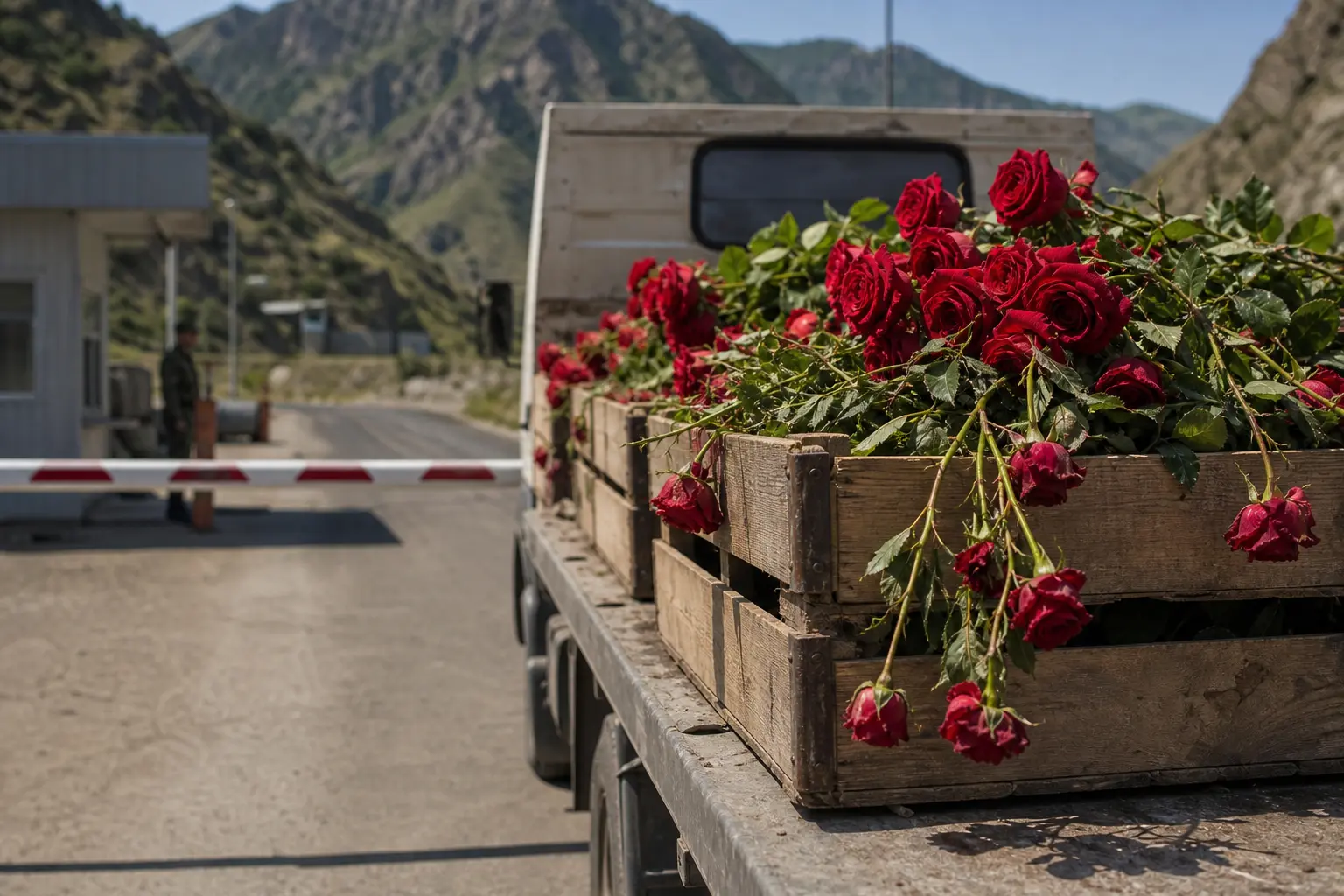
Georgia’s Revenue Service sent 13,350 rose branches back across the Armenian border this week after inspectors found the shipment failed the country’s phytosanitary checks. It is the third rose consignment Georgia has bounced at the same stretch of border in just over a year, and the second rejection in a month alone.
The timing is awkward for Armenia. The Sadakhlo crossing has become the country’s flower industry lifeline since Russia shut its own border to Armenian blooms in May, citing the identical complaint Georgian inspectors keep repeating: live pests riding along with the flowers.
Roses Turned Back at the Armenian Border, Again
The rejected shipment crossed at the Sadakhlo-Motorway checkpoint, one of Georgia’s busiest road links with Armenia. Inspectors from the Customs Department’s Sanitary, Phytosanitary and Veterinary Control Division flagged the branches during routine border quarantine procedures, the Revenue Service said.
The agency did not name the exporting country this time, describing the shipment only as arriving “from a foreign country.” Under Government Resolution No. 463, signed September 20, 2019, the entire batch had to be turned around and sent back the way it came. No fine, no destruction order, just a return trip.
Sadakhlo is not a minor outpost. It sits among Georgia’s five primary road and rail customs checkpoints, alongside Sarpi on the Black Sea coast and Kazbegi on the Russian border, according to the Revenue Service’s own reporting.
What we know:
- The shipment held 13,350 rose branches and crossed at Sadakhlo-Motorway.
- Inspectors found the flowers did not meet Georgia’s phytosanitary standards.
- The return was ordered under Government Resolution No. 463 of September 20, 2019.
What’s unconfirmed:
- Georgia’s Revenue Service has not stated which country the shipment came from.
- Whether the branches originated in Armenia, like the two rejected shipments before this one, or simply transited the same corridor.
A Pattern That Stretches Back to Last Summer
This is not a new problem at this crossing. Georgian customs detained 10,000 cut flowers at Sadakhlo back in June 2025, more than a year before the current wave, after inspectors found insect damage on the plants, according to the Armenian news agency ARKA. That was well before Russia’s flower ban or Armenia’s scramble for new buyers ever began.
Then came the flood. Once Armenia started shipping far more flowers north into Georgia, the rejections started stacking up too, as Georgia Today first reported.
| Date | Checkpoint | Volume Rejected | Stated Finding |
|---|---|---|---|
| June 2025 | Sadakhlo | 10,000 cut flowers | Insect damage |
| Early July 2026 | Sadakhlo and Ninotsminda | 22,290 cut roses | Live harmful organisms |
| Late July 2026 | Sadakhlo-Motorway | 13,350 rose branches | Phytosanitary non-compliance |
Three rejections, one crossing, and a pattern that keeps repeating despite Armenia’s growers having every reason to get it right this time.
Moscow Shut the Door in May
Russia’s federal veterinary and phytosanitary watchdog, Rosselkhoznadzor, suspended flower imports from Armenia effective May 22, 2026. The agency said it kept finding western flower thrips, a small invasive insect, in Armenian shipments despite assurances from Yerevan’s own food safety officials.
The ban landed days before Armenian Prime Minister Nikol Pashinyan’s Civil Contract party won a parliamentary majority, a result read in Moscow as a rebuke of Russian influence in the South Caucasus. Within weeks, restrictions spread to Armenian tomatoes, cucumbers, peppers, strawberries, mineral water, wine, brandy, fish, grapes, stone fruit and potatoes. By June 11, Russia had banned nearly all Armenian plant products outright.
Rosselkhoznadzor framed every step as a safety matter. Armenia’s government read it differently.
Okay, there may be a problem for one month, two months, three months, but in the fourth month, if the problem still exists, it means there is no EAEU.
Pashinyan said in June, needling the Russia-led Eurasian Economic Union (EAEU) over the restrictions.
The pest problem may not have stayed inside Armenia either. Rosselkhoznadzor said on July 17 that flower volumes arriving from Iran had jumped sharply this year, and that the packaging looked identical to shipments previously sent from Armenia. It asked Iranian officials to suspend flower export certification while it investigates whether Armenian roses are being relabeled to dodge the ban.
Pest-related rose rejections happen well beyond the Caucasus. The U.S. Department of Agriculture’s own inspection service restricted rose imports over a hidden bacterial pathogen found silently infecting otherwise healthy-looking plants earlier this year. Phytosanitary enforcement is routine worldwide. What is unusual is how fast the same complaint keeps repeating on one specific trade route: Sadakhlo, three times in thirteen months.
Tbilisi Becomes Armenia’s Biggest Flower Buyer
Georgia bought 218.2 tons of flowers from Armenia in May 2026, a record for the trade relationship, according to Georgia’s national statistics office. That was nearly three times April’s total and comfortably above the previous record of 128.9 tons set just two months earlier, in March.
Armenian flowers made up more than 63% of everything Georgia imported in that category that month. Total flower imports into Georgia reached 341.7 tons in May, with the remaining roughly 123 tons split among Ecuador, the Netherlands, Kenya, Turkey, China, South Africa and Italy, the country’s traditional flower suppliers.
Georgia is not simply waving the flowers through to somewhere else, either. The country exported no flowers of its own to the global market that month, meaning the Armenian blooms are being sold and used inside Georgia itself.
What Happens When Georgia Rejects a Rose Shipment?
A rejected shipment goes back to the exporting country under Georgian law, full stop. It is not destroyed, resold at a discount, or donated. For an Armenian grower, that round trip usually means a total loss, since the flowers are already wilting by the time a truck makes it back across the border.
Rejected batches rarely find a second life at home either. Domestic markets in Armenia will not take flowers that failed a border inspection, even at steep discounts, leaving growers to absorb the entire cost, the regional outlet Caucasian Knot reported. Farmers and truck drivers told the outlet that government support has not been enough to offset the losses.
The stakes are not abstract for individual growers. The Armenian-American outlet Armenian Weekly reported this month that one rose grower had already sold his home and greenhouses just to keep the business running through the export crisis.
Yerevan has tried to soften the blow. The government is paying growers 37 Armenian drams, about 10 cents, for every flower shipped abroad, under a one-month relief program the Ministry of Economy has said could be extended.
Armenia Is Hedging Its Bets Beyond Georgia
Georgia is Armenia’s biggest new customer, but it is not the only one Yerevan is courting. The government has leaned on subsidies and trade diplomacy to open doors elsewhere since May.
- United Arab Emirates: Armenia exported 204,500 flowers there in 2026, with 41,900 of those shipped in just the past two months, following a July meeting between Armenian and Emirati trade officials.
- Latvia: a first batch of 5,500 flowers reached the Baltic country as Armenian exporters test entry points into the European Union.
- Ukraine: flower shipments have also started arriving, part of the same westward push.
- Export assistance: a government program adopted in January 2025 reimburses exporters shipping to the EU, the United Kingdom and Canada at a rate tied to each destination’s own customs duty.
These new markets do not come close to matching Georgia’s volume yet. For now, Georgia is carrying a share of Armenia’s flower trade no other buyer is close to replicating.
Georgia’s Own Balancing Act
Georgia’s phytosanitary system runs on a split. The Revenue Service checks goods at the border, while a separate National Food Agency handles inspections inside the country, under a structure the Ministry of Environmental Protection and Agriculture oversees, according to a regional program document outlining Georgia’s border control setup. That is the same machinery that has now rejected three Armenian-linked rose shipments in thirteen months.
Georgia has every reason to want the trade to keep growing. Armenian flowers now fill a market that used to lean heavily on Ecuador, the Netherlands and Kenya, and Georgian buyers are getting roses at volumes they have not seen before.
But the same border post keeps finding the same defect. Every rejection sends a loaded truck back the way it came, and every Armenian grower watching those trucks return knows the next one is not guaranteed to make it through either.