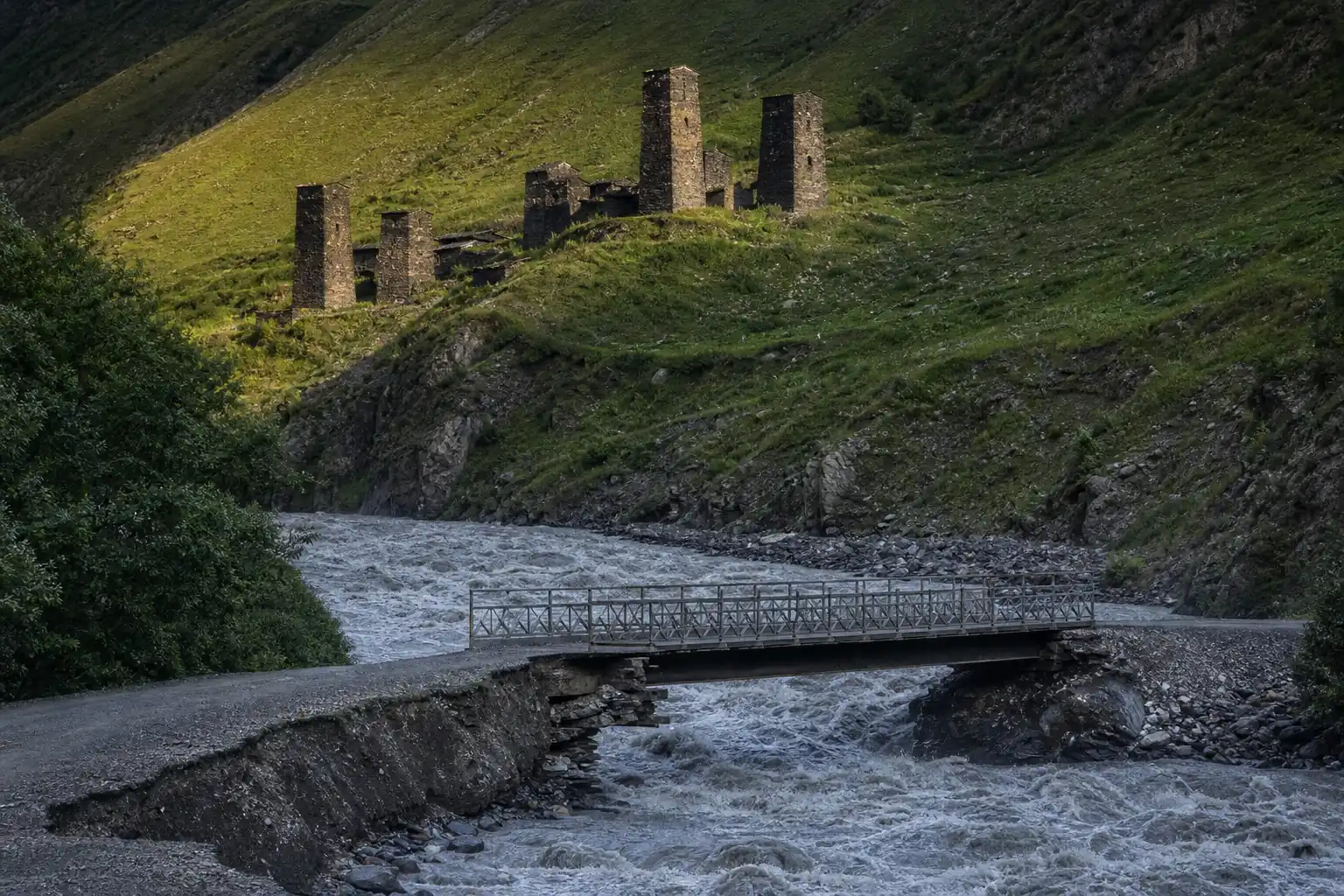
A washed-out bridge cutting off four villages in Georgia’s Tusheti highlands reopened on July 21, two days after floodwater and melting snow tore out a support. The Tusheti Protected Landscape administration said repair crews restored the crossing linking Shenako and Diklo with Omalo and Bari, the cluster of stone tower villages that anchor Georgia’s most isolated national park.
The fix took two days. The single road network binding Tusheti’s valleys together, with no backup route anywhere in the system, is the same one that stranded more than 200 residents and tourists during a similar storm four years ago.
A Bridge Support Gives Way Near Shenako
Heavy rainfall combined with melting mountain snow on July 19, and the runoff sent water levels in Tusheti’s rivers surging, the Tusheti Protected Landscape administration said.
A powerful current tore away one of the supports holding up a bridge at the edge of Shenako. Part of the roadway went with it, severing the only link between that village cluster and Omalo, the region’s administrative hub, and the settlement of Bari.
Officials told residents in Shenako and Diklo to stay inside their homes or family guesthouses while engineers assessed the damage. Soil along the riverbank was still shifting, and the road stayed off limits to vehicles.
Due to safety regulations, it is strictly forbidden to approach the damaged road section by transport, as the process of soil collapse is still dynamic.
The Tusheti Protected Landscape administration said that in its initial warning on July 19, adding at the time that it could not yet say when traffic would resume.
By July 21, the administration said the bridge had been rebuilt, letting residents and visitors move through the area again safely and without restrictions.
Why Does Tusheti Flood in the Middle of Summer?
Tusheti’s rivers run on snowmelt as much as rainfall, and in mid-July both can spike together. The region’s peaks hold snow well into summer, so a warm downpour can trigger a sudden surge in rivers already running high with melt, right in the middle of the area’s busiest tourist month.
The Abano Pass, the only road into Tusheti, tops out at 2,864 meters (9,396 feet) elevation, among the highest drivable crossings anywhere in the Caucasus. Snow can sit on the surrounding peaks into early summer, and every storm that follows adds more water to rivers that never fully drain.
Georgia’s Roads Department, which is midway through an eight-section rehabilitation of the route, says the road carries traffic for only four to five months a year.
That narrow window is also why the damage lands so hard. Nobody drives the road in January, so a closure then would cost nothing. In July, every lost day comes out of the only season the region has to earn a living.
Four Villages, One Road In
Only a few hundred people live in Tusheti through the warm months, spread across Omalo, Shenako and Diklo, the core settlements of what locals call the Chagma valley. It is the only one of Tusheti’s four historic communities that is still densely populated.
Winter empties the region out almost completely. Most families relocate to the lowland towns of Alvani and Akhmeta in Kakheti, mirroring the seasonal movement of their sheep. Shenako, one of the villages cut off by the July 19 break, is a rare exception. One family stays there through the snow.
Summer runs the opposite way. Shepherds drive flocks up from the lowlands each spring and back down each autumn, a transhumance tradition that shapes the region’s economy alongside tourism. Guesthouses across Omalo, Dartlo and Diklo book up fastest in July and August, when the reserve’s eleven marked hiking trails across the protected area draw most of the year’s visitors.
The region’s exposure comes down to a handful of overlapping facts:
- One road in, no detour: the whole region depends on a single unpaved route, with no alternate way to drive in or out.
- A high choke point: the Abano Pass sits near 2,864 meters and is the first stretch to close each autumn.
- A short operating window: the route carries vehicle traffic for roughly four to five months a year.
- Rougher roads once you’re inside: the tracks linking villages such as Omalo and Diklo can be worse than the pass itself.
- Ongoing repair, not one-time fixes: crews clear slides and washouts through the season just to keep that one road open.
That last point is what failed on July 19. The bridge near Shenako was not part of the Abano Pass itself. It was one of the smaller internal crossings that the main road’s rehabilitation budget was never built to cover.
Georgia Has Been Here Before
This was not the first time heavy rain cut Tusheti off. In July 2022, a similar storm damaged the region’s main access road and stranded more than 200 residents and tourists, according to Agenda.ge, a Georgian news agency. Rescue teams spent several days evacuating people to Telavi, the nearest large town, before the road reopened.
Tbilisi’s response at the time was a big one. Georgia’s Ministry of Infrastructure announced a 100 million lari (roughly $34 million) rehabilitation of the 72 kilometer Pshaveli-Abano-Omalo road, the only route to Omalo, with work planned in stages through 2025.
| Detail | July 2022 | July 2026 |
|---|---|---|
| What failed | The main Pshaveli-Abano-Omalo access road | A bridge support near Shenako, inside the park |
| Area cut off | All of Tusheti | Shenako and Diklo, isolated from Omalo and Bari |
| People affected | More than 200 residents and tourists | Residents and guests told to shelter in place |
| How it ended | Multi-day evacuation to Telavi | Bridge rebuilt and reopened within two days |
| Follow-up investment | Lari 100 million road upgrade announced | Not yet announced |
The 2026 break healed faster than the 2022 one, and nobody needed evacuating this time. But the bridge that gave way sat outside the stretch of road that money was meant to fix.
The Upgrade That Skipped This Bridge
Georgia’s Roads Department has been rebuilding the Pshaveli-Abano-Omalo road in pieces since the 2022 announcement. Tender records describe the work section by section, covering nearly 30 kilometers of the route across its first two tendered sections, with paving, drainage and slope repairs.
None of that work touches the internal roads between Omalo, Shenako, Diklo and Dartlo, the tracks locals say are sometimes worse than the pass itself. Those are the roads, and the small bridges on them, that keep failing.
The same wet spell reached other parts of the country this month. Azernews, an Azerbaijani news outlet, reported that flooding overtook a highway near the Sakdri Bridge crossing in Georgia’s western Imereti region the same week, forcing an emergency closure hundreds of kilometers from Tusheti.
What We Know
- The bridge near Shenako failed on July 19 after heavy rain and snowmelt, and reopened on July 21 after repair work, according to the Tusheti Protected Landscape administration.
- A comparable rain-triggered closure of the main access road stranded more than 200 people in July 2022, according to Agenda.ge.
What Remains Unconfirmed
- Whether other internal bridges in Tusheti’s village network carry similar risk before the road closes for the season.
- The current completion status of the 2022 road safety project, which targeted substantial completion by 2025.
The Abano Pass is due to stay open into September or October this year, conditions permitting. Crews keep the route clear of landslides and washouts for as long as the season runs, one repair at a time. For now, Tusheti’s four valleys have their one road, and their one bridge, back.
Frequently Asked Questions
When does the Abano Pass usually close for the winter?
The pass typically shuts down by mid-October, though the exact date shifts with snowfall, and it does not reliably reopen until late May or early June. Outside that window Tusheti has no vehicle access at all, and some homestays do not open until July.
How do people reach Tusheti when the road is closed?
Mostly, they don’t. Vehicle access ends once the first heavy snow closes the Abano Pass. Seasonal government helicopter flights operate from Tbilisi during parts of the closed months, echoing weekly flights Georgia once ran to Omalo for border guards and permanent residents, but there is no scheduled winter substitute for the road.
Is Tusheti safe to visit now that the bridge has reopened?
Yes, according to the Tusheti Protected Landscape administration, which said the crossing was rebuilt and that residents and visitors can move through the area safely and without restrictions. The wider network still includes landslide-prone stretches that crews clear routinely, so conditions can change fast after heavy rain.
How many people live in Tusheti through the winter?
Very few. Most of the region’s historic villages empty out once snow closes the road, with residents wintering in the Kakheti lowland towns of Alvani and Akhmeta instead. Shenako, one of the villages affected by the July 19 bridge failure, is a rare exception, with a single family staying through the cold months.
How much has tourism to Tusheti grown in recent years?
Sharply, by regional trekking operators’ estimates. Annual visitor numbers are estimated to have climbed from roughly 1,000 in 2008 to more than 15,000 by 2018, driven by growing interest in the region’s medieval tower villages and multi-day hiking routes, though the single road remains the hard limit on how much further that growth can go.