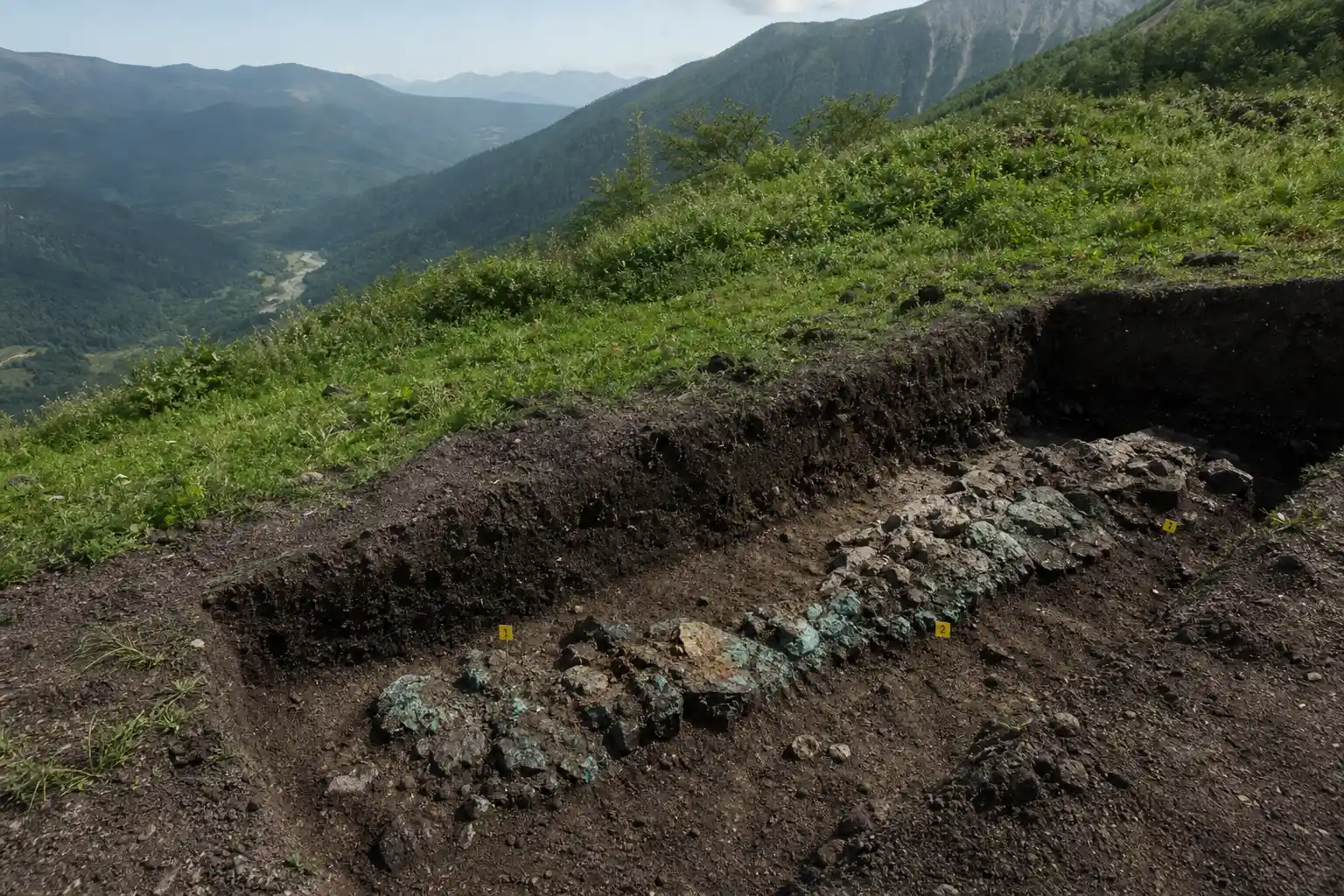
Archaeologists have uncovered the largest Bronze Age metal-smelting workshop yet found in ancient Colchis, a 3,000-year-old copper complex buried in the mountains of Lechkhumi in western Georgia. The University of Oxford dated the site to the 13th through 9th centuries BC. The dig is led by the Georgian National Museum, working with researchers from the UK, Israel and Italy, and it confirms years of suspicion that this remote valley once anchored the Caucasus’s copper trade.
Georgia has found a metal site this significant before. The last one, a gold mine once called the oldest on Earth, did not survive contact with a modern mining company.
A Workshop Larger Than Any Other Found in Colchis
The complex sits in Doghurashi, a village in Tsageri Municipality within Lechkhumi, a historical province in Georgia’s Racha-Lechkhumi-Kvemo Svaneti region. The Georgian National Museum calls it the largest Bronze Age metallurgical workshop of its kind ever found in Colchis, the ancient Black Sea kingdom that once covered much of western Georgia.
Furnace remains and processing debris cover the site. Analysis at the University of Oxford placed its active period across the 13th to 9th centuries BC, spanning the Late Bronze Age into the Early Iron Age.
That timing lines up with other evidence from the region. Research published in the Journal of Archaeological Science found that the South Caucasus was a major center of metal production during those same centuries, concentrated in the hills above the Black Sea’s eastern shore.
Archaeologist Nana Rezesidze leads the excavation. Historian Nino Sulava heads research into the copper workshops themselves, working alongside Georgian and international specialists.
Who Is Digging in Doghurashi?
The excavation is a joint project run by the Georgian National Museum and backed by Georgia’s Ministry of Culture, with researchers from the United Kingdom, Israel and Italy working alongside Georgian specialists. Four people anchor its public face, from the archaeologist directing the trenches to the regional official who toured the finished dig this year.
- Nana Rezesidze – the archaeologist leading the excavation on the ground
- Nino Sulava – the historian heading research into the ancient copper workshops
- David Lordkipanidze – Georgian National Museum Director General, who toured the finished trenches
- Papuna Margvelidze – State Representative in Racha-Lechkhumi and Kvemo Svaneti, who joined the site visit with local officials and invited guests
Their work builds on groundwork most people outside Georgia have never heard of.
Ten Years Before This Trench Opened
Georgian National Museum teams first scouted Lechkhumi’s copper potential in 2013 and 2014, running reconnaissance surveys across the province. That early legwork became a peer-reviewed paper in 2022, when Rezesidze and Sulava joined three co-authors to publish research on Late Bronze Age copper production in Lechkhumi in the journal Historical Metallurgy.
That paper built on a bigger academic case that had been forming since at least 2014. Oxford researchers Nathaniel Erb-Satullo and Brian Gilmour, working with Georgian archaeologist Nino Khakhutaishvili, had already shown that ancient Colchis held an unusually dense concentration of copper smelting sites, a record their own research describes as rich but still largely unfamiliar outside the former Soviet Union.
One 2014 study on the region also found that Colchian metalworkers were using tin bronze earlier than expected, evidence pointing to nearby ore rather than imported tin. That detail undercut old assumptions that the Caucasus only received metallurgical know-how from more famous centers to the south.
The Mine That Didn’t Survive Its Own Discovery
Doghurashi is not the first Georgian metal site to draw international attention. In 2004, a joint Georgian-German team began examining Sakdrisi, a hill in the Bolnisi district about 95 kilometers southwest of Tbilisi. By the early 2010s, researchers had documented ancient shafts, stone hammers and antler picks old enough to call Sakdrisi, tentatively, the world’s oldest known gold mine, dating to somewhere in the fourth to third millennium BC.
In 2013, the Georgian government stripped Sakdrisi of the cultural monument status it had held since 2006. A government-appointed commission argued there was no proof gold had ever been extracted there, a conclusion most archaeologists who had worked the site rejected. The decision cleared the way for RMG Gold, a Russian-owned mining company already working a neighboring copper deposit, to fold Sakdrisi into its concession.
Sakdrisi is the oldest gold mine worldwide.
Hermann Parzinger, president of Germany’s Prussian Cultural Heritage Foundation, wrote those words to the Georgian government in 2013, arguing the site belonged to the world, not just to Georgia. Officials were not persuaded. Then-Prime Minister Irakli Gharibashvili noted that RMG Gold had already invested $300 million in the Georgian economy and employed 3,000 people, a case that outweighed a Bronze Age one for preservation.
TICCIH, the International Committee for the Conservation of the Industrial Heritage, designated Sakdrisi as heritage at risk that November, warning that planned opencast mining would destroy the prehistoric site. Open-pit operations began anyway in late 2014.
Three of Georgia’s most studied ancient metal sites have followed very different paths since their discovery:
| Site | Region | Metal | Approximate Date | Status Today |
|---|---|---|---|---|
| Doghurashi workshop | Lechkhumi (Tsageri) | Copper | 13th-9th century BC | Active dig, Ministry of Culture-backed |
| Sakdrisi-Kachagiani | Kvemo Kartli (Bolnisi) | Gold | 4th-3rd millennium BC | Heritage status revoked 2013; opencast mining since 2014 |
| Chorokhi estuary furnaces | Colchis (southeastern Black Sea) | Iron and bronze | c. 1500-600 BC | Studied since 2001; ongoing academic research |
Doghurashi’s furnaces remain in the ground for now, protected by the same Ministry of Culture that once withdrew protection from Sakdrisi.
Modern Mining Claims Already Circle the Old Copper Belt
Racha-Lechkhumi still carries mineral wealth well beyond its Bronze Age slag heaps. A 1933 Soviet-era geological survey, cited in the 2022 Lechkhumi copper paper, had already logged a copper ore deposit near Opitara, a village in the same Tsageri district as Doghurashi.
Mineral databases list gold occurrences scattered through the wider district too, including a gold deposit on the Tskhenistskali River in Tsageri district. Georgia’s Ministry of Economy has already acted on that kind of potential elsewhere in the province.
According to the U.S. Geological Survey’s mineral industry report on Georgia, the ministry issued two 10-year exploration and mining licenses in northern Racha-Lechkhumi in July 2021, covering more than 1.5 square kilometers in a district that already includes an RMG Copper operation.
Nothing ties those specific licenses to Doghurashi’s plot of land. The Ministry of Culture’s presence at this year’s site visit, with Lordkipanidze and Margvelidze among the guests, points to a different posture than the one Georgia took toward Sakdrisi. But the region’s copper and gold have drawn commercial interest before, and Sakdrisi is proof of how fast that interest can outrun a heritage designation.
Lordkipanidze and Margvelidze walked the Doghurashi trench together this summer. Thirteen years ago, Georgian officials walked away from Sakdrisi instead.
Frequently Asked Questions
What is Colchis, and how does it connect to the Golden Fleece myth?
Colchis was the ancient kingdom that covered much of what is now western Georgia, including Lechkhumi and Svaneti, and Greek myth places Jason and the Argonauts there hunting the Golden Fleece. Classical writers described local miners using sheepskins to trap gold dust from mountain streams, a detail often cited as the myth’s real-world root, tied to Svaneti’s genuine ancient gold-panning tradition just north of Lechkhumi.
Where exactly is Lechkhumi, and how far is Tsageri from Tbilisi?
Lechkhumi is a historical province inside Georgia’s Racha-Lechkhumi-Kvemo Svaneti region, with Tsageri as its administrative center. Tsageri sits about 318 kilometers from the capital, Tbilisi, and roughly 70 kilometers from Kutaisi, Georgia’s second-largest city, reached through the mountainous Rioni river valley.
How did researchers determine the copper workshop’s age?
Georgian excavators sent material recovered from the furnace and slag deposits to a laboratory at the University of Oxford, which returned a date range spanning the 13th to 9th centuries BC. That range matches earlier work on Colchian metallurgy, which also relied on Oxford-based analysis of slag and technical ceramics from other western Georgian smelting sites.
Why did Georgia strip protection from the Sakdrisi gold mine in 2013?
A government commission concluded there was insufficient proof gold had ever been mined at Sakdrisi, a finding most archaeologists who had worked the site rejected, and the Ministry of Culture and Monument Protection revoked its cultural monument status that year. The decision cleared the way for RMG Gold, already mining a neighboring copper deposit, to expand into the prehistoric mine.
Can archaeologists still visit the Sakdrisi site today?
Sakdrisi technically remains listed as an official archaeological site, but Georgian National Museum archaeologist Goderdzi Narimanishvili has reported that much of it is now covered in earth, and the mining company does not allow archaeologists or journalists onto the property to check on what remains.