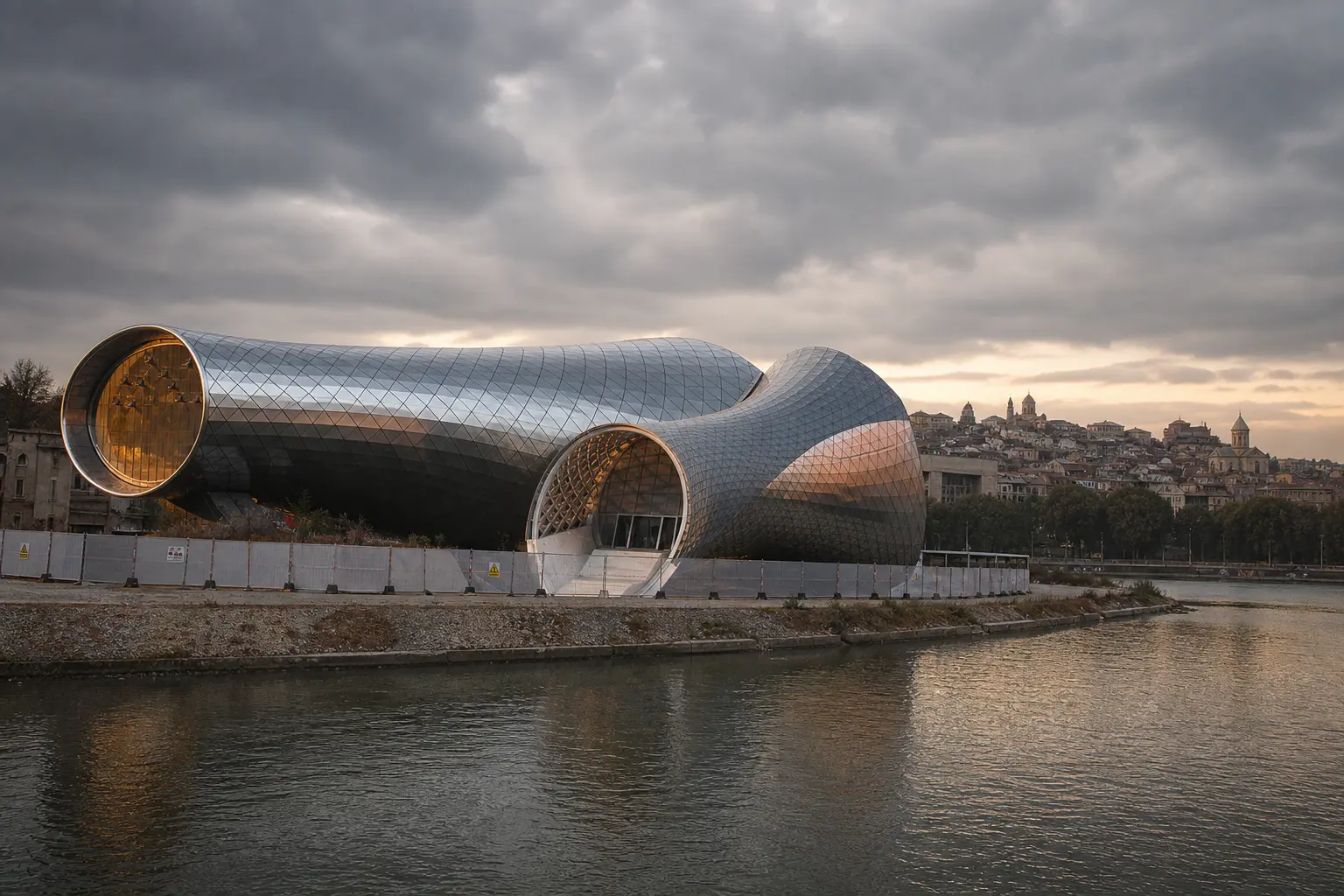
Georgia’s Vice Prime Minister Mamuka Mdinaradze says restoring Tbilisi’s abandoned Rike Tubes would cost more than the structure is worth. Studio Fuksas, the Italian firm that designed it, says the city never wrote back to a single one of its letters.
The tube shaped concert hall has sat empty beside the Kura River since 2012, when a change of government shelved Georgia’s push to look Western. Fourteen years later, officials are tearing it down just as that same push toward Europe has stalled all over again.
Kaladze Says No Letter From Fuksas Ever Arrived
Speaking to journalists this month, Mdinaradze, who also serves as State Minister for the Coordination of Law Enforcement Agencies, said people familiar with the building had concluded it was poorly designed, with serious flaws in its climate control system.
“To get inside this building and give you a chance to survive would cost much more than the building itself,” Mdinaradze said.
He compared it to Georgia’s former parliament building in Kutaisi, where he said some floors had reached 55 degrees Celsius because of a failed ventilation system. The Rike Tubes, sometimes labeled Rike Docks in official notices, are worse, he claimed.
Mdinaradze added that no investor had ever made the building work, and that its owners are now willing to give the structure away to anyone prepared to rebuild it somewhere else.
“The owners are ready not only to dismantle it, but to give it to any interested person who wants to rebuild it in another place,” Mdinaradze said. No one has taken them up on it, he added, because of the expected cost.
Tbilisi Mayor Kakha Kaladze, a former AC Milan defender who now serves as Georgian Dream’s secretary general, aimed a similar argument directly at Studio Fuksas. The firm had told the architecture publication Dezeen that it spent the past year trying to reach Tbilisi City Hall and the building’s private owners about alternatives to demolition, without a single reply. Kaladze said no such letters ever arrived.
“No letter has been received from them. If it had been received, the relevant municipal services would have responded,” Kaladze said.
He said the decision on the Rike Tubes had already been made, called the building nonfunctional, and put the public spending on it at tens of millions of GEL, the Georgian lari. The building is privately owned now, he added, so its future is not City Hall’s call. If Fuksas wants a different outcome, he said, it should negotiate with the owner directly.
A Steel Periscope Commissioned for a Government That Fell
The Rike Tubes almost happened. Studio Fuksas, led by architects Massimiliano and Doriana Fuksas, was commissioned in 2011 to design a music theatre and exhibition hall for Rike Park, the riverside promenade President Mikheil Saakashvili was building to announce Tbilisi as a Western facing capital.
The government hired international names for the job. Michele de Lucchi designed the park’s glass topped Peace Bridge. Fuksas designed both the park’s twin tube structures and, across the river, the mushroom canopied Public Service Hall.
“It is a periscope to the city and looks towards the river framing the historic core of Old Tbilisi,” the studio said of its design.
The two connected structures were designed to hold 566 seats across 14,591 square meters of steel and glass, financed through Tbilisi’s municipal budget at a cost of roughly €40 million.
Construction was largely finished by 2012. Then Georgian Dream, the party founded by billionaire Bidzina Ivanishvili, took power from Saakashvili’s United National Movement that October. The project simply stopped. The Rike Tubes never opened.
Four Owners in Fourteen Empty Years
For most of the next decade, the Rike Tubes sat on the Economy Ministry’s books, too expensive to finish and too strange to sell. The state auctioned it more than once, cutting the asking price each time from an opening GEL 95 million, about $36 million.
By 2020, Kaladze himself said no investor wanted it, even free, because finishing the interior would take another GEL 20 million, roughly $8 million. Georgian fact checking outlet FactCheck.ge later tallied GEL 75 million, about $29 million, already spent on the site by that point.
A sale finally went through in 2022, when the National Agency of State Property auctioned the building to a private developer for about €10 million, or GEL 47 million. Control passed through businessman Davit Khidasheli’s company, Global Victory Trust, before Rike Dom LLC bought it in April 2025. Rike Dom’s owner sold the firm on to Makro Property that June in a deal worth $2.84 million.
| Year | Event | Value |
|---|---|---|
| 2010 to 2012 | Built by the Georgian state under Saakashvili | Roughly €40 million |
| 2020 | Kaladze says no investor wants it even for free | GEL 20 million ($8 million) more needed to finish |
| 2022 | State auctions the building to its first private owner | About €10 million (GEL 47 million) |
| April 2025 | Sold to Rike Dom LLC by Khidasheli’s Global Victory Trust | Undisclosed |
| June 2025 | Rike Dom sold on to Makro Property | $2.84 million |
The entity now known as Rike Dome is wholly owned by Makro Constructions, whose owner is Emin Uchar, a dual citizen of Turkey and Georgia, according to reporting from the outlet OC Media. It is Uchar’s company that applied for, and received, the demolition permit.
The Architects Who Read About It in the Press
Studio Fuksas found out the way most of Tbilisi did, through news reports. “We have been given very little information,” Massimiliano Fuksas told The Architect’s Newspaper. “We didn’t know anything. We had no contact with them.”
The studio said it had spent the past year offering to work with Georgian authorities on alternatives, all of it ignored. “The loss of an internationally recognized and award winning work of architecture would represent a significant cultural setback,” it told Dezeen, adding that demolition would only pile new public expense on top of the original bill.
In more than sixty years of professional practice, this is the first time Studio Fuksas has faced the demolition of one of its projects without ever being invited to discuss possible alternatives.
The studio said so in its statement to Dezeen, which also carried its founders’ appeal to the building’s owner to reconsider.
Public patience with the site had already worn thin before that statement landed. A teenager died after falling into a pit at the neglected complex in January 2025, an accident that revived pressure on officials to act. That May, Prime Minister Irakli Kobakhidze said the building’s “ugliness does not befit our beautiful capital.” Tbilisi’s Cultural Heritage Protection Council endorsed demolition in June 2026, and the city’s Architecture Service issued the formal permit on July 13.
“Together with the Cultural Heritage Council, we gave the owner the opportunity to proceed with the demolition,” Kobakhidze said this July, adding that officials would wait for a new development plan before weighing in again.
Who Will Get Rike Park’s Riverside Land Next?
Nobody has filed a redevelopment plan yet, but a government decree already clears the way for a hotel on the site once the tubes come down. That leaves Makro Constructions, which paid under three million dollars for the company holding the property last year, sitting on some of the most valuable river frontage in the capital.
The decree, issued on May 6, 2025, opened the Rike Docks site to hotel development. Kaladze has said the same thing twice now: once the tubes are gone, the city will wait for the owner to submit a project, then review it.
That review will happen against a backdrop of rising political risk for anyone investing in Georgia. Georgian Dream’s decision to freeze the country’s EU membership talks has already pushed Western law firms to warn clients of growing political and security uncertainty across the South Caucasus.
No design has been shown publicly. For now, Rike Park’s most prominent empty lot is simply waiting for someone to file paperwork that City Hall says it has not yet seen.
Georgia’s Own Path to Europe Is Frozen, Too
The Rike Tubes were always more than a concert hall. Saakashvili commissioned Italian and Spanish architects across Tbilisi specifically to signal that Georgia belonged with the West. Fourteen years on, the government tearing down his most literal monument to that idea is the same government that has just frozen the underlying project.
Georgia gained European Union candidate status in December 2023. Georgian Dream suspended accession talks in November 2024, a move the Council of the European Union says brought the process to a de facto halt. Talks are not due to resume before 2028.
Kaladze, who doubles as Georgian Dream’s secretary general, has waved off criticism of that freeze before. “As for the European bureaucracy and the West, all their statements are full of lies,” he told journalists after a critical EU assessment, adding that European officials were bitter that Georgians had defeated them at home.
The European Parliament has since urged sanctions on several Georgian Dream officials by name, Kaladze among them, alongside Kobakhidze and former Prime Minister Bidzina Ivanishvili.
- 2011: Studio Fuksas is commissioned to design Rike Park’s twin tube structures under President Mikheil Saakashvili.
- October 2012: Georgian Dream takes power from Saakashvili’s party, and construction on the nearly finished building simply stops.
- 2022: The state auctions the building to a private developer for the first time in a decade.
- December 2023: Georgia is granted European Union candidate status.
- November 2024: Georgian Dream suspends EU accession talks until 2028, triggering mass protests.
- January 2025: A teenager dies after falling into a pit at the neglected site.
- June 2026: Tbilisi’s Cultural Heritage Protection Council endorses demolition.
- July 13, 2026: The city’s Architecture Service issues a formal demolition permit.
- December 25, 2026: The deadline for the owner to finish dismantling the building.
Whatever eventually rises on that riverside, the paperwork for it will cross the desk of a mayor the European Parliament has already asked Brussels to sanction, in a country that has already put its own European ambitions on ice until at least 2028.
Frequently Asked Questions
Will Demolition Affect the Rest of Rike Park?
No. The permit covers only the twin tube structures. Rike Park’s other landmarks, including Michele de Lucchi’s glass topped Peace Bridge, the Narikala cable car station, and the park’s amphitheater and musical fountain, are not part of the plan and will stay open to the public.
Was the Concert Hall Ever Used for Anything?
Briefly, and unofficially. The collective behind Tbilisi’s famous Bassiani club held its first ever party inside the unfinished structure in 2013, a year after construction stalled. It never hosted a sanctioned concert or exhibition.
Is Fuksas’s Other Tbilisi Landmark Also at Risk?
No. The studio’s Public Service Hall, completed around the same time on the opposite bank of the Kura River, remains in active government use and has not appeared in any demolition plan.
What Could Replace the Rike Tubes?
A hotel is the only use named so far. The May 2025 decree opened the site to hotel development, though its wording leaves room for other proposals too. Neither Tbilisi City Hall nor Makro Constructions has filed a formal design.