Six universities are launching Georgia’s first Superfund research center this year, backed by $15 million in federal funding. The question they are chasing is one Brunswick, Georgia residents have asked for decades: what is actually in the floodwater that keeps rising around their homes.
Half a mile from Semona Holmes’s porch sits a shuttered pesticide plant turned federal Superfund site, one of four such sites in Glynn County that a changing climate is starting to test in new ways. Scientists now say rising seas and stronger storms could unlock chemicals regulators once assumed were sealed for good.
A $15 Million Answer to Decades of Questions
The National Institute of Environmental Health Sciences (NIEHS), part of the National Institutes of Health, is putting $15 million behind the effort over five years. Emory University leads a team that also includes the University of Georgia, Georgia Institute of Technology, Morehouse School of Medicine, Spelman College and Texas Tech University.
Emory’s own announcement counts fewer than 24 Superfund Research Centers nationwide, which makes Glynn County’s the first one in Georgia.
“By combining cutting-edge exposure science and health research with direct community partnerships, the center will translate complex environmental data into practical information that can support healthier decisions for families, clinicians, and policymakers,” said Dana Barr, a professor of environmental health at Emory’s Rollins School of Public Health and the new center’s director.
The work has two main goals, according to Noah Scovronick, an Emory public health professor on the project. “One is to understand the health effects of past chemical exposures, and the other is to try and reduce people’s future exposures,” he said.
That means tracing links between the toxic substances left at old industrial sites and possible health effects, then running environmental sampling to figure out how and where people actually get exposed.
Climate Change Complicates the Cleanup
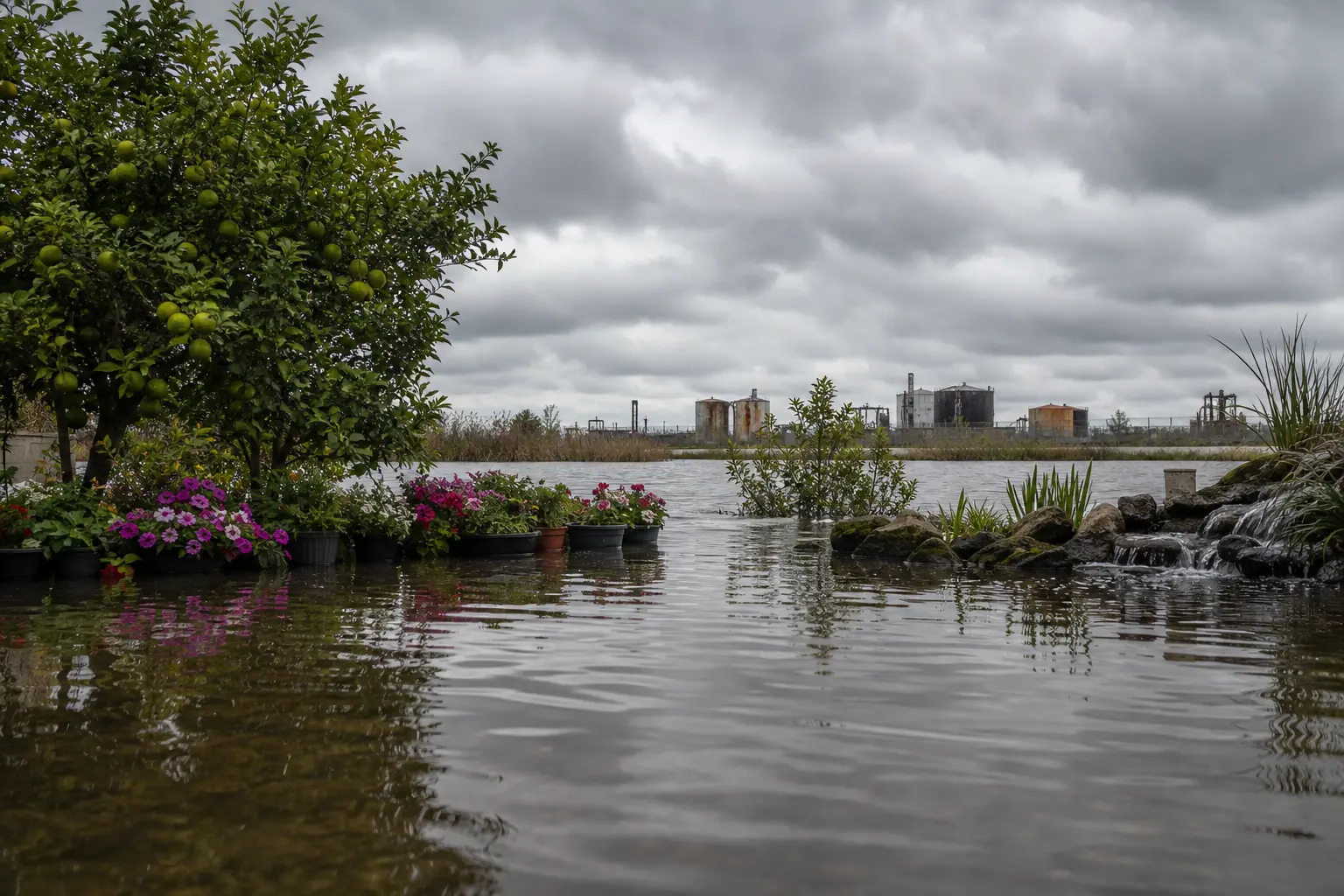
“More exposure to extreme weather could actually release more of the contaminants into the environment,” Scovronick explained. Rising sea levels and groundwater, along with stronger storms, could flood the sites and spread chemicals into the surrounding environment.
On sites where toxic material sits inside structures or under protective caps, flooding could breach the very barriers meant to keep people safe. “We want to be sure that the remediation that is ongoing at those sites is resilient to extreme weather moving forward,” Scovronick said.
Barr told Georgia Public Broadcasting the center is weighing engineering methods that could pull toxins out of water in fragile marsh ecosystems entirely. “Because we’re concerned if you have extreme weather like flooding, which is not uncommon in this area, that these chemicals might be released and migrate to other areas in the marshland,” she said. The goal, in her words, is to “go in and actually break these chemicals down, break them into components that are not toxic.”
The EPA already runs its own version of this exercise. The agency’s climate program calls for periodic screening of Superfund remedy vulnerabilities at sites where rising seas, heavier rain or wildfire could undo a cleanup that regulators already consider finished.
Four Sites, One Contaminated Coastline
Glynn County’s pollution problem goes back more than a century. Industrial plants along the coast made pesticides, paint, chlorine gas and treated lumber for decades before environmental law caught up with them.
| Site | Primary Contaminants | Operated / Listed | Notable Detail |
|---|---|---|---|
| LCP Chemicals | PCBs, mercury, lead, dioxins | 1919 to 1994; listed 1996 | 813 acres, the largest of the four, mostly tidal marsh |
| Hercules 009 Landfill | Toxaphene | 1948 to 1980; listed 1984 | Smallest site; unlined trenches leached pesticide waste |
| Terry Creek Dredge Spoils / Hercules Outfall | Toxaphene | Discharges tied to Hercules manufacturing | Four source areas between the plant and the Back River |
| Brunswick Wood Preserving | Creosote, pentachlorophenol, chromium/copper/arsenic | 1958 to 1991 | 1989 spill sent contaminated diesel fuel into Burnett Creek |
PCBs, chemicals once common in industrial manufacturing that persist in soil and water for decades, turn up across several of these sites. Toxaphene is a pesticide, similar to DDT, that the EPA banned in 1990.
More than 700 acres of contaminated salt marsh at the LCP site alone remain under federal trusteeship, NOAA says, threatening the dolphins, shrimp and blue crab that depend on the estuary.
What Did Emory’s Blood Study Find in Glynn County?
Emory researchers tested blood from 97 Glynn County residents in 2023 and published the results in 2025. Forty percent showed higher-than-average levels of a toxicant tied to the old LCP Chemicals plant, and 20% showed elevated levels of a second chemical linked to the Hercules Brunswick facility.
Both are legacy pollutants from plants that stopped running decades ago. “Even when production stops, these chemicals can continue to get into people’s bodies through lingering exposure pathways,” said Melanie Pearson, an associate professor at Rollins who worked on the study.
Soon after finishing that pilot work, Emory and its five partner schools applied to NIEHS to expand it into the full research center now getting underway.
Semona Holmes Wants More Than Data
Holmes’s yard, across the road from Brunswick’s waterfront, holds fruit trees, potted flowers and a fish pond. It also floods, she said on her porch on a recent afternoon, whenever rain or an unusually high tide rolls in.
“We would have like a river on our street,” she said, describing what happens when the whole area floods. The water has reached her knees before. Once, after a hurricane, a neighbor paddled a canoe down the block.
Stormwater upgrades have helped some in recent years. But her worry runs deeper than an inconvenienced street. “Everything from that chemical plant has flowed into our community,” she said.
Her family doesn’t drink the tap water or eat fish and crab from Glynn County’s waterways. She has six grandchildren, several of whom attend an elementary school just blocks from the site. “We want them to be healthy,” she said. “And you don’t want to worry about, they’re playing on a playground that has contaminated soil.”
“It shows that you care about humanity. And that you are able to acknowledge that, ‘yeah, by our actions, we have possibly contaminated an entire county.’”
Holmes said even damage that can’t be undone is worth documenting, and acknowledging, by the companies that once ran Glynn County’s industrial sites. Recognition alone isn’t enough, she added: “there has to be continued action.”
Brunswick’s Risk Fits a National Pattern
Glynn County isn’t an isolated case. A 2019 federal watchdog analysis found that 60 percent of Superfund sites face flood or fire risk, based on data covering 945 of the nation’s 1,571 nonfederal priority cleanup sites.
A newer review goes further. EPA’s inspector general reported this spring that roughly 100 toxic sites sit in flood zones among the 157 federal Superfund properties it reviewed, with about 3 million Americans living within a mile of them and 13 million within three miles.
Many of those five-year cleanup reviews never accounted for the stronger storms or rising seas now reaching the sites, the report found. “That is a big problem because it means the site managers are not planning mitigation measures,” said Betsy Southerland, a former director of the EPA’s water protection division who spent more than three decades at the agency.
The report never uses the phrase climate change, a term this administration has removed from many federal sites. President Trump rescinded an Obama-era climate preparedness order in 2017, and the language has stayed largely absent from Superfund oversight since.
Five Studies, One Deadline Set by the Tide
The center’s work breaks into five research tracks, according to Georgia Tech.
- Human health research – evaluates links between chemical exposure and metabolic disease.
- Toxicity testing – measures exactly how the contaminants damage health.
- Environmental sampling – traces soil and water exposure pathways across the county.
- Extreme weather modeling – simulates how storms and flooding move the chemicals.
- Remediation research – tests low-impact cleanup methods suited to marsh and tidal creek ecosystems.
Researchers describe the fourth track as modeling how storms move hazardous chemicals through the marsh, the same flood pathway Holmes watches from her porch.
The stakes are rising along with the population. Just outside town, developers recently finished a 237-unit build-to-rent townhome community in Brunswick, adding new households near a floodplain that is already testing decades-old containment systems.
Researchers met with residents like Holmes before finalizing their plans, so the studies would answer the questions Glynn County has carried for years. The work itself is expected to begin later this year and run the length of the five-year grant.
Frequently Asked Questions
What Is a Superfund Site?
A Superfund site is a heavily polluted location that the U.S. Environmental Protection Agency has placed on its National Priorities List for federally supervised cleanup. The designation covers hazardous waste dangerous enough to threaten human health or the surrounding environment, and it can remain in effect for decades after a plant stops operating.
How Many Superfund Sites Does Georgia Have?
Georgia counts 23 Superfund sites on the federal priorities list, four of them in Glynn County. Coastal Georgia alone carries more than 60 sites on the state’s broader Hazardous Site Inventory, a separate state registry that includes contaminated properties beyond the federal list.
Is Brunswick’s Tap Water Safe to Drink?
Brunswick’s public water system draws from the deep Upper Floridan Aquifer and is reported to meet federal standards. Even so, some residents, including Holmes and her family, choose not to drink it and avoid eating fish and crab caught in local waterways as an added precaution.
Who Owns the LCP Chemicals Site Today?
Honeywell owns the property now known as the LCP Chemicals Superfund site and works with the EPA on the remediation of its roughly 813 acres, making it one of the largest Superfund properties in the country.
How Can Glynn County Residents Get Involved?
Healthy Coastal Neighborhoods, the community coalition that helped announce the funding, is building a community advisory group tied to the new center and expanding its Seafood Smart website with fish-consumption guidance. The center also plans education sessions for local health care providers who treat patients with high chemical exposure.