Physicists at the Advanced Science Research Center at the CUNY Graduate Center have run the Penrose-Zel’dovich superradiance experiment on a stationary benchtop device. Their setup mimics a spinning black hole’s ergosphere by modulating a ring of electronic resonators in space and time, the journal Nature reported on July 8, 2026. The demonstration produced wave amplification that mirrors what a fast-rotating black hole could trigger around itself. The team argues the same mechanism could feed research in wireless communications, photonics, and quantum platforms that real spinning hardware cannot reach.
Two Theories, One Lab Test Half a Century in the Making
More than half a century ago, Sir Roger Penrose proposed that energy could be extracted from a rapidly spinning black hole. He argued that a particle entering the rotating hole’s ergosphere, a region where spacetime is dragged along by the rotation, could split into two fragments. One fragment would fall inward while the other escaped, carrying more energy than the original particle. Physicist Yakov Zel’dovich later proposed a wave analogue: a wave striking a sufficiently fast-rotating object could extract energy from that motion and emerge amplified.
For decades, those predictions stayed confined to theory. Spinning any real object fast enough to engage the regime would destroy the hardware before any measurement could be made. The CUNY team took a different route. Instead of moving matter, they engineered a stationary radio-frequency device that imitates ultrafast rotation by adjusting itself in a synchronised sequence. Their Nature paper, titled Observation of Floquet rotational super-radiance, documents the first controlled observation of Penrose-Zel’dovich superradiance in electromagnetic waves. The result turns a long-untestable theory into a working benchtop test.
The Ring That Doesn’t Spin
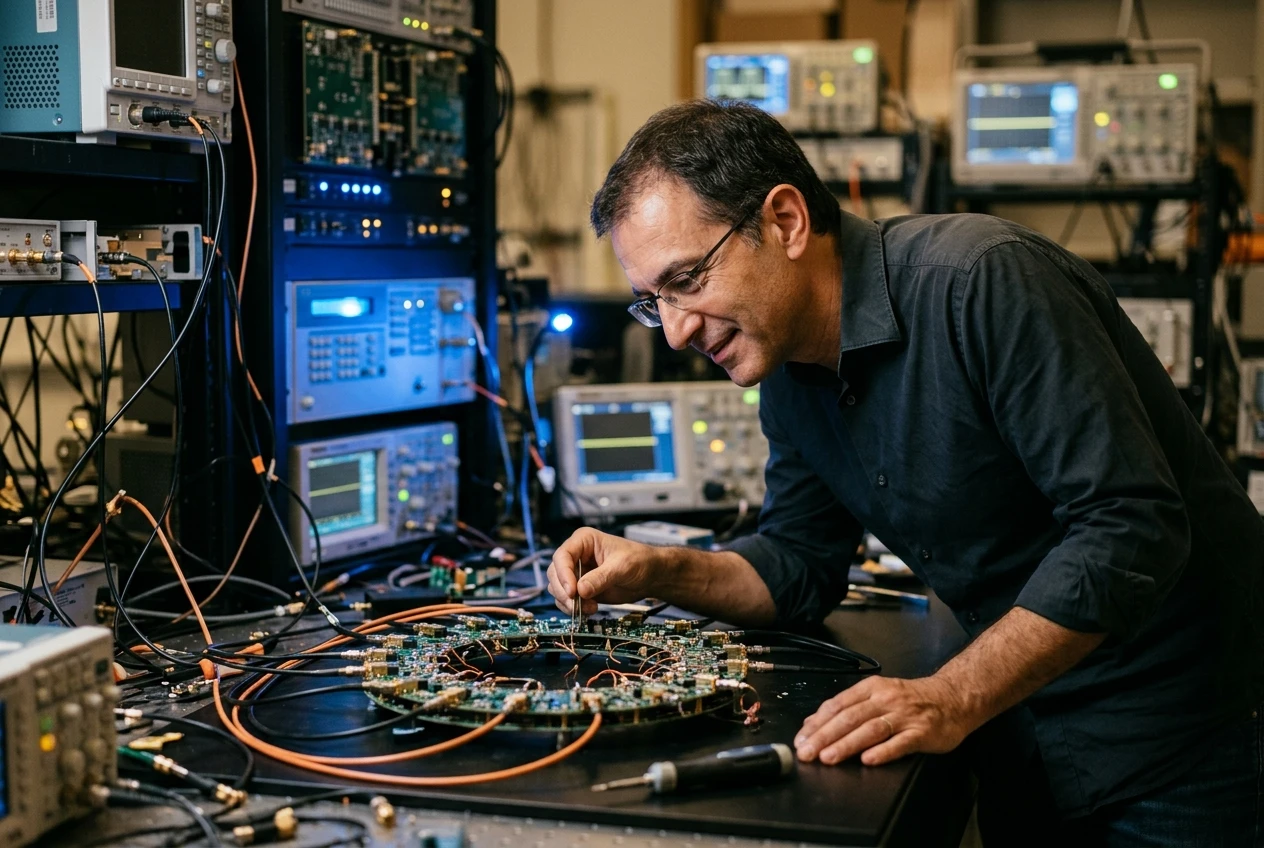
The core of the apparatus is a ring-shaped network of electronic resonators, each tuned to respond to radio-frequency signals. The team didn’t rotate the ring. They changed the resonators’ properties in a precise, synchronised sequence. As the modulation swept around the loop, the electromagnetic field inside behaved as if a real object were turning at extreme speed. Co-lead author Hady Moussa, a former Ph.D. student with the CUNY ASRC Photonics Initiative, said the device relied on engineered metamaterials that shape how waves propagate.
Electromagnetic waves sent into the ring decoded the simulated rotation through their own angular momentum. Waves with the right rotational signature absorbed energy from the time-engineered spin and emerged amplified, while mismatched waves did not.
| Mechanical rotation | Synthetic rotation (this study) | |
|---|---|---|
| Source of spin | Physically rotating matter | Time-varying resonator properties |
| Speed ceiling | Limited by material strength | Set by modulation electronics |
| Penrose-Zel’dovich superradiance observed | Not yet with a real rotor | Yes, CUNY ASRC, Nature, July 8, 2026 |
The demonstration reproduces the essential physics of the Penrose-Zel’dovich process: a stationary system handed energy to a wave because the wave carried the rotational character the system was mimicking. The method becomes testable because mechanical rotors cannot reach the rotational speeds needed for natural superradiance in any Earth-bound lab. By replacing motion with modulation, the CUNY team sidestepped the speed barrier that had stalled experimental work for half a century. The result is, the team reports, the first laboratory observation of Floquet rotational super-radiance.
Waves with the appropriate rotational characteristics extracted energy from the system and became amplified, reproducing the essential physics of the Penrose-Zel’dovich process.
The Moment the Waves Came Out Amplified
At the centre of the experiment was a single-minded question: could electromagnetic waves interacting with a completely stationary device behave as if they had encountered an object turning at ultrafast speed, drawing energy from that synthetic motion? To answer it, the researchers tuned the ring of resonators so the modulation cycle matched the rotational characteristics they wanted incoming waves to see. Waves carrying that matching angular momentum gained amplitude as they passed through the device. Waves that didn’t match the pattern did not. The selectivity is what the team calls broadband selective amplification: a controlled laboratory footprint of a phenomenon astrophysicists had previously inferred only from observations of distant black holes and rotating neutron stars.
Andrea Alù, Distinguished Professor and Einstein Professor of Physics at the CUNY Graduate Center and founding director of the CUNY ASRC’s Photonics Initiative, framed the published method as a new form of wave-matter interaction built around time-engineered rotation. He said the achievement opens a regime of inquiry that no real-world rotating laboratory hardware can match. The U.S. Department of Defense, the U.S. National Science Foundation, and the Simons Foundation funded the work, per the institutional press release distributed July 8, 2026.
The Three Researchers Behind the Apparatus
Andrea Alù, founding director of the Photonics Initiative, an engineering hub that studies wave behaviour at extreme conditions, served as principal investigator. Lead author Hadiseh Nasari is a postdoctoral researcher in the same initiative and led the experimental execution. Co-lead author Hady Moussa completed his Ph.D. as part of the project and designed the metamaterials that translated a rotating-body physics problem into a stationary one.
Moussa’s contribution centred on the engineered metamaterials that shape how waves propagate through the device. The CUNY ASRC runs the Photonics Initiative alongside programs in environmental sciences, nanoscience, neuroscience, and structural biology. The team’s framing casts the work as a versatile experimental platform for studying the intersection of astrophysics, wave physics, and quantum science. Nasari said the result moves extreme-rotation theory into a working benchtop device with uses in communications, optics, photonics, and quantum science.
Alù, who holds the Einstein Professorship of Physics at the CUNY Graduate Center, described the published method in terms of how waves with selected rotational properties extract energy from synthetic time-engineered rotation. In CUNY’s announcement on the lab demonstration, the work is described as a versatile platform for the intersections of astrophysics, wave physics, and quantum science. Funding came from the same three sponsors named in the institutional release.
Our approach facilitates a new method of wave-matter interaction in which waves with selected rotational properties extract energy from synthetic time-engineered rotation, producing a form of broadband selective amplification.
From Black Hole Theory to Wireless and Optical Work
In the lab, the synthetic-rotation platform gives researchers a way to study regimes of physics that real rotors could never enter, including motion that appears to exceed the speed of light. The team’s framing points first at wireless communications, classical and quantum optics, and photonic platforms as the most plausible near-term homes for the technique.
- Wireless: selective amplification of radio-frequency signals without spinning hardware.
- Quantum optics: a regime of light-matter interaction no real rotor can reach.
- Photonics: engineered metamaterial components that route and amplify specific wave modes.
Specific uses the team highlights include new ways to manipulate light, process information, and investigate wave phenomena inspired by some of the most extreme environments in the universe. The same time-modulated structures that imitate black hole spin can, in principle, route specific frequencies of electromagnetic radiation in photonic and radio-frequency circuits. The lab demonstration ran at radio frequencies, the band where modulator electronics are mature enough for the engineered sequence.
Practical devices still need adapting before the principle can be deployed. The published paper and accompanying announcement note that the same engineered-modulation approach could be retuned for photonic and quantum platforms beyond radio frequencies. The Photonics Initiative’s broader research spans communications, optics, and photonics work that synthetic rotation could feed into. The CUNY ASRC, founded to host initiatives across environmental sciences, nanoscience, neuroscience, photonics, and structural biology, is positioned to carry that translation work.
The team’s framing puts the published result less as a single demonstration than as the start of a versatile platform for further wave-matter experiments across the photonic and quantum bands. The Penrose-Zel’dovich effect now has, in their published account, its first controlled laboratory proof.
Frequently Asked Questions
What is the Penrose-Zel’dovich process?
The Penrose-Zel’dovich process is a theoretical framework in which a rotating black hole could surrender energy to nearby matter or radiation. Penrose proposed more than half a century ago that a particle entering a black hole’s ergosphere could split into two fragments: one falling inward, the other escaping with more energy than the original particle carried. Zel’dovich later proposed the wave version, in which waves striking a fast-rotating body could similarly gain energy. No Earth-based experiment had previously confirmed either mechanism in electromagnetic waves; the CUNY ASRC demonstration reported in Nature on July 8, 2026, is described as the first controlled laboratory observation of superradiance.
What is synthetic rotation?
Synthetic rotation is a laboratory stand-in for physical spinning. Instead of moving matter, the CUNY team rapidly modulated the properties of electronic resonators arranged in a ring. As the modulation swept around the loop, electromagnetic waves treated the system as if it were rotating at ultrafast speed. The approach reaches rotational velocities that mechanical systems cannot match and sits at the heart of the Penrose-Zel’dovich demonstration reported in Nature on July 8, 2026.
Could this research lead to practical applications?
The team names wireless communications, classical and quantum optics, and photonic platforms as the most plausible near-term uses for the synthetic-rotation approach. Those include routing specific frequencies of electromagnetic radiation, manipulating light in new ways, and processing quantum information. Both the published paper and the institutional announcement note that practical devices will need further adaptation before the principle can be deployed in commercial or industrial settings.
Who funded the study and where was it published?
The Nature paper, Observation of Floquet rotational super-radiance, was published on July 8, 2026. The U.S. Department of Defense, the U.S. National Science Foundation, and the Simons Foundation funded the work, according to the institutional press release from the CUNY Graduate Center’s Advanced Science Research Center.
How does the CUNY experiment differ from earlier attempts to test the theory?
Earlier attempts relied on physically spinning objects, which limited testable speeds to what mechanical hardware could survive in a laboratory setting. The CUNY ASRC team instead engineered a stationary ring of resonators whose properties change in synchronised sequences. That substitution puts the Penrose-Zel’dovich regime on a controlled lab bench for the first time, with the result reported in Nature on July 8, 2026.