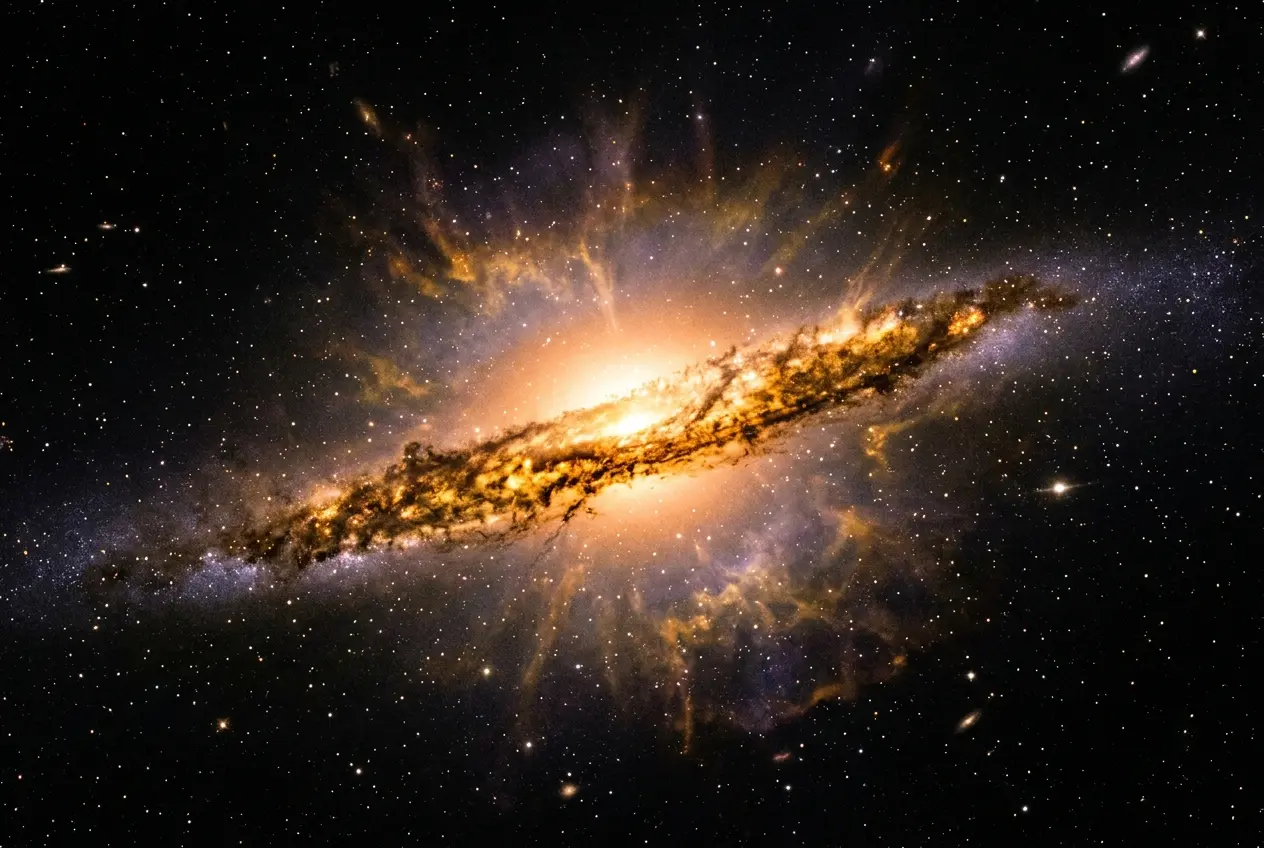
NASA’s James Webb Space Telescope marked its fourth science anniversary by turning its mirrors on a galaxy astronomers have mapped since 1826, and showed it to them for what looks like the first time. The target was Centaurus A, 11 million light-years from Earth, and the view was the deepest portrait yet taken of its dust-choked interior. Webb’s near- and mid-infrared instruments pierced the lanes of material that hide the galaxy’s core from every previous telescope and exposed a packed field of individual stars, a warped parallelogram of glowing dust, and an unexplained S-shaped feature that researchers cannot yet model.
The release, dated 6 July 2026, doubles as a stocktake of four years of better-than-anticipated performance for the most powerful space telescope in history. The visible-light view of Centaurus A shows a galaxy split by a dark lane. Older infrared surveys mapped large dust structures without resolving individual stars. In Webb’s mid- and near-infrared view, the stars can be counted inside the dust, and the dust reads as a record of where stars have formed and where they are forming now. Centaurus A is the galaxy astronomers have mapped longest in radio and X-rays, and the one Webb has now mapped star by star in the infrared.
The New View of Centaurus A
Centaurus A, catalogued as NGC 5128, sits in the southern constellation of Centaurus and is the nearest active galaxy to Earth. Its active galactic nucleus, powered by a supermassive black hole, has made it a fixture of radio and X-ray astronomy since the mid-twentieth century. Its optical appearance is dominated by a dark dust lane that splits the galaxy’s bright body in two, a structure first catalogued by Scottish astronomer James Dunlop in 1826. The dark lane is the same dust that Webb has now resolved into stars, gas, and structure.
Webb’s new images treat that dust as the subject rather than the obstacle. The mid-infrared view from MIRI shows a warped parallelogram-like band of dust crossing the galaxy’s centre, glowing in shapes the release describes as intricate and at times perplexing. A separate “S” shaped feature, most visible in the MIRI frame, runs through the dust field and has no settled origin. The MIRI image of Centaurus A is the release’s lead frame, taken at infrared wavelengths of 5.6, 7.7, and 10 micrometres. The combined near- and mid-infrared view, where NIRCam resolves the stars and MIRI traces the dust, is the campaign’s signature composite.
The release credits three image processors: Alyssa Pagan and Joseph DePasquale of the Space Telescope Science Institute, and Macarena Garcia Marin of the European Space Agency’s office at STScI. The credits matter because the Centaurus A mosaic stitches together MIRI and NIRCam data in a way previous infrared surveys could not. The result is the first image of the galaxy that reads as both a star field and a dust field at the same time.
What the Image Actually Shows
The headline results from Webb are not the galaxy itself but the structures inside its dust band. Researchers highlighted four features that previous telescopes could not resolve. Each one maps a different part of the merger history that built the galaxy. Each one sits at a wavelength older telescopes could not open at this resolution.
- A warped parallelogram-like band of dust cutting across the galaxy’s centre
- An unusual S-shaped feature running through the mid-infrared frame
- Wisps of glowing material stretching outward like cosmic clouds
- A grainy background that resolves, at Webb’s resolution, into a packed field of individual stars
The wisps are the most counterintuitive of the four. They appear as faint extensions beyond the main dust band, and the release notes that many of the glowing red points in the MIRI image are dust-rich stars or stellar nurseries, where aging stars are shedding material back into space or new stars are forming. Each point is a separate star or proto-star traced by the dust it is emitting or illuminating. The four-year framing matters because the original expectation for Webb was a ten-year primary mission, and the telescope is performing better than anticipated. Centaurus A is the centerpiece image, not the only one.
How Centaurus A Got Its Shape
The reason Centaurus A looks the way it does is a merger that happened roughly two billion years ago. The release describes it as a major collision with another galaxy, the aftermath of which is still visible today in the galaxy’s unusual structure and its ongoing star formation. The dust lanes that astronomers had long treated as an obstacle are, in Webb’s view, the very tracer of that history. Each bright knot in the dust band is a record of star formation triggered by the merger. That same dust now reads as a timeline of the galaxy’s evolution, a record the merger has not finished writing. The closer Webb looks, the longer that timeline becomes.
Centaurus A’s identity as a radio source is not new. The galaxy has been studied as an active galactic nucleus since well before Webb launched. It has long been a reference object for understanding how black holes and galaxies co-evolve. Webb adds the piece those earlier surveys could not supply: a star-by-star census of the same galaxy the radio maps described.
The framing of the anniversary release is itself a statement about how observatories build on each other. Webb’s fourth-anniversary view is part of a chain that started with Hubble and Spitzer, each mission leaving the next a clearer problem to solve.
No single telescope tells the whole story. Discoveries build over time and new observatories expand on the foundations laid by earlier missions. Webb represents the most powerful step forward yet, opening a window into wavelengths and details never before accessible.
Shawn Domagal-Goldman, division director for Astrophysics at NASA Headquarters in Washington, gave the statement as part of NASA’s release of the Centaurus A anniversary images. The previous infrared record is not empty. NASA’s retired Spitzer Space Telescope revealed large-scale structures in the same galaxy at lower resolution, including the warped dust shape. What Webb supplies is the resolution: a clear view of the stars inside the dust band, and the motion of the gas around them. Hubble, in turn, gave visible-light images of the outer structure that Webb’s infrared layers now sit on top of.
With Webb’s view of Centaurus A, the team writes, the galaxy becomes a case of galactic archaeology. Each star revealed helps to reconstruct when different events happened: when older stars first formed, when activity slowed down, the burst of star formation during the collision, and stars born from gas stirred in its aftermath. Together they form a timeline of the galaxy’s evolution. The release closes that loop by publishing, in the same campaign, the spectrographic data on the gas motion that imaging alone could not deliver. That combination is what turns a familiar galaxy into a working laboratory. Older missions left the problem of the dust; Webb has begun to read it.
Reading the Gas Around the Black Hole
Webb’s instruments read more than pictures. Spectroscopic data from the same campaign found fast-moving ionised gas flowing outward, in patterns the team attributes to the black hole’s activity at the core, and warmer molecular hydrogen sitting in a warped rotating disk near the centre. The two motions together begin to address one of astronomy’s longest-running questions: how a black hole shapes the galaxy around it. The answer, in this case, is two-directional.
The black hole can compress gas enough to trigger star formation. It can also push material away and shut that formation down. Centaurus A, at 11 million light-years, is the closest natural laboratory where astronomers can watch that tug of war in detail.
| Telescope | Era | What it could show | What it could not |
|---|---|---|---|
| Hubble | Visible light | Outer structure, dust lane silhouette | Central region hidden by dust |
| Spitzer (retired) | Mid-infrared | Large-scale dust structures, warped band | Individual stars unresolved |
| Webb | Near- and mid-infrared | Resolved stars, dust tracers, gas motion | None reported in this release |
The Spitzer row above is one example of how the previous infrared record of this galaxy worked. Webb’s contribution is resolution and instrument sensitivity, layered on top of what earlier missions saw. The combined dataset is the first time Centaurus A has been mapped at wavelengths that can resolve both its stars and its gas in a single campaign. The release frames that as the practical difference between a galaxy seen and a galaxy read. Earlier images mapped the silhouette; the new data maps the interior.
Webb is an international partnership between NASA, ESA, and the Canadian Space Agency, with ESA providing the NIRSpec spectrograph and 50% of MIRI through a European consortium. The Centaurus A observations use both instruments together for the first time on this galaxy. The synergy matters because the parallelogram and the S-shape only become legible when both wavelengths are stacked. That is what previous infrared missions could not deliver, and what Webb’s combined wavelength coverage now offers.
Inside Webb’s Fourth Science Year
The Centaurus A release is the centerpiece of a broader anniversary summary that places Webb’s fourth year of science operations in one place. Beyond Centaurus A, the year brought new evidence for a planet orbiting Alpha Centauri, four light-years from the Sun. The year also brought eight gravitational lenses from an in-depth survey that identified hundreds of candidates, and a supernova dated to 730 million years after the Big Bang, the earliest to date. A black hole that appears to have formed before its host galaxy did was identified in the early universe. Webb took a fresh look at the Hubble Ultra Deep Field, returning thousands of distant galaxies from the earliest periods of cosmic history. Earlier Webb coverage on this site tracked the 3I/ATLAS interstellar comet findings and Webb’s WASP-121b atmosphere map from the same operational year.
The summary also lists the imagery that defined the year: gossamer nebulae around a planet-forming disc, the edge of the Helix Nebula, a “cosmic butterfly,” and a joint Webb and Hubble portrait of Saturn showing layered storms in its atmosphere. Webb also mapped the upper atmosphere and auroras of Uranus. The full NASA Centaurus A anniversary release carries the same summary in the agency’s own framing. The parallel ESA Webb release does the same with the European agency’s instrument credits and detail. The point of the anniversary is to show how one telescope has changed what can be seen across the solar system, the nearby galaxy, and the early universe in a single year.
Webb launched at 7:20 a.m. EST on 25 December 2021 from Europe’s Spaceport in French Guiana and released its first images on 12 July 2022 after a six-month commissioning period. The fourth-anniversary framing covers the four years of science operations that began that morning. The Centaurus A images are the public face of a mission that, by its own engineers’ account, is performing better than it was designed to. The two instruments behind the new view, MIRI and NIRSpec, were built with European contributions through ESA and the MIRI European Consortium.
What Centaurus A Hasn’t Given Up Yet
The release closes on an open question rather than a conclusion. The S-shaped feature in the MIRI frame has no settled origin. The team lists three live possibilities for the shape. None of the three has been ruled out by the data released on 6 July 2026.
The shape may trace the black hole’s influence directly. It may instead be the signature of star formation triggered in the merger. Or it may be some combination of the two. Each new Webb image of Centaurus A adds new readable detail to a galaxy long studied only as a radio source. The team has listed the S-shape among the features that need further study to answer. The dust that hid its interior from two centuries of optical astronomy is, in the infrared, a record of where stars have formed, where they are forming now, and where a supermassive black hole is still reshaping the galaxy around it.