Meta’s June 12, 2026 outage knocked Facebook, Instagram, Messenger, and Ads Manager offline together for roughly two hours, leaving users around the world staring at a “Page Not Found” error when they tried to log in. Andy Stone, Meta’s vice president of communications, acknowledged the issue on X that morning and said the company was “working on it,” with restoration rolling out by mid-afternoon Eastern time.
Three weeks later, the failure has not been explained publicly. Thirteen days before the outage, a separate incident in which attackers took over Instagram accounts through an unverified email field was contained but never written up either. The public now has less visibility into Meta’s reliability story than it did after the company’s last widely documented outage, in October 2021, and the contrast is doing more work than the outage itself.
The Friday That Took Down a Family of Apps
Internet monitoring firm ThousandEyes detected response errors and timeouts beginning around 13:40 UTC across Facebook, Messenger, WhatsApp, and later Instagram on June 12, with service availability returning near baseline by approximately 15:30 UTC. The window matches what users and advertisers saw on the consumer side. the response-error data spanning Meta’s outage window showed network reachability to Meta’s front-end infrastructure as intact, with no packet loss and no elevated latency.
Outage tracker Downdetector recorded more than 100,000 Facebook problem reports by 10 a.m. ET, a spike that began just before 9:30 a.m. ET and peaked at 69,569 reports at 9:39 a.m. ET. The Telegraph put the visible peak at nearly 130,000 Facebook reports, almost 20,000 Messenger reports, and just over 10,000 Instagram reports, with the standard caveat that Downdetector counts people who report a problem, not everyone affected. Reports spanned at least 10 countries, including the United States, United Kingdom, Canada, the Philippines, and India.
Meta’s own status page marked consumer-facing disruptions as resolved by 4:22 p.m. ET, but the WhatsApp Business Platform still showed “High Disruptions” later that afternoon, which matters more to commerce teams than to scrolling users. StatusGator logged 14,940 user-submitted outage reports in the 24-hour window around the event, and noted that Meta had not yet acknowledged the consumer outage on any official channel aimed at consumers.
What Users Saw When They Tried to Log In
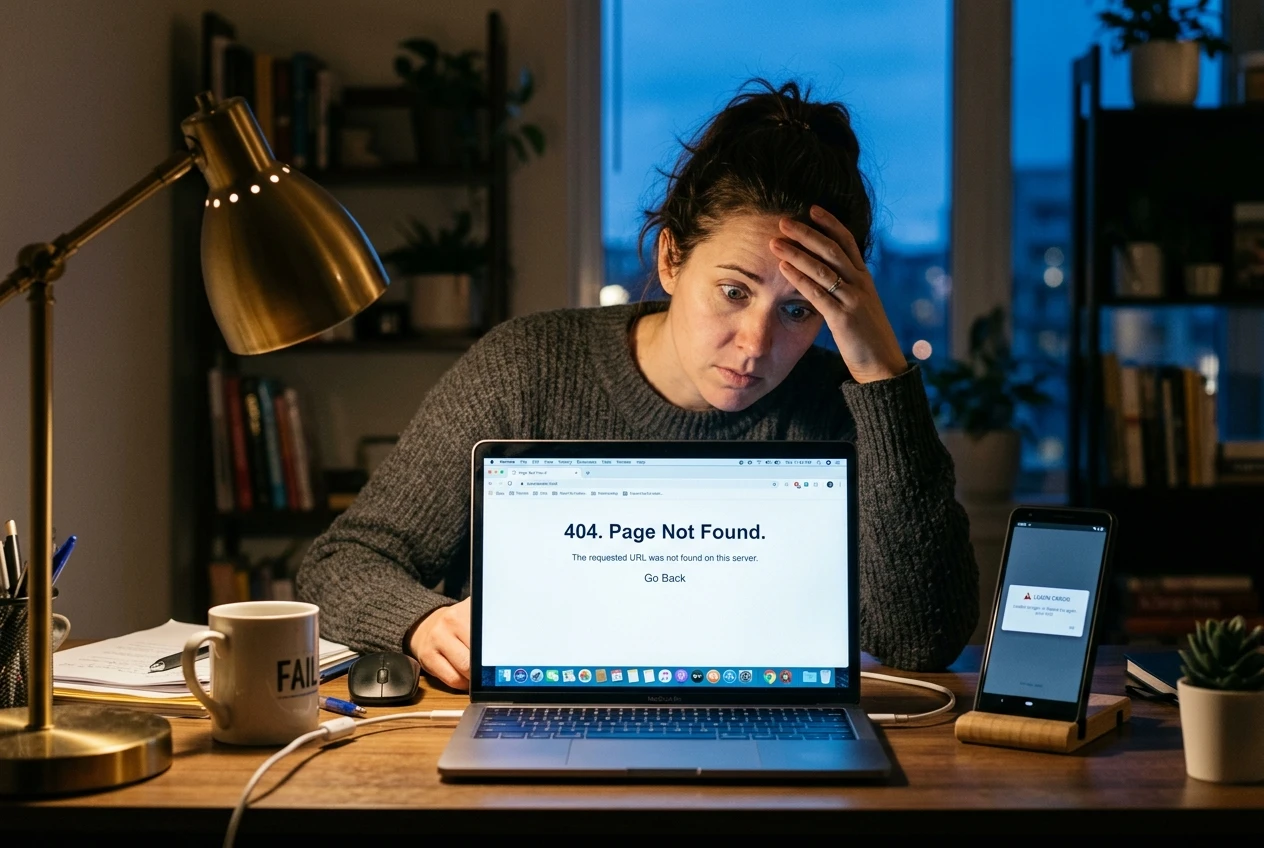
For many Facebook users, the experience started with being logged out of their accounts and being unable to log back in. The desktop site displayed a generic “Something went wrong – we’re working on it” error. The iPhone app told users to check their internet connection, which was not the problem. The most reported symptom was the simplest: a page not found or 404 message where the news feed should have been.
The New York Post documented Downdetector comments from users who said they were “logged out of my account out of nowhere” and could not sign back in, and from others who received a “Blank page” or “query error” when they tried to recover their session. Repeated failed login attempts could trigger a temporary account lock, adding insult to the underlying server-side failure. The disruption was global in scope, hitting both web and mobile users in countries on multiple continents.
Instagram behaved inconsistently. Most reports placed failures on the desktop version, while some mobile users could load feeds and others received a generic server error. Threads and WhatsApp consumer appeared normal. The company addressed it in measured terms through its communications lead.
We’re aware people are currently having trouble accessing our services. We’re working on it.
Andy Stone, Meta’s vice president of communications, posted that line on X on June 12, 2026. A second post, before noon Eastern, said services were coming back and that full normalization could take more time. Stone did not provide a technical explanation in either update, and Meta has not provided one publicly since.
The Business Side That Stayed Out of the Headlines
Meta’s own status page showed “High Disruptions” for Facebook Ads Manager by 10:15 a.m. ET. The accompanying company statement read: “We are aware that some advertisers may be having trouble creating or editing their ads in Ads Manager. Our engineering teams are aware and are actively looking to resolve the issue as quickly as possible.” For any business with active campaigns that morning, that was the official answer to a question with very direct financial exposure.
The stakes are not abstract. In its first-quarter 2026 results, Meta reported an average of 3.56 billion people using the family of apps every day. The same report said Meta’s first-quarter advertising revenue topped $55 billion, and made up more than 98 percent of total revenue. Meta’s advertising infrastructure handles over $130 billion in annual ad spend across every account on the platform.
Unlike Google, which publishes a 99.9 percent uptime commitment for its advertising products, Meta does not offer advertisers a public service level agreement, and it has no automatic refund policy for downtime. Past outages have shown that campaigns can continue to spend against daily budgets even when delivery is impaired. A small business running a $500-per-day campaign through a two-hour disruption window ends up holding the bag. The same week, Apple’s iCloud outage on June 25 across India briefly knocked Photos, Mail, and Find My offline for users in that market, a useful reminder that the architecture of consumer-facing outages is not unique to one company, but the advertiser exposure at Meta is unmatched in scale.
Why All Four Apps Fall at Once
When Facebook, Instagram, and Messenger go down together, the cause is rarely a network-level failure. Meta runs thousands of microservices that share a centralized authentication layer to verify user identity across all of its products. When that shared layer throws errors, every surface that depends on it fails at the same time, even though the underlying network is fine. That is why the June 12 outage produced centralized authentication layer symptoms: users logged out, unable to log back in, seeing authentication error messages rather than network timeouts.
Cisco ThousandEyes documented this same pattern during the December 2024 Meta outage, noting “internal server errors and timeouts” while “network connectivity to Meta’s frontend web servers remains unaffected,” and again during the March 5, 2024 multi-platform disruption, which it attributed to “backend authentication system failures.” The June 12 event matched that profile, though Meta has not confirmed the cause on the record.
That profile is distinct from Meta’s most famous outage. On October 4, 2021, a Border Gateway Protocol configuration error withdrew Meta’s IP address prefixes from the global internet entirely, making its DNS servers unreachable. The company later published a detailed postmortem acknowledging that the same network that carried live traffic also carried internal authentication and recovery tools, forcing engineers to physically access data centers to fix the issue. The current outage, based on the available evidence, does not appear to involve a BGP withdrawal.
| Date | Approx. duration | Surface trigger | Public postmortem |
|---|---|---|---|
| Oct 4, 2021 | ~6 hours | BGP config change withdrawing IP prefixes | Yes |
| Mar 5, 2024 | Several hours | Backend authentication failures (Cisco ThousandEyes) | No |
| Dec 2024 | ~3 hours | Authentication / timeout errors (Cisco ThousandEyes) | No |
| Jun 12, 2026 | ~2 hours | Server-side; cause undisclosed | None as of publication |
The Reckoning Behind the Outage
Thirteen days before the outage, on May 30, 2026, attackers took over Instagram accounts through a password-reset flow that accepted an unverified email address with no further check. Meta calls this severity tier a SEV0, the highest on its internal scale, and says the incident was contained by June 1. The bug was not sophisticated. A password reset that trusts an unverified email field is the kind of gap automated security scanners flag by default, and that a code reviewer catches in a new engineer’s first week.
The day after containment, Meta’s chief information security officer, Guy Rosen, told colleagues he was leaving the company after thirteen years. Meta has not confirmed any connection between his exit and the breach his organization would have owned the response to. The timing did the talking instead.
Both incidents sit against a broader organizational shift. Meta’s push into AI development moved an estimated 30 to 50 percent of engineers on core product teams into a new internal group, Agent Data Optimisation, built around generating and labeling training data. That group’s headcount is roughly 6,500, with 4,000 to 5,000 of those people drawn from software engineering roles elsewhere in the company, close to one in every five or six of Meta’s roughly 25,000 engineers. Instagram’s Trust and Safety team was among the teams that lost people this way, with its staff reduced by close to half between the reassignments and an April layoff round that cut 10 percent of Meta’s headcount on a month’s notice.
The reorg followed Meta’s roughly $14.8 billion investment in Scale AI and the arrival of its CEO, Alexandr Wang, to run Meta’s AI strategy. Reporting also documents an internal practice employees nicknamed “tokenmaxxing,” with 60.2 trillion AI tokens burned across a single 30-day stretch this year, over $100 million in compute for internal usage alone. CTO Andrew Bosworth called the reorg “atrocious.” the analysis of why Meta stopped publishing postmortems lays out how this leaves security and trust-and-safety teams absorbing the same reassignment and headcount pressure as any feature team, at the moment when they need to be paying the most attention.
What Meta Has Not Published
After the roughly seven-hour outage in October 2021, Meta published a detailed public postmortem and an apology from engineering leadership, naming the configuration error that took its services down. That document set a standard: when something breaks badly enough, Meta tells you, in writing, why. October 2021 is the most recent example of Meta clearing that bar.
AWS, Cloudflare, and GitHub routinely publish detailed root-cause writeups after major outages, down to the specific commit, configuration change, or capacity limit that triggered the failure. Those documents do not read as confessions. They read as evidence the company understands its own system well enough to say precisely what broke. Meta met that bar once, in 2021, and has not matched it since.
The market shrugged at the June 12 outage. Meta’s stock fell about 0.6 percent in afternoon trading. The company raised its 2026 capital spending forecast to $125 billion to $145 billion after the first quarter, citing higher component pricing and added data center costs, and advertising revenue continues to grow. User complaints called the event the third Meta outage in a week, though Meta has not framed it that way publicly. The concentration risk is the through-line, and India’s order to pause WhatsApp’s username feature is the same regulatory lens that now sits across Meta’s consumer products pointing at its infrastructure. The harder question is what happens when interruptions become a pattern people start planning around.
Frequently Asked Questions
What caused Meta’s June 12, 2026 outage?
Network monitoring data from ThousandEyes placed the disruption between roughly 13:40 and 15:30 UTC, with response errors and timeouts on Facebook, Messenger, WhatsApp, and Instagram while network connectivity to Meta’s front-end servers remained intact. Meta has not publicly disclosed the root cause, though the symptom profile, users logged out and unable to log back in with authentication error messages, matches the pattern Cisco ThousandEyes documented during the March 2024 and December 2024 Meta outages.
Is Facebook still down as of July 2026?
Facebook and Instagram are operational as of publication. The June 12 consumer disruptions were resolved by 4:22 p.m. ET that day, though the WhatsApp Business Platform still showed “High Disruptions” later that afternoon. Meta’s status page is the most direct source for current service state, alongside StatusGator’s tracking of Meta’s official channels.
Were user accounts compromised during the June 12 outage?
The June 12 outage was not a breach. Separately, Meta disclosed a SEV0 incident on May 30, 2026, in which attackers took over Instagram accounts through a password-reset flow that accepted an unverified email address. Meta said the incident was contained by June 1 and stated there was no evidence user data was compromised as a result.
Will Meta refund advertisers for the outage?
Meta has not announced automatic refunds. The company does not publish a service level agreement for its advertising products and reviews spending disputes on a case-by-case basis. Advertisers who ran active campaigns through the disruption window and want to seek credit should contact a Meta representative directly, since the standard policy is to handle each claim individually rather than issue blanket credits.
Has Meta published a postmortem for the June 12 outage?
Meta published a detailed postmortem after its October 2021 BGP outage. As of publication, Meta has not released a comparable document for the May 30 Instagram incident or the June 12 outage. AWS, Cloudflare, and GitHub routinely publish detailed root-cause writeups after major outages; Meta cleared that bar once, in 2021, and has not matched it since.