Georgia opened the inaugural World Rugby Nations Cup with a 41-34 win over Uruguay at Montevideo’s Estadio Charrúa on Saturday. The ten-try thriller ended with Mikheil Alania touching down in the 79th minute to deny the hosts a famous comeback. The first Test between the teams ever played on Uruguayan soil produced five tries apiece and a yellow card on each side. Luka Matkava scored a try, slotted four conversions and two penalties at fly-half for the Lelos. Uruguay’s Jean Cotarmanac’h answered with three conversions, a penalty and an audacious cross-kick assist that bounced over Georgian winger Romani Makhatadze and into the arms of Juan Manuel Alonso. The Estadio Charrúa can punish goal-kickers when the wind picks up, the Americas Rugby News preview had noted. In the end, neither the wind nor the kicking decided the contest, and the result fell to the Lelos in the way the same preview had predicted.
How the Match Unfolded
Los Teros struck first in the inaugural World Rugby Nations Cup match. Hooker Joaquín Myszka broke off a lineout won by Lucas Bianchi and scored in the right corner at the 8-minute mark, giving Uruguay an early 5-0 lead. The Lelos needed seven minutes to respond, with Matkava running in untouched on 15 minutes to tie the match at 5-5. Matkava added the extras and then a penalty three minutes later, nudging Georgia in front at 5-10. The opening exchanges had been end-to-end, with both teams showing the attacking intent the ARN preview had identified as a strength of each side.
Georgia’s pack began to assert itself in the second quarter. Nikoloz Sutidze crashed over from close range on the 23-minute mark, with Matkava’s conversion extending the lead to 5-17. Cotarmanac’h landed a penalty at 30 minutes to pull Uruguay back to 8-20, but Matkava answered with his second penalty of the afternoon moments later. The first half ended with Juan González scoring in the corner from a pass by Ignacio Álvarez Akiki, a brilliant finish that pulled Uruguay back to 15-20 at the interval. Captain Davit Niniashvili was sin-binned in the 39th minute after a head-clash with Felipe Arcos Pérez, per the official match record.
Georgia went into the break a man down, and Uruguay went ahead for the first time at the start of the second half. Arcos Pérez powered over in the 45th minute, and Cotarmanac’h’s conversion made it 22-20. The lead did not last. Myszka was sin-binned in the 49th minute for what the officials judged a separate infringement, and Tornike Jalagonia crashed over for Georgia in the 53rd minute to nudge the Lelos back in front at 22-27. A penalty try in the 67th minute, awarded after repeated infringement at the maul, pushed Georgia to 22-34. Cotarmanac’h answered with the moment of the match, an audacious cross-field kick that bounced over Makhatadze and was collected by Juan Manuel Alonso for a try in the 70th minute. The conversion two minutes later made the score 29-34.
Uruguay trailed by five with ten minutes to play. The Lelos held firm, and Mikheil Alania touching down in the 79th minute from a well-worked move made it 29-39 before Matkava added the conversion two minutes from time to make it 29-41. Rodríguez Bosch touched down for Uruguay at 80 minutes to set the final margin at 34-41. Georgia began the inaugural Nations Cup with five match points and a bonus-point victory that the ARN preview had billed as the likely outcome.
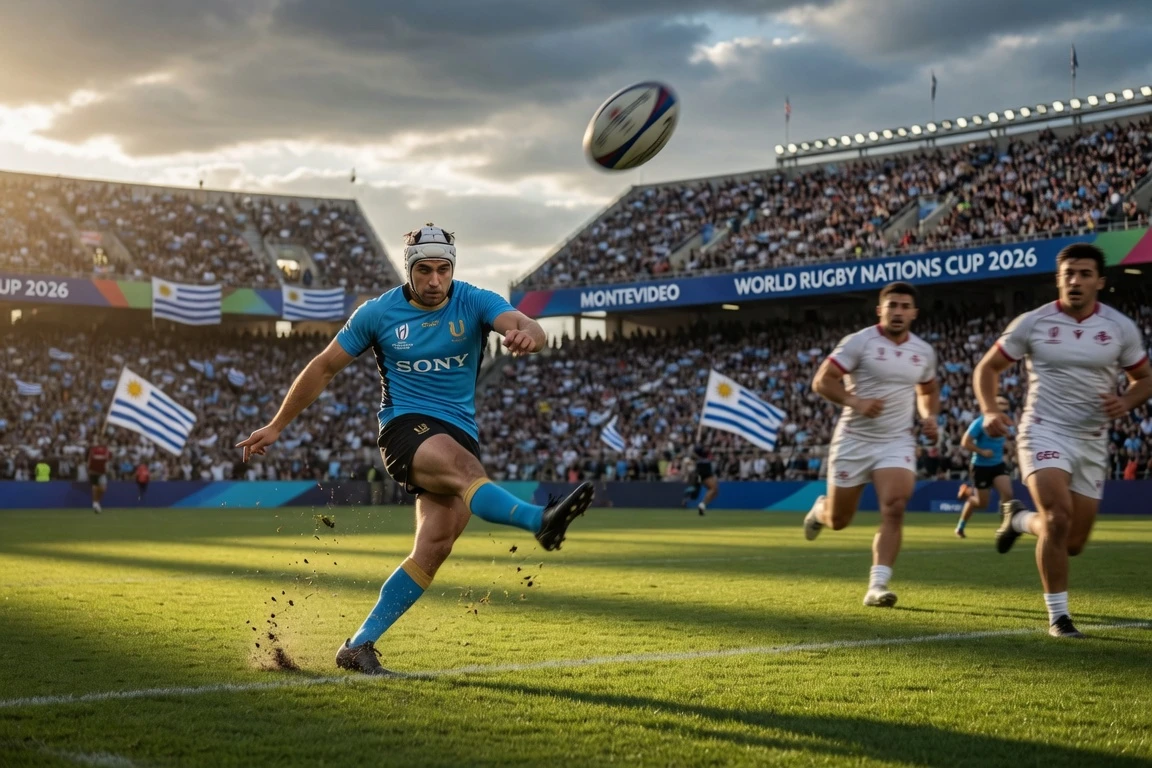
The Cross-Kick That Lit Up Montevideo
Jean Cotarmanac’h’s cross-field kick was the moment of the match, a piece of skill that briefly changed the tenor of the contest. The fly-half, on his first test start for Uruguay, sent a cross-field kick toward the right wing that bounced over the back-pedalling Georgian defence. The ball sat up perfectly for Alonso, who gathered it cleanly and crossed for a try in the 70th minute that made the score 29-34 with ten minutes to play. The Estadio Charrúa, which the ARN preview noted can punish goal-kickers when the wind picks up, suddenly had a different feel. The Asia Rugby match report framed it as a nervy last ten minutes in which Uruguay were knocking on the door of a famous win.
Cotarmanac’h had stepped into a starting role that is normally held by more capped Uruguayans. Regular captain Manuel Leindekar is not on the roster due to a deal struck with his French club to keep him fresh for the World Cup year, per the ARN guide. Scrum-half Santiago Arata is missing on similar grounds. Both would normally have been in the matchday squad, and Cotarmanac’h filled in with composure well beyond his cap count. He was one of five players making their first appearances or near-first appearances in the Uruguay matchday 23, alongside Germán Kigel, Lucas Porcelli, Ignacio Rodríguez Bosch and Arturo Ten Hoever.
The penalty try in the 67th minute, the sin-binning of Niniashvili at 39 minutes, and the soft concession at the maul all combined to keep Uruguay chasing. Argentina’s Tomás Ninci and Federico Longobardi served as assistant referees under referee Craig Evans of Wales. England’s Dan Jones was the television match official. The neutral officials had a busy afternoon, with two sin-binnings and a penalty try among the seven-point swings that shaped the match.
Where Both Teams Stand After Round One
The Uruguay-Georgia opener was the marquee match of a six-game opening day that produced 59 tries across the Americas, according to Asia Rugby’s round-one summary. Samoa ran in ten tries against Hong Kong China in Santiago, beating the tournament debutants 66-19. Chile, Tonga and the United States all won, while Canada and Spain drew 42-42 in Edmonton in the closest match of the day. The day’s scoring underscored what the ARN preview had predicted, that this would be a tournament of attacking rugby between teams who, in the absence of Tier 1 fixtures, would take the game to each other.
Georgia sits atop the European-African-Asian pool on five points, the maximum available from a win with a try-scoring bonus. Uruguay is fifth in the Americas-Pacific pool after the opening round, one spot below Samoa, Chile, Tonga and the United States, and one ahead of Canada on points difference. The pools will play out across the summer and autumn international windows before two champions are crowned in November. The structure rewards geographic clustering to limit travel, with Samoa and Tonga playing home matches in South and North America respectively. Hong Kong and Zimbabwe will host their games in Continental Europe and England.
| Team | Tries | Conversions | Penalties |
|---|---|---|---|
| Uruguay | 5 | 3 | 1 |
| Georgia | 5 | 4 | 2 |
A Tournament Built for the Road to Australia 2027
The 2026 World Rugby Nations Cup is the inaugural World Rugby Nations Cup, run alongside the more familiar Nations Championship that features the sport’s Tier 1 nations. The 12 teams in the Nations Cup are the ones that have qualified for the 2027 Rugby World Cup but are not part of the Nations Championship, per the official round one preview. World Rugby confirmed the tournament’s name and structure on 17 November 2025, four months before the opening round. The competition fills a gap that has long frustrated second-tier unions, who have historically struggled to schedule competitive matches between Rugby World Cups.
The teams are split into two geographically defined pools, each playing the six teams in the opposite pool across the summer and autumn international windows. Samoa, Tonga, Zimbabwe and Hong Kong China will play home matches in neutral venues to limit travel, according to the Nations Cup tournament hub. In November, the European teams host the return fixtures. Hong Kong will travel to England for Zimbabwe’s home matches, while Tonga’s final group game will be held in Hong Kong itself. Two champions will be crowned, one in each pool, when the round-robin concludes.
World Rugby has stated that promotion and relegation between the Nations Championship and the Nations Cup are intended for a future date, but there will be no exchange in 2026. Neither Georgia nor Uruguay will play a Tier 1 opponent this year as a result. Georgia sits in Pool B of Rugby World Cup 2027 with Italy, Romania and South Africa. Uruguay sits in Pool D with Ireland, Portugal and Scotland. The inaugural Nations Cup is, in effect, a year of high-stakes games between teams who will face each other only once more in Australia.
The structure has already shaped the tactical shape of the opening matches. Teams without Tier 1 fixtures in 2026 cannot afford to leave points on the field against teams in the same boat. Georgia’s bonus-point win in Montevideo, earned by scoring four or more tries, is worth five match points. Uruguay reached a joint-highest ranking of 14th in 2025, per the official preview, and would have reached a new high of 13th with a win by 15 points or more. The opening round produced bonus-point wins for Samoa, Chile, Tonga and the United States as well, suggesting teams have absorbed the lesson quickly.
Americas-Pacific Pool
- Uruguay
- Canada
- Chile
- United States
- Samoa
- Tonga
European-African-Asian Pool
- Georgia
- Spain
- Portugal
- Romania
- Hong Kong China
- Zimbabwe
What the Head-to-Head Still Tells Us
Saturday’s match was the seventh meeting between Uruguay and Georgia, and the first ever played on Uruguayan soil, per the ARN guide’s full head-to-head listing. The previous six meetings stretched back to Rugby World Cup 2003 in Sydney, where Uruguay claimed its only win in the fixture. Georgia has won all five meetings since, building a 5-1 head-to-head record that Saturday’s result extended to 6-1. The Lelos now lead the series by the widest margin in its history, but the recent closeness of the contest tells a more complicated story.
The pattern of the rivalry tells a story of two teams on different trajectories. Georgia’s wins in 2008, 2013, 2015, 2019 and 2022 came by margins that grew wider as Georgia’s professional depth expanded. The 2008 result in Bucharest finished 20-18, while the 2019 match in Kumagaya ended 33-7. Uruguay’s lone win came at the 2003 Rugby World Cup, when Los Teros stunned a Georgia side still finding its feet in the international game. The 2003 result remains the only time Uruguay has beaten Georgia, and it came on rugby’s biggest stage.
The head-to-head history shows the kind of imbalance that has built up over two decades of professional depth on the Lelos’ side. Saturday’s result extends that record further, even as the closeness of the scoreline hints at a narrower gap than the 2010s suggested. Georgia head coach Pierre-Henry Broncan, recently appointed after missing the 2026 Rugby Europe Men’s Championship due to his commitments with French club Brive, will want more from his team in the closing minutes of tight matches. Both teams return to action on July 11, with Georgia facing Samoa at Estadio Sausalito in Viña del Mar and Uruguay hosting Romania at Estadio Charrúa in Montevideo, per the tournament schedule.
| Date | Venue | Result |
|---|---|---|
| Oct 28, 2003 | Sydney (RWC) | Georgia 12, Uruguay 24 |
| Jun 15, 2008 | Bucharest | Georgia 20, Uruguay 18 |
| Jun 11, 2013 | Tbilisi | Georgia 27, Uruguay 3 |
| Jun 13, 2015 | Tbilisi | Georgia 19, Uruguay 10 |
| Sep 29, 2019 | Kumagaya | Georgia 33, Uruguay 7 |
| Nov 6, 2022 | Tbilisi | Georgia 34, Uruguay 18 |
| Jul 4, 2026 | Montevideo | Georgia 41, Uruguay 34 |