Belkin has launched a 14-in-1 Thunderbolt 5 dock in China at 2,299 yuan (approximately $338), the lowest confirmed price for a Thunderbolt 5 dock from a major brand so far in 2026. The company briefly listed the unit on its global site at $350 before pulling the page, putting international pricing within a few dollars of the Chinese figure. The hardware delivers up to 140W of laptop charging, an 80Gbps data path that scales to 120Gbps for high-refresh displays, and a port array aimed at triple-4K Windows workstations.
Two compatibility gates narrow the addressable audience before any buyer opens the box. Apple’s silicon rules cap MacBook owners running M1, M2, and M3 chips at a single external display, and Belkin’s own product page rules out Thunderbolt 3 laptops and docks entirely. On launch day, the dock’s feature list reads as both a market statement and a hardware gate.
How Belkin Reset the Thunderbolt 5 Price Floor
Before Belkin’s late-June launch, the Thunderbolt 5 dock conversation in 2026 belonged to OWC, StarTech, Satechi, and CalDigit, with prices that opened around $305 and stretched past $749. Belkin entered at 2,299 yuan in China, undercutting the premium tier without dropping into generic territory. The launch follows the Baseus Spacemate RD1 Pro 15-port docking station at $300 by days, according to coverage from Notebookcheck of the China listing.
Belkin’s roughly $338 China price still leaves the brand cheaper than the two newest Thunderbolt 5 docks that explicitly target professional buyers. OWC’s Thunderbolt 5 Dual 10GbE Network Dock, a $499.99 dual-10GbE Thunderbolt 5 dock that won a TechRadar Pro 2026 CES Picks Award, pairs the new standard with two 10GbE Ethernet ports and three 8K display support. StarTech’s Thunderbolt 5/USB4 dock (model TB5USB4DOCK) sells for $305.44 in the US and offers driverless support for Windows 11 and macOS Tahoe.
The pattern is clear: Belkin’s 14-in-1 sits at the bottom of the brand-name tier without dropping into generic territory. Buyers who want networking extras will pay more. Buyers who want the standard’s headline specs at the standard’s lowest mainstream price will read the Belkin spec sheet first.
| Dock | Price | Standout angle |
|---|---|---|
| Belkin 14-in-1 | 2,299 yuan in China (~$338); $350 briefly on global site | 140W PD plus triple 4K@144Hz on Windows |
| Baseus Spacemate RD1 Pro | $300 (US) | 15-port expansion |
| StarTech Thunderbolt 5/USB4 (TB5USB4DOCK) | $305.44 (US) | Driverless macOS Tahoe support |
| OWC Thunderbolt 5 Dual 10GbE | $499.99 (US) | Dual 10GbE Ethernet plus three 8K displays |
What the 14-in-1 Dock Actually Delivers
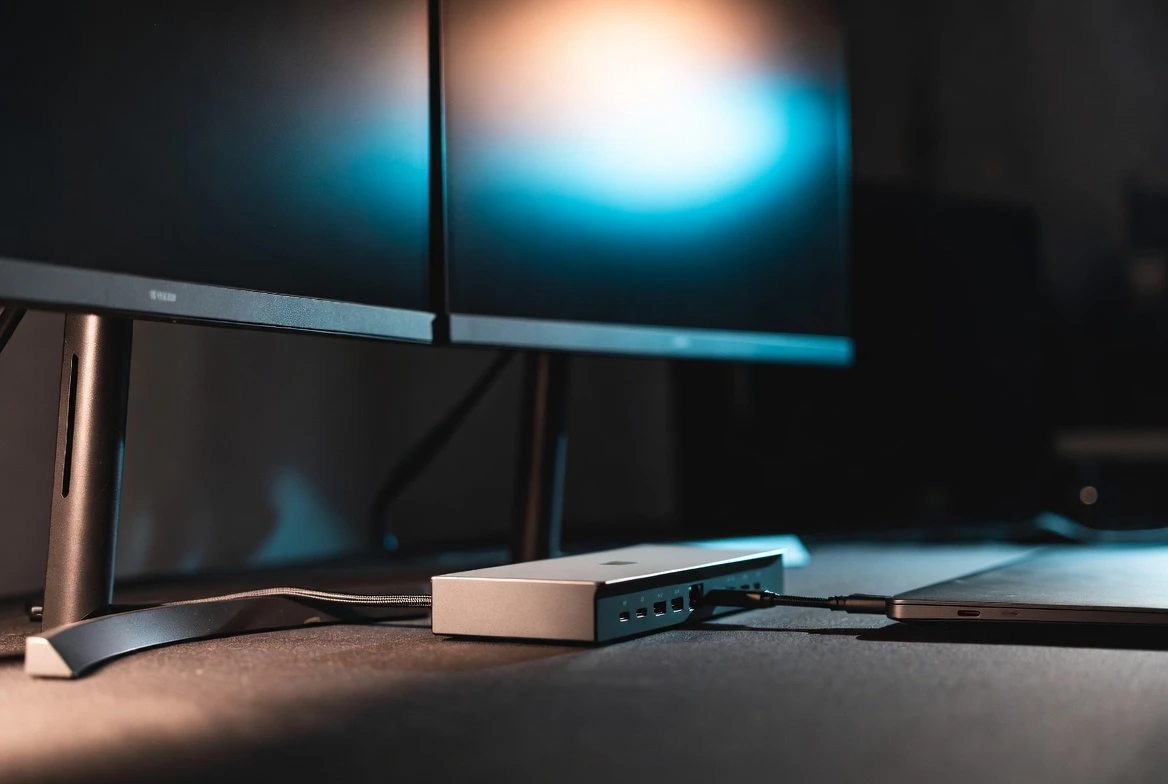
Belkin built the dock around a single Thunderbolt 5 upstream port that carries data, video, and up to 140W of USB Power Delivery to the host laptop. A 180W power adapter and a one-meter Thunderbolt 5 cable ship in the box, sized for the dock to run the 140W laptop charge while powering every downstream port at full spec. The same upstream handles 80Gbps of bi-directional data by default; when the system detects higher-resolution or higher-refresh monitors, the dock scales to 120Gbps through Intel’s Bandwidth Boost.
For video, the unit offers one DisplayPort 2.1 and one HDMI 2.1 output, each rated for 8K at 60Hz or 4K at 240Hz on compatible hardware. Two downstream Thunderbolt 5 ports route additional video and supply 15W of accessory charging each. Together, the four physical video outputs are what the dock’s top feature, triple external 4K monitors at 144Hz, hangs on.
The chassis uses aluminum, weighs 510 grams, and measures 22.2 by 8.5 by 2 centimeters, small enough to sit behind a laptop on most desks. Belkin describes a distributed thermal management layout to dissipate heat during sustained workloads, with a physical power button, an LED status light, and a Kensington lock slot for hot-desking setups.
Storage and networking round out the count. Two UHS-II SD 4.0 card readers (full-size and micro) are rated at 312 MB/s, fast enough for offloading 4K footage from a camera in mid-shoot. A 2.5 Gigabit Ethernet port targets users on full-fiber links, and a 3.5mm audio jack covers headsets and basic speakers.
- 1× Thunderbolt 5 upstream, 140W USB Power Delivery
- 2× Thunderbolt 5 downstream, 15W charging each
- 1× DisplayPort 2.1 (8K@60 / 4K@240)
- 1× HDMI 2.1 (8K@60 / 4K@240)
- 1× USB-C 3.2, 30W
- 1× USB-C 3.2, 7.5W
- 1× USB-A 3.2, 10Gbps
- 2× USB-A 3.0, 5Gbps
- 1× 2.5 Gigabit Ethernet
- 1× 3.5mm audio
- 1× UHS-II SD 4.0 (312MB/s)
- 1× UHS-II microSD 4.0 (312MB/s)
The Triple-4K Promise Holds on Windows, Thins on Older Macs
On compatible Windows machines, the dock can drive three external 4K displays at 144Hz, for a total of four independent screens counting the laptop. Belkin-aligned coverage confirms this configuration works through the DisplayPort, HDMI, and downstream Thunderbolt 5 ports. The 80Gbps base data path scales to 120Gbps when the system detects the resolution and refresh load, which is how the dock claims enough headroom for the triple-4K workflow.
Mac compatibility splits down the middle of the product cycle. M4 and M5 series MacBooks, the Mac mini, and the Mac Studio can drive multiple external displays, per the same coverage. M1, M2, and M3 machines are restricted by Apple’s silicon to a single external display, irrespective of how many outputs the dock offers. StarTech’s own Thunderbolt 5 dock, in a separate February 2026 feature, lists macOS support capped at dual 6K at 60Hz, the same ceiling that emerges from Apple’s chipset rules.
The practical effect: a buyer running a 2020 MacBook Air on M1 cannot use this dock for triple 4K, even though the dock is fully capable. Apple only ships Thunderbolt 5 across its top tier of MacBook Pros, Mac minis, and Mac Studios running M4 Pro and M4 Max chips, per a February 2026 roundup that traces the standard’s laptop roll-out. Buyers outside that envelope need either a Windows machine or a recent M4/M5 Mac for the headline experience.
A Hard Line Drawn at Thunderbolt 3
Belkin’s documentation explicitly excludes Thunderbolt 3 laptops and displays. The dock runs on Thunderbolt 4 and USB4 devices with reduced bandwidth and fewer display outputs, and on standard USB-C within the same allowances. Buyers who upgraded to a TB3 dock in 2016 or 2017 will need to replace the dock, not just plug it in, to access the new standard’s bandwidth.
The cutoff exists because Thunderbolt 3 tops out at 40Gbps of data transfer, below the 80Gbps baseline the Belkin dock uses and well under the 120Gbps Bandwidth Boost mode. Belkin’s own explainer on Thunderbolt 5 positions the new standard as backward-compatible with TB4 and USB4, not TB3, describing the older lane as a closed chapter. The result: the cheapest path into the dock is a 2020 or newer laptop with at least TB4.
Thunderbolt 5 Enters Its Mainstream Year
Intel’s Thunderbolt 5 standard hit the market in 2026, doubling Thunderbolt 4’s 40Gbps ceiling to 80Gbps and adding a 120Gbps Bandwidth Boost for high-resolution displays. Power delivery rises to 140W across compliant cables, enough to charge most 14-inch and 16-inch Windows laptops and every MacBook Pro sold since 2021. Belkin’s own announcement follows the launch of its Thunderbolt 5 Cable (1m) by weeks.
Belkin has produced Thunderbolt devices since 2013, according to the company’s own guide to the standard, and the dock lands in a market that research firm Coherent Market Insights sizes at USD 1,317.9 million in 2026. The same report forecasts an 18.3% CAGR through 2033, reaching USD 3,612.3 million. Thunderbolt cables are projected to take 46.4% of the product mix in 2026, ahead of docking stations, with North America holding 41.4% of regional share.
Belkin has worked with Thunderbolt technology developed by Intel since its inception in 2011 and launched our first product in 2013.
The mainstreaming question for 2026 is when Thunderbolt 5 moves beyond early adopters. Apple’s roll-out to M4 Pro and M4 Max MacBooks, Mac minis, and Mac Studios covers the upper end of its lineup, per Forbes’ overview of the Thunderbolt 5 standard arriving in laptops in 2026. A January 2026 Satechi CubeDock launch and OWC’s TechRadar Pro award round indicate more third-party dock options than Thunderbolt 4 had in its 2020 launch year. Belkin’s 2,299 yuan dock is the first major entry below the $300 Western price floor.
- $1,317.9 million Thunderbolt devices market value in 2026
- 18.3% projected CAGR through 2033
- $3,612.3 million projected market value by 2033
- 46.4% Thunderbolt cables’ share of the 2026 product mix
- 41.4% North America’s 2026 regional share
Source for all five figures: Coherent Market Insights, Thunderbolt Devices Market report.
Frequently Asked Questions
Will the Belkin 14-in-1 Thunderbolt 5 dock work with M1, M2, or M3 Macs?
Limited. M1, M2, and M3 MacBooks cannot drive more than one external display over Thunderbolt regardless of the dock’s capabilities, a limit set by Apple’s silicon. M4 and M5 systems support multiple external displays, so any buyer planning a 4K triple-monitor setup from a Mac needs a recent Apple Silicon machine or a Windows host.
Why does Belkin explicitly exclude Thunderbolt 3 laptops?
Thunderbolt 3 tops out at 40Gbps, below the 80Gbps baseline the dock uses and well under the 120Gbps Bandwidth Boost required for 8K and high-refresh screens. Belkin’s product materials treat Thunderbolt 3 as strictly not supported, while accepting Thunderbolt 4 and USB4 devices at reduced capability.
When will the dock launch outside China?
Belkin has not formally announced international availability. The company briefly listed the dock on its global site at $350 before pulling the page, suggesting a wider rollout is being prepared without a confirmed date.
Can the dock handle 8K video editing?
Yes, on the right host. The DisplayPort 2.1 and HDMI 2.1 ports each support up to 8K at 60Hz, and the dock’s 80Gbps data path scales to 120Gbps when the system detects high-resolution displays, a Bandwidth Boost designed into the Thunderbolt 5 standard by Intel.
What other Thunderbolt 5 docks are available today?
StarTech’s Thunderbolt 5/USB4 dock is on sale at $305.44, with driver-free support for Windows 11 and macOS Tahoe. OWC’s Thunderbolt 5 Dual 10GbE Network Dock is priced at $499.99 after winning a TechRadar Pro 2026 CES Picks Award, and adds two 10GbE ports plus a 2.5GbE port that the Belkin unit lacks.