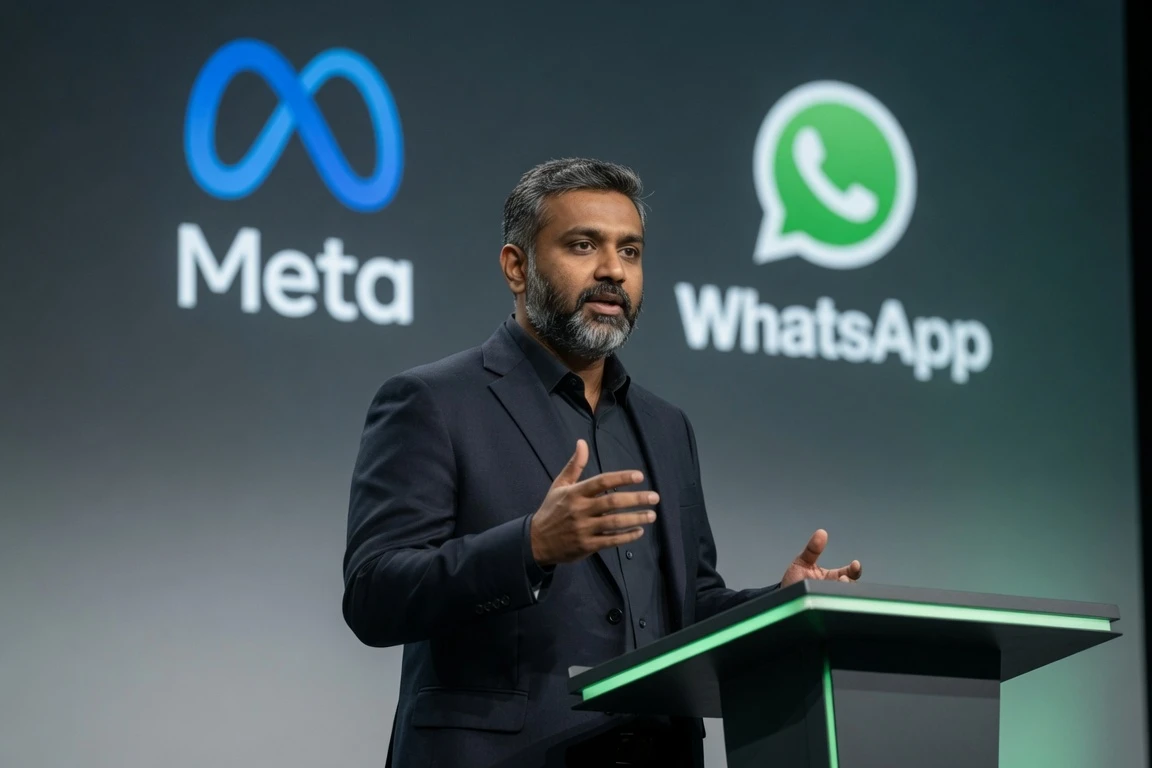
Meta named CRED founder Kunal Shah to lead WhatsApp on June 22, 2026, succeeding Will Cathcart after nearly seven years at the helm. The appointment is paired with a Meta-led $900 million investment in Shah’s Indian fintech startup. Cathcart is stepping into a new product-building role at Meta, the company said on the same day.
The dual announcement lands at the moment WhatsApp is trying to crack India’s dominant payments network. India is WhatsApp’s largest market, with more than 500 million users of the app’s 3 billion-plus global base. Meta has framed the next chapter as one about business messaging and payments in that country, an area Shah has spent a decade building for.
Meta Taps an India Founder to Run WhatsApp
Meta CEO Mark Zuckerberg said Shah had built CRED into “one of India’s most important technology companies” and brought the “builder mentality and global perspective” needed to run WhatsApp. The appointment was paired with a $900 million investment in Shah’s fintech startup and detailed in TechCrunch’s report on Meta’s $900 million CRED deal and Shah’s WhatsApp appointment, which puts an Indian consumer-internet operator in charge of WhatsApp as Meta pushes deeper into business messaging and payments in India.
Cathcart took over WhatsApp in 2019 and exits after overseeing Communities, Channels, and AI integrations, plus expansion past 100 million users in the United States. He hands Shah a service that has scaled but has not converted messaging reach into payments revenue in India. Cathcart’s move into a new product-building role at Meta, rather than an exit, leaves him inside the company working on adjacent products.
Shah founded CRED in 2018 and grew it to 17 million monthly active users. Before CRED he built FreeCharge, one of India’s early digital payments startups. He has also backed more than 250 companies as an angel investor, putting him at the centre of India’s consumer-internet scene.
- Founder and CEO, CRED: Founded the fintech platform in 2018 and grew it to 17 million monthly active users.
- Founder, FreeCharge: Built one of India’s early digital payments startups before CRED.
- Angel investor: Backed more than 250 companies across Indian consumer internet.
- Industry and advisory roles: Sits in advisory positions across India’s technology and financial services sectors.
How Meta’s $900 Million CRED Round Breaks Down
Meta’s $900 million investment is structured as an even split between primary and secondary capital, Moneycontrol reported, citing people familiar with the deal. About $450 million will go into CRED as fresh capital, and the remaining $450 million will buy shares from existing investors and shareholders. CRED confirmed the round at a post-money valuation of about $4.5 billion and a pre-money valuation of about $4.03 billion, Moneycontrol said. Because half the deal buys out existing holders, often at a discount to the company’s valuation, Meta is expected to end up with a stake larger than 20 percent.
The deal marks a sharp swing in CRED’s valuation curve. CRED hit a peak valuation of $6.4 billion in 2022, was marked down to about $3.6 billion in a May 2025 funding round, and now values the company at about $4.5 billion post-money. Before this Series F round, CRED had raised more than $1 billion from investors, per TechCrunch.
Despite the cheque size, Meta is not expected to seek a board seat at CRED and will not gain access to the company’s customer data, Moneycontrol reported. The structure, the publication said, suggests the relationship extends beyond a conventional strategic or financial investment because it is paired with Shah’s move to run WhatsApp. CRED will continue to run day-to-day independently of Meta, with Shah retaining his personal shareholding even as he leads WhatsApp full time.
The fresh capital is earmarked for growth across CRED’s payments, lending, insurance, and wealth businesses, the company said. CRED’s board and leadership team are working on a longer-term management structure as the company prepares for an eventual initial public offering.
| Round | Period | Valuation |
|---|---|---|
| Peak round | 2022 | $6.4 billion |
| Prior round | May 2025 | about $3.6 billion |
| Meta-led Series F | June 2026 | about $4.5 billion post-money, pre-money about $4.03 billion |
WhatsApp Pay Has Been Losing the UPI Race
WhatsApp Pay has gained traction in India since regulatory caps on user onboarding were lifted in late 2024. The service still trails PhonePe and Google Pay by a wide margin on India’s UPI real-time payments network. That gap is the problem Shah has been hired to close.
PhonePe and Google Pay together handled 79 percent of UPI transactions in May 2026, slipping below 80 percent for the first time since NPCI began publishing app-level statistics, according to PhonePe and Google Pay’s combined UPI share slipping below 80%. The top three apps, PhonePe, Google Pay, and Paytm, collectively dropped from 95.2 percent of all transactions in January 2024 to 87 percent in May 2026. Navi and Flipkart’s super.money captured a combined 5.5 percent slice since launching two years ago. WhatsApp Pay “recorded sustained growth during the same period,” per NPCI data cited by Outlook Business.
UPI processes more than 23 billion payments a month worth roughly ₹30 lakh crore, and accounts for almost 86 percent of all digital transactions in India. The NPCI previously delayed implementation of a 30 percent market cap on any single UPI app by two years on December 31, 2024, citing operational challenges. Shah arrives at WhatsApp with the brief of building WhatsApp Pay into a product that competes with PhonePe and Google Pay on its own, beyond its current role as a feature inside the messaging app.
While WhatsApp Pay gained traction in India, the service struggled to replicate the scale and engagement achieved by local rivals such as PhonePe and Google Pay, leaving significant room for growth in one of the world’s largest payments markets.
Cathcart’s Six-Year Run and the Brief He Leaves
Cathcart led WhatsApp from 2019 to 2026, a period in which the service crossed 3 billion monthly active users globally and pushed past 100 million users in the United States. He launched Communities, the group-chat product built for clubs and neighbourhoods, and Channels, the broadcast feature WhatsApp uses to take on Telegram and X. He also oversaw early AI integrations and deepened WhatsApp’s push into business messaging for small merchants in India, Brazil, and Indonesia.
What Cathcart did not solve was monetisation at scale in India. WhatsApp Pay remained a small share of UPI volume throughout his tenure, capped for years by a regulatory limit on new user onboarding that was lifted only in late 2024. Cathcart’s move into a new product-building role inside Meta signals that the company is keeping him inside rather than losing him to a competitor, and that the brief he could not close in India is now Shah’s to inherit.
CRED After Shah
As Shah moves to Meta, CRED named Miten Sampat as interim chief executive with immediate effect. Sampat has overseen strategy and finance at CRED since 2020 and is now the senior-most executive running day-to-day operations. Shah retains his personal shareholding in the company after stepping away from day-to-day leadership.
CRED’s board is working on a longer-term management structure as the company prepares for an eventual initial public offering. The Meta capital is earmarked for growth across CRED’s payments, lending, insurance, and wealth businesses, the company said. CRED has not filed for the listing and has not given a target date.
CRED built its brand around rewarding creditworthy users for paying credit card bills on time. The platform has 17 million monthly active users, a fraction of PhonePe’s base, but a customer profile that skews higher-income and more engaged. Investors will read CRED’s next quarterly disclosures for signs of how the company plans to replace Shah’s product instincts while running a more diversified business ahead of an IPO.
- 17 million: Monthly active users at CRED as of June 2026.
- $1 billion+: Raised by CRED from investors before the Meta round.
- $4.5 billion: Post-money valuation in the Meta-led Series F.
- $4.03 billion: Pre-money valuation in the Meta-led Series F.
- 250+: Companies Shah has backed as an angel investor.
India Now Sits at the Centre of Meta’s Bets
India is the strategic centre of Meta’s WhatsApp ambitions, and the Shah appointment comes weeks after Meta announced a separate India infrastructure bet. Meta is leasing a 168 megawatt AI data centre in Jamnagar, Gujarat, built and operated by Reliance Industries, with the first phase targeted for delivery within two years, per Meta’s 168 megawatt AI data centre lease in Jamnagar reporting from June 2026.
That deal sits alongside the Reliance-Meta joint venture announced in August 2025, which is building enterprise AI products on Meta’s Llama models for Indian businesses. The Shah move now adds an India fintech founder to Meta’s senior leadership, completing a triangle of bets: AI infrastructure, enterprise AI products, and consumer payments and messaging. India accounts for more than 500 million of WhatsApp’s 3 billion-plus global users, making it WhatsApp’s largest single market, and Meta has now stacked the personnel, capital, and infrastructure to chase that scale.
Frequently Asked Questions
Who is Kunal Shah, the new WhatsApp chief?
Kunal Shah is the Indian entrepreneur who founded CRED in 2018 and grew it to 17 million monthly active users. Before CRED he built FreeCharge, one of India’s early digital payments startups. He has also backed more than 250 companies as an angel investor, making him one of the most connected figures in Indian consumer internet.
Why is Will Cathcart stepping down as WhatsApp head?
Cathcart is not retiring. Meta said on June 22, 2026 that he is moving into a new product-building role inside the company after leading WhatsApp for nearly seven years. Cathcart oversaw Communities, Channels, and AI integrations at WhatsApp and pushed the service past 3 billion monthly users globally.
How big is Meta’s investment in CRED?
Meta is investing $900 million in CRED, split roughly evenly between primary capital going into the company and secondary capital buying out existing shareholders. The deal values CRED at about $4.5 billion post-money, up from about $3.6 billion in May 2025, but still below the $6.4 billion peak set in 2022. Moneycontrol reported Meta is expected to end up with a stake larger than 20 percent.
Will WhatsApp Pay become a real rival to PhonePe and Google Pay?
WhatsApp Pay has gained traction since India lifted onboarding caps in late 2024, but it remains a small share of UPI volume. PhonePe and Google Pay together handled 79 percent of UPI transactions in May 2026, per NPCI data cited by Outlook Business. The Shah appointment signals Meta is treating India payments as a strategic priority rather than a side project.
What happens to CRED after Shah leaves?
CRED named Miten Sampat, who has overseen strategy and finance at the company since 2020, as interim chief executive with immediate effect. Shah retains his personal shareholding in CRED while running WhatsApp full time. CRED’s board is reviewing a longer-term management structure as the company prepares for an eventual initial public offering.