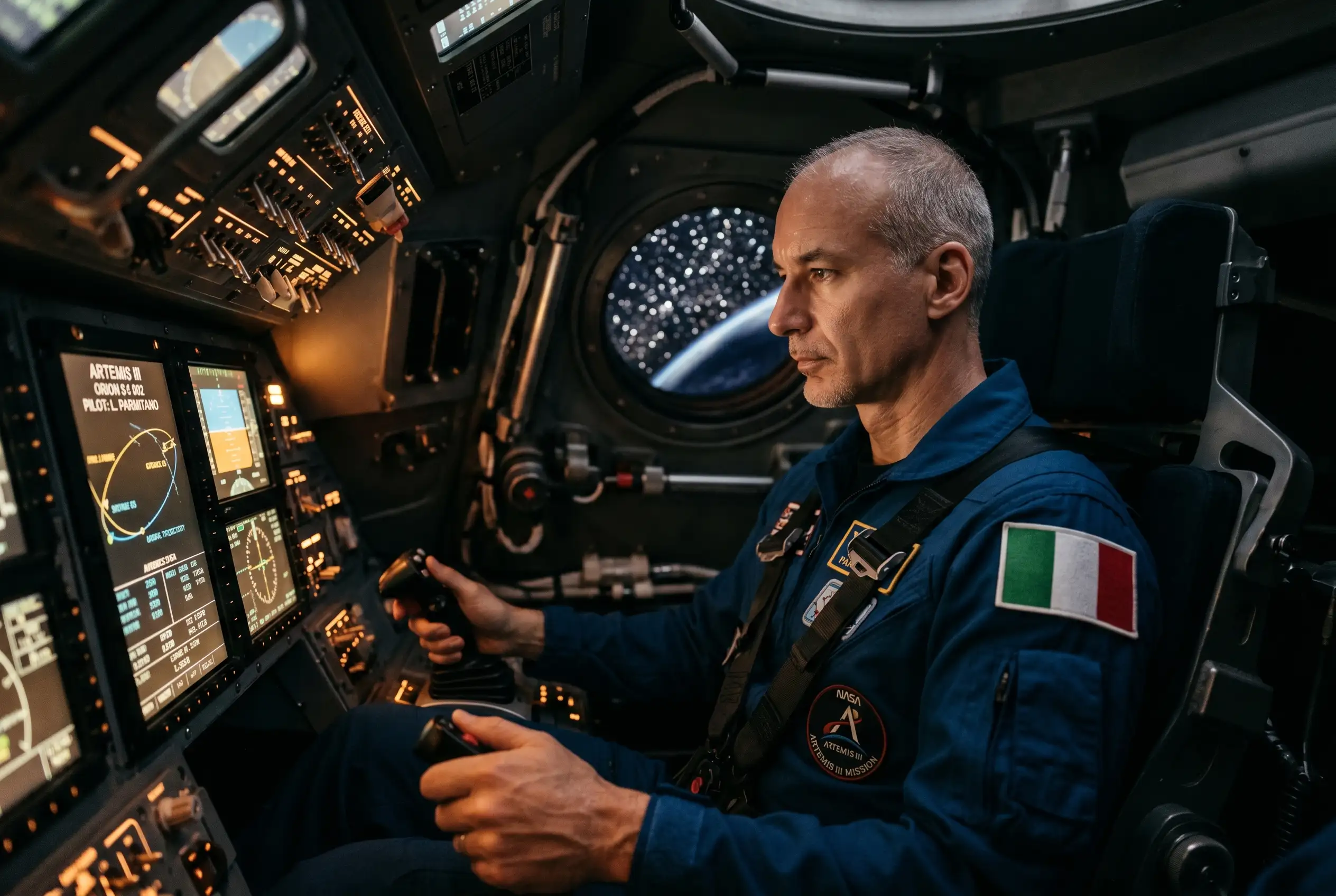
Luca Parmitano, the first European Space Agency astronaut ever assigned to a crew in the lunar program, will sit in the pilot’s seat of NASA’s Orion for Artemis 3, a 2027 test flight NASA unveiled on June 9 at the Johnson Space Center in Houston. ESA Director General Josef Aschbacher called the seat, hours after the announcement, step one in a wider negotiation to put a European on the lunar surface.
ESA’s First Artemis Seat
ESA framed the assignment as recognition of European skill. The agency’s release on June 9 carried a line from Aschbacher praising Parmitano’s operational experience. ESA’s director of human and robotic exploration, Daniel Neuenschwander, said Europe was supplying both a senior astronaut and the propulsion module that drives Orion.
Two days later, at a press conference at the ILA Berlin Air Show, Aschbacher told reporters that Parmitano’s seat is part of a negotiation aimed at getting Europeans onto future Artemis landing missions, in a discussion covered in Aschbacher’s full ILA press conference exchange. The slot, Aschbacher said, was not clear at all just a couple of weeks before the announcement, a sign of how unsettled the bargaining still is. For ESA, the seat sets a precedent. Once a European has flown an Artemis mission, excluding Europeans from later ones gets politically expensive.
The announcement this week of Luca Parmitano being part of Artemis 3 is part of the negotiation process as the first step. The next obviously interesting flights would be to the lunar surface, and this is exactly what we are negotiating with NASA right now, that we can obtain flights to the lunar surface.
Why Gateway’s Collapse Changed the Math
The bargaining became urgent because the structure Europe had built its lunar plan around stopped existing. On March 24, 2026, NASA Administrator Jared Isaacman announced at the agency’s Ignition event that the Lunar Gateway would be paused in its current form, with resources redirected to a surface base at the lunar South Pole, in the full breakdown of the March 24 Moon announcements. NASA expects to spend roughly $20 billion on the lunar base over the next seven years and $6 billion on expanded Commercial Lunar Payload Services operations over the coming decade.
Crewed flights after Artemis 4 and 5 would arrive at a cadence of one every six months using commercially procured, reusable hardware, NASA said. That broke a carefully negotiated European position. At its November 2025 ministerial in Bremen, ESA secured €22.07 billion ($25.58 billion) in member-state commitments and announced three Gateway seats assigned to astronauts from Germany, France, and Italy, with Germany flying first. ESA’s human and robotic exploration budget came in at just under €3 billion, more than 20% below its request. When NASA shelved Gateway, those three seats lost their destination.
ESA has begun talking to its member states about how to participate in the new lunar base effort. Aschbacher said the agency was in active discussions, with an ESA Council meeting next week. The International Space Summit in Paris in September and an interministerial conference in December are the next formal decision points. He added that “we are just at the beginning of these negotiations, but I certainly hope that we get clarity before the end of this year.”
The Hardware Europe Brings to the Table
Europe’s strongest card is one it already holds. The European Service Module, built by Airbus in Bremen with Thales Alenia Space in Turin, supplies Orion’s main propulsion, power, water, oxygen, and thermal control. The first two ESMs powered the uncrewed Artemis I in 2022 and the crewed Artemis II earlier this year, detailed in the Artemis II Moon flyby and Earthrise preview.
The third ESM is now at NASA’s Kennedy Space Center, where engineers will connect it to the Orion crew module this summer. ESA handed the module to NASA in September 2025, and it has since completed acoustic testing. The four European-built solar arrays are due to be installed next, ahead of the launch campaign. Neuenschwander said the module’s structure spans 13 ESA member states, with 20 main contractors and over 100 suppliers involved.
Aschbacher named three new surface offerings. Each is a chip ESA is willing to play in exchange for future landing seats.
- Argonaut lunar lander. An ESA cargo lander designed to deliver up to 1,500 kg to the lunar surface from the early 2030s, with Thales Alenia Space as prime contractor.
- Moonlight constellation. A planned communications and navigation satellite network in lunar orbit, the kind of infrastructure NASA does not currently fund on its own.
- Rovers, surface robotics, and cargo return. Rovers, surface robotic systems, and the option of returning cargo from the Moon, with “other possibilities” still in the mix, Aschbacher said.
Aschbacher said NASA has also asked for additional service modules. ESA’s existing agreement covers six ESMs through Artemis 5 plus a flight spare. “We are right now discussing with industry, and obviously also with NASA, to have future service modules seven and eight that are to be planned as well,” he told reporters in Berlin.
A Partner Whose Schedule Is Slipping
Europe is negotiating with a program whose own timeline keeps moving. NASA had already reshuffled the flight plan, with Artemis 3 now a mid-2027 test flight in low Earth orbit, per the full Artemis III crew announcement. The Orion crew will rendezvous and dock with prototype landers from Blue Origin and SpaceX, rehearsing the choreography for Artemis 4, now the first crewed South Pole landing, targeted for 2028. Both lander providers are running behind. SpaceX has not yet demonstrated the orbital propellant transfer its Starship lunar variant needs to reach the Moon with enough fuel to land, and Blue Origin is still working through development on its Blue Moon lander.
| Mission | Profile | Year | Outcome |
|---|---|---|---|
| Artemis 3 | Crewed test flight, low Earth orbit | 2027 | Docks with Blue Origin and SpaceX lander prototypes; no landing |
| Artemis 4 | First crewed South Pole landing | 2028 | First surface mission in the program |
The Gateway pause was itself partly a response to ballooning costs and slipping schedules across Artemis. The paradox for NASA is that simplifying the architecture left it with fewer assets to trade at the moment it needs partners more. That asymmetry is what gives a mid-sized agency room to push.
The Markers That Will Tell by Year-End
Three decisions will show whether ESA’s play is working before January. Whether NASA commits to additional European Service Modules for later flights, extending the line beyond the current six-plus-spare. Whether Argonaut wins a formal role in the revised surface-logistics plan. And whether any European astronaut is named to an actual landing mission.
The calendar is filling in. France is hosting an international space summit in Paris in September, and ESA’s next ministerial conference arrives in December, the meeting where money and commitments get fixed. Aschbacher has flagged both as moments where the lunar question gets pressed. He told reporters in Berlin he wants clarity on a surface seat by the end of 2026, and he ruled out framing the talks as a US-China race. “We’re not having an ambition as ESA to be part of this race,” he said. “We are participating with NASA on this ambition to go back to the moon.”
One small marker is settled already. The German astronaut who was first in line for a Gateway seat has not yet been named, and the deal for the French and Italian seats in sequence has not been re-cut. Until Europe has a confirmed surface-seat commitment from NASA, the next German, French, and Italian astronaut in line is still on the bench, not the launch pad.
Parmitano, the Man in the Pilot’s Seat
Putting a European in the pilot’s seat of an Orion required picking a particular kind of astronaut. ESA’s slot on the mission lines up with a record that fits the test-pilot’s profile.
- 366 days in orbit across two long-duration missions to the ISS
- 6 spacewalks totaling more than 30 hours, including the 2019 Alpha Magnetic Spectrometer repair series
- First Italian, third European to command the International Space Station, on Expedition 61 in 2019
- 2,000+ flight hours across 40 types of aircraft, with a master’s in experimental flight test engineering from ISAE-SUPAERO in Toulouse
On July 16, 2013, during his second spacewalk, water from a failed cooling system flooded the inside of his helmet. He could not hear the ground, and an orbital sunset had just cut his visibility. In roughly seven minutes, feeling his way along the safety tether, he found the airlock and got back inside. The cause was a blocked filter in the suit’s cooling loop, and NASA later added a makeshift snorkel to every EMU spacesuit. ESA’s profile of the assignment, in Parmitano’s record and the pilot’s role on the mission, calls the work a natural fit for a test pilot who has already operated under pressure in a vacuum.
His own words on the assignment, released the same day, frame it as a milestone for the partnership. The full statement sits below.
I am honoured to be part of this crew, and humbled at the same time: my crew mates bring a wealth of different experiences, and I’m looking forward to working with them, eager to learn and to contribute as much as I can in my role. As a test pilot, this is truly a dream mission, as we’ll be able to help testing systems and developing procedures so that future crews may go further and ultimately take humanity back to the Moon. It’s the confirmation that ESA is a reliable partner, and the continuation of a strong partnership with NASA that will take a European to the Moon.
Luca Parmitano, an Italian Air Force colonel and ESA astronaut, said this in a NASA statement released on June 9.
The fact on the manifest is fixed. A man who once felt water rising inside his helmet will ride the next Orion into orbit as its pilot. He will not step onto the Moon on this flight. The chair he occupies, though, is the one Europe intends to keep occupying. Somewhere in a meeting room in Paris this autumn, his name is already making the argument.
Frequently Asked Questions
What will Artemis 3 actually do?
It is now a 2027 crewed test flight in low Earth orbit, not a landing mission. The Orion crew will launch on the Space Launch System, then dock sequentially with pathfinder vehicles from Blue Origin and SpaceX, spending about two days with the Blue Origin test article and roughly a day with Starship before returning to Earth. Total time in space is expected to be about two weeks.
Did NASA cancel the Lunar Gateway?
No. The agency paused the program in its current form on March 24, 2026, redirecting resources to a surface base at the lunar South Pole. The hardware commitments from international partners, including Europe’s planned modules, are still being negotiated into a revised architecture.
Why is ESA talking about a European on the Moon if the seat is just an orbit?
Because the first Artemis seat for a European sets a precedent. Aschbacher has framed the Parmitano assignment as the opening step in a negotiation to get a European assigned to an actual landing mission. Future Artemis crew selections are where ESA wants to be.
What is the European Service Module?
It is the powerhouse of NASA’s Orion spacecraft, providing propulsion, power, water, oxygen, and thermal control. Airbus in Bremen is the prime contractor, with the structure built by Thales Alenia Space in Turin, Italy. ESA has an agreement to provide six of the modules through Artemis 5, plus a flight spare, and is in talks about modules seven and eight.
When could a European actually land on the Moon?
ESA has not committed to a date. Aschbacher said he hopes for clarity on the surface question before the end of 2026, with the September Paris space summit and the December ESA ministerial as key moments.