Rep. Lucy McBath returned to the Capitol on Tuesday with a familiar bill and a new frame. The Georgia Democrat used a June 9, 2026, press conference on domestic violence and red flag laws to relaunch her Federal Extreme Risk Protection Order (FERPO) Act, the same red flag legislation she has filed in some form since 2019.
She was joined by three House colleagues whose day jobs include running the Democratic Women’s Caucus, the Gun Violence Prevention Task Force, and a bipartisan working group on domestic violence. The press conference’s center of gravity was the FBI’s February 2026 special report on domestic violence, which McBath and her colleagues used to argue that the red flag bill is, in practice, a domestic violence intervention. The press conference’s title was “Stopping Domestic Violence with Common-Sense Tools.” McBath’s son, Jordan Davis, was fatally shot at a Florida gas station in 2012, and the press conference opened with his name.
What the Federal Red Flag Bill Would Do
The bill McBath is pushing would create a federal court process for red flag orders, sitting alongside the state-level systems that now exist in more than 20 states, plus Washington, D.C., and the U.S. Virgin Islands. A family or household member, or a law enforcement officer, could petition a federal court for an order restricting an at-risk individual’s access to firearms. Federal firearms restrictions would automatically apply to anyone subject to such an order.
The federal bill also directs the Justice Department to set up a grant program for state, local, and tribal authorities to implement their own red flag laws. The legislation would create a federal track for the most urgent cases and a federal subsidy for state systems that already exist, a structure that tracks the program President Biden signed into law in 2022 as part of the Bipartisan Safer Communities Act.
State laws on the same idea vary widely in who can petition and how long the orders last. The differences show what a federal floor would standardize. The federal bill would apply on top of those state systems, not in place of them.
| State | Petitioners | Initial order length |
|---|---|---|
| Florida | Law enforcement | Up to 14 days |
| California | LEO, family, employer, co-worker, school employee | Up to 21 days |
| New York | LEO, family, school administrator, healthcare professional, district attorney | Up to 6 days |
| Maryland | LEO, family, healthcare professional | Up to 7 days |
| Colorado | LEO, family, healthcare professional, educator | Up to 14 days |
A Coalition Built Around Domestic Violence
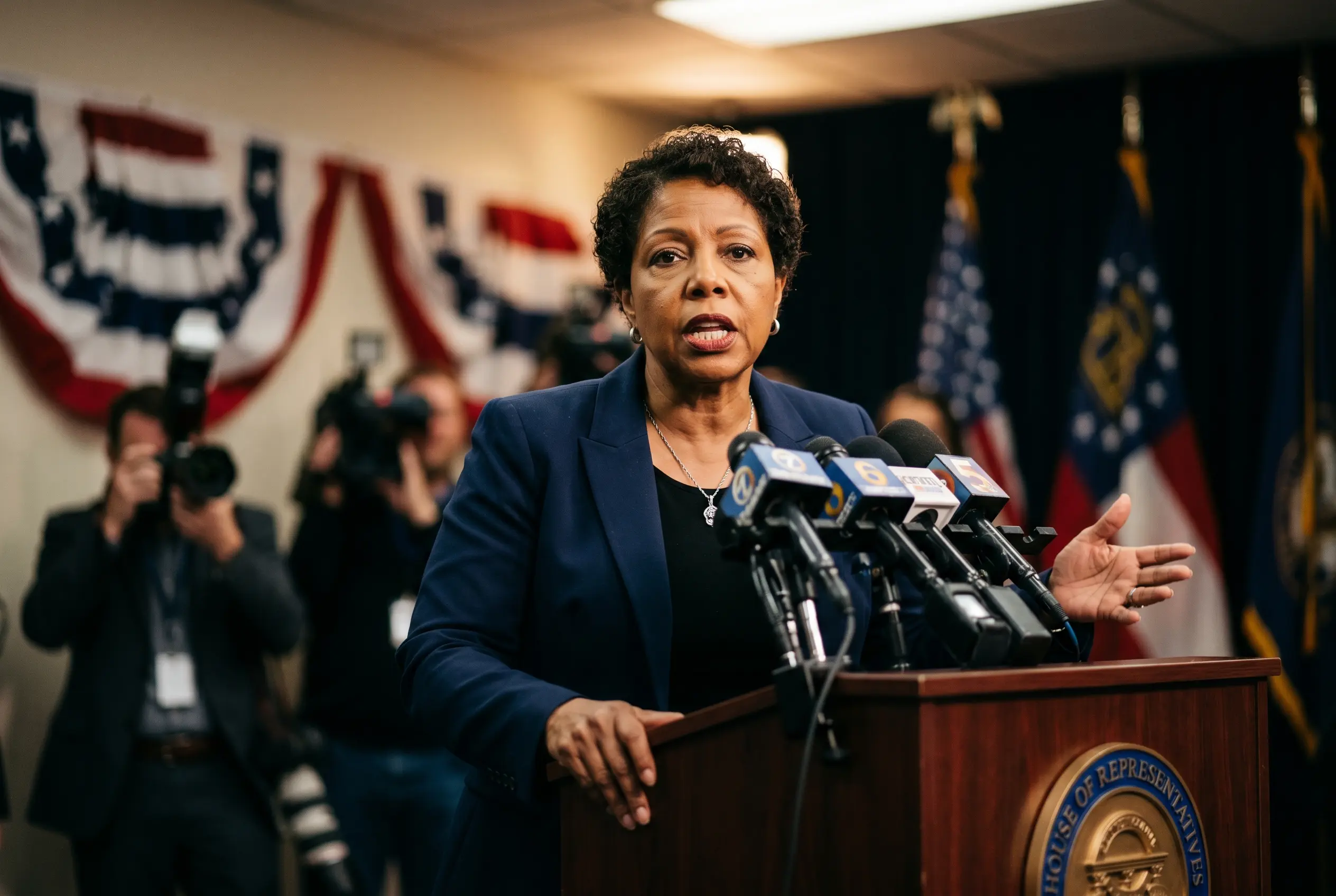
At the lectern on Tuesday, McBath framed the bill as an intervention against the most dangerous moment in an abusive relationship. “Every day in this country, survivors of domestic violence are navigating a terrifying reality,” she said.
She was joined by Rep. Teresa Leger Fernández of New Mexico, who chairs the Democratic Women’s Caucus; Rep. Mike Thompson of California, who chairs the Gun Violence Prevention Task Force; and Rep. Debbie Dingell of Michigan, who co-chairs the Bipartisan Working Group to End Domestic Violence. Dingell, in remarks carried by McBath’s office, made the case with a personal story and a stark statistic. All three joined McBath in the same press conference, where the bill and the FBI’s February 2026 data were both featured in every speaker’s remarks.
I grew up in a home where my father should never have had access to a gun. No child should ever have to live through that. People do not understand the scars it leaves on families. When someone is convicted of domestic violence, they should not have access to a firearm. We know the facts: when a gun is present in a domestic violence situation, the risk of homicide increases fivefold. Red flag laws work.
Thompson brought a related figure. A woman in America is killed by an intimate partner every twelve hours, he said, a figure the press conference used to argue that the bill is a frontline tool for the cases that drive homicide numbers up.
Leger Fernández pointed to a parallel set of numbers. Every month, more than 70 women in America are shot and killed by an intimate partner, she said, and nearly six million women have had a gun used against them by someone who claimed to love them. The FBI’s February report puts the same cohort at the center of its topline numbers, and McBath’s office cited the report in the press conference’s opening remarks.
FBI Data Backs the New Frame
The coalition’s data anchor was the FBI’s February 11, 2026, special report on domestic violence, “Domestic Relationships and Violent Crimes, 2020-2024,” which drew on National Incident-Based Reporting System submissions. The report was released during Gun Violence Awareness & Prevention Month, the same window the press conference was timed to. McBath, Dingell, Leger Fernández, and Thompson all cited the same topline figures. The four Democrats spoke at a press conference titled “Stopping Domestic Violence with Common-Sense Tools,” and each put the bill in the context of that working title.
The 75 percent figure for female victims gives the bill’s domestic violence framing a denominator the press conference repeatedly used. The 13.7 percent firearms involvement figure is the share of domestic violent crime incidents that involved a firearm during the same five-year window. The topline, from the FBI report:
- More than 11,000 domestic violence murder victims reported, 2020 to 2024
- 1.1 million additional domestic violence victims in the same span
- Nearly 75 percent of the victims were female
- 13.7 percent of domestic violent crime incidents involved a firearm
- 70,500+ incidents of teen relationship violence reported in 2024
How the Bill Passed the House in 2022
McBath has pushed this bill before. The 117th Congress version, H.R. 2377, cleared the House on June 9, 2022, by a 224-202 vote that fell almost entirely along party lines. Five Republicans crossed the aisle to support it. Only one of those five is still in Congress: Rep. Brian Fitzpatrick of Pennsylvania.
A portion of the bill’s grant program survived the Senate’s failure to act. The Bipartisan Safer Communities Act, which former President Biden signed in 2022, provided $750 million in funding over five years for states to implement crisis intervention programs, including red flag laws.
The bill’s 2026 re-introduction is McBath’s attempt to put the original bill back on the table in a different Congress, as detailed in her February 2026 re-introduction of the red flag bill. The re-introduction is the same federal track McBath has been pushing since 2019. The legislative history of the bill, in five steps:
- April 8, 2021: H.R. 2377, the Federal Extreme Risk Protection Order Act of 2021, is introduced in the House.
- June 9, 2022: The House passes H.R. 2377 by a 224-202 vote. The bill is received in the Senate and referred to the Judiciary Committee, where it stalls.
- 2022: President Biden signs the Bipartisan Safer Communities Act, which includes $750 million in grants for state red flag programs over five years.
- February 12, 2026: McBath announces the re-introduction of the Federal Extreme Risk Protection Order Act of 2026.
- June 9, 2026: McBath and three Democratic colleagues hold a press conference tying the bill to the FBI’s new domestic violence data and signaling a re-upped discharge petition.
The Republican Case Against Red Flag Laws
Rep. Richard Hudson of North Carolina, then the lead House Republican on the issue, used a House floor speech on the Senate gun bill in 2022 to argue the laws “subvert due process protections and threaten the constitutional rights of law-abiding citizens.” The bill’s 2022 House passage was the last recorded vote on a federal red flag bill.
His argument centered on the due process concerns that have anchored the Republican caucus’s position. He pointed to a list of 12 mass shootings in states with red flag laws as evidence the laws do not work. He asked unanimous consent to insert that list into the record. He proposed an alternative: $7 billion for school safety and mental health programs, paid for by redirecting unspent COVID-19 funds.
Why would we agree to borrow more money that we don’t have so that the federal government can give it to states to enact laws that don’t work and threaten the rights of our citizens?
The opposition stance has not softened as the bill’s public support has hardened. The 2025 Johns Hopkins survey of gun policy found 77 percent of Americans support allowing family members to ask a court for a temporary red flag order against a relative. That support includes 70 percent of Republicans and 71 percent of gun owners.
Most Americans, including most gun owners, back a court process for removing firearms from a relative who is at risk of harming themselves or others. The McBath coalition cited the same 77 percent number at Tuesday’s press conference.
The Discharge Petition Mechanism
The political path forward runs through a procedural mechanism McBath has used before. She announced Tuesday that she’ll re-up a discharge petition to bring her proposal to the House floor. McBath’s office said “hundreds” of members have already signed the petition, and the new push is partly an effort to bring the bill’s newer cosponsors on board.
The bill’s public support numbers are unusually broad for a gun policy. A separate Johns Hopkins finding, from a 2024 multi-state study by the Center for Gun Violence Solutions, estimated that one life is saved for every 17 to 23 ERPOs issued. With that record in the public record and the FBI’s domestic violence numbers on the press conference backdrop, McBath’s campaign is now framed as a public safety argument that happens to involve firearms. The 2026 re-introduction targets the newer members of the House Republican caucus who were not part of the 2022 vote.