Adrenaline Powerboats International, the high-performance boat manufacturer based in Lincolnton, Georgia, is relocating its build operation to South Florida. The company has signed a seven-year lease on 50,000 square feet of industrial space in Medley, a Miami-Dade town about 12 miles northwest of downtown Miami, according to reporting from American City Business Journals surfaced on June 2.
On its own the lease is a footnote in a busy commercial-real-estate market. It also drops a respected performance brand into the densest cluster of custom boatbuilding in the United States, where suppliers, buyers and deep water all sit within a short drive.
Seven Years and 50,000 Square Feet
By industrial-real-estate math the deal is small. What it signals is larger. The basics first, as reported through the bizjournals.com network of American City Business Journals:
- 50,000 square feet of leased industrial space
- A seven-year term, a long commitment for a custom shop
- About 12 miles northwest of downtown Miami
- A new address in Medley, in the heart of Miami-Dade’s industrial belt
Medley sits wedged between Hialeah and Doral, a grid of warehouses, concrete yards and, more and more, boat plants. SeaVee Boats already runs its headquarters and production campus in the same town. So the Georgia firm is not pioneering anything by showing up here. It is renting space in a neighborhood that already knows how to lay up a hull, paint it and rig it.
The company has not put a public figure on jobs or capital spending for the new site. The seven-year term is the tell, though; shops that build boats to order rarely sign that long for a trial run. That length reads like a base of operations, not a satellite.
Why Boatbuilders Keep Choosing Miami-Dade
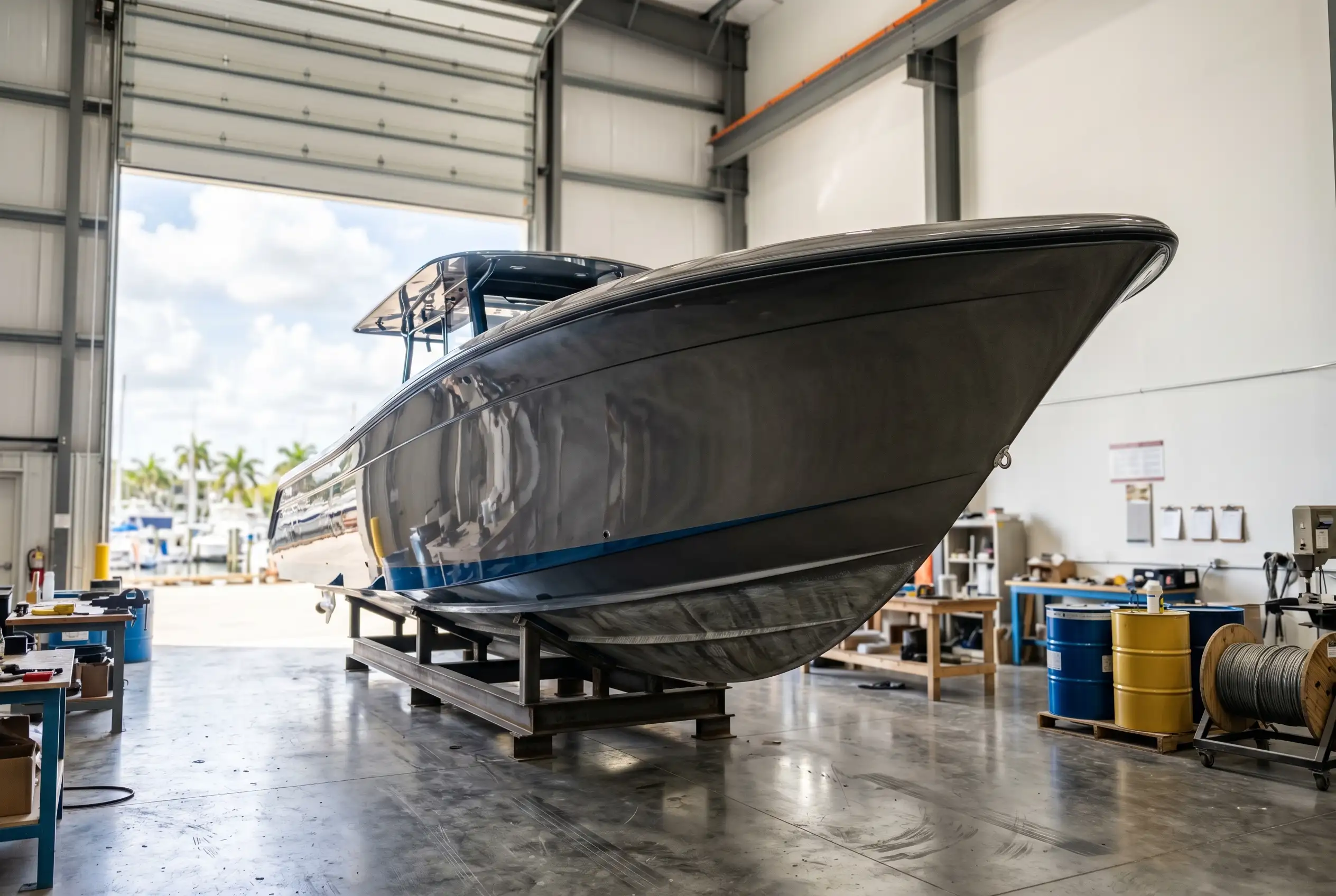
The pull is practical before it is anything else. A custom powerboat is an assembly of resin, gelcoat, hardware, engines, wiring and electronics, and almost every one of those suppliers keeps a South Florida branch within an hour’s drive. A builder in rural Georgia trucks parts in and trucks finished boats out. In Miami-Dade, the supply chain is local and the test water is at the end of the road.
Then there are the buyers. South Florida is the richest offshore-fishing and performance-boat market in the country, and the Discover Boating Miami International Boat Show each February gathers tens of thousands of those buyers in one place. South Florida’s marine trade group has argued for years that being close to that demand is worth the premium on rent and wages.
Scale backs the pitch. Florida builds roughly 40% of the boats made in the United States, and the thickest pocket of custom center-console production sits in Miami-Dade, from Contender down in Homestead to Midnight Express on the Miami River. A high-performance brand that wants to be taken seriously increasingly needs an address inside that pocket, close enough to the dealers, the riggers and the salt to compete on more than price.
Florida’s $31 Billion Boating Economy in Context
The relocation lands inside an industry that has grown fast. The National Marine Manufacturers Association (NMMA, the trade body that tracks the sector) pegged Florida’s recreational boating economic impact at $31.3 billion in its most recent state study, up 53% from 2018, supporting about 109,000 jobs across more than 7,100 businesses. The state ranks first in the nation on marine spending and registrations, with over 920,000 boats on its rolls.
| Metric | Florida | United States |
|---|---|---|
| Annual economic impact | $31.3 billion | $230 billion |
| Jobs supported | ~109,000 | ~812,000 |
| Marine businesses | 7,100+ | 36,000+ |
| Registered boats | 920,000+ | n/a |
Nationally, the NMMA puts recreational boating’s $230 billion footprint across 36,000 businesses and 812,000 jobs. Florida carries more than one in eight of those jobs. That share is the simplest answer to why a Georgia builder would pay up to move south rather than expand at home.
Who Adrenaline Powerboats Is
Adrenaline Powerboats International was founded in 2000 by Mike Layton, a lifelong boater who built the brand around a phrase its marketing still leans on, “art in motion.” For more than two decades the shop has worked out of Lincolnton, a small town near the South Carolina line, roughly 40 miles up the road from Augusta.
The catalog runs to the top end of the performance market:
- 47-Reaper and 42-Reaper, the flagship offshore center consoles
- ZRX47 and Legacy on the performance-boat side of the lineup
- In-house 5-axis CNC (computer numerical control) machining and full 3D CAD (computer-aided design) for tooling and prototyping
That last point matters for a move. A maker that owns its design and tooling, and runs its build process in-house, travels far more easily than one tied to a fixed set of molds and a workforce that cannot follow. Each boat is still hand-laid, custom-painted and rigged to order. The brand is listed in the U.S. Coast Guard manufacturer registry, the federal database every American boatbuilder files into. Plenty of small builders have turned to technology to offset manufacturing headwinds like labor shortages and supply snags; the company’s CNC-heavy setup is that kind of bet.
Georgia’s Loss and the Cost of the Trade
For Lincolnton, this stings. A town of a few thousand does not have many homegrown manufacturers that ship a branded product nationwide, and losing one to Florida fits a pattern the Southeast has watched for years as companies chase the bigger market across the state line. A Florida buyer’s recent acquisition of a Georgia community bank is the same current running through a different industry.
The trade is not free for the company either. Miami-Dade industrial space is among the tightest and priciest in the country, with vacancy near record lows and rents that have climbed hard since 2020. Cheap rural square footage gets swapped for some of the most expensive working real estate in the Southeast. Labor is the second bill. Every other builder in the cluster is hiring from the same pool of laminators, riggers and finishers, and wages reflect the competition.
The wager is that closeness to buyers and suppliers earns back the premium. For a brand selling six-figure-plus performance boats, sitting where the money and the boat shows are can do exactly that. It is still a wager, and the lease term says the owners are comfortable making it.
Another Hull in the Florida Current
This is one lease, and it is not happening in isolation. Builders keep pointing their compasses at the state. Voltari Electric, a Canadian maker of carbon-fiber electric boats, picked Panama City for its U.S. headquarters in a project tied to about 285 jobs at an average salary near $77,000, converting the old Queen Craft Shipyard. The catamaran brand Platinum Powerboats is shifting production from O’Fallon, Missouri, into a 22,000-square-foot plant in Port Orange on the state’s east coast. Different towns, same reasoning: Florida has the water, the buyers and the supplier base, and most other states have at most one of the three.
What sets this move apart is the address. Those other towns are Florida; Miami-Dade is the deep end of it, the pocket where the priciest custom boats already get built and sold. Renting into that pocket says more about ambition than about cutting costs, because cost is the one thing the move does not save.
The company has not said how many jobs the new plant will carry, or whether the original shop stays open once production shifts south. Those answers come when the build line starts running.