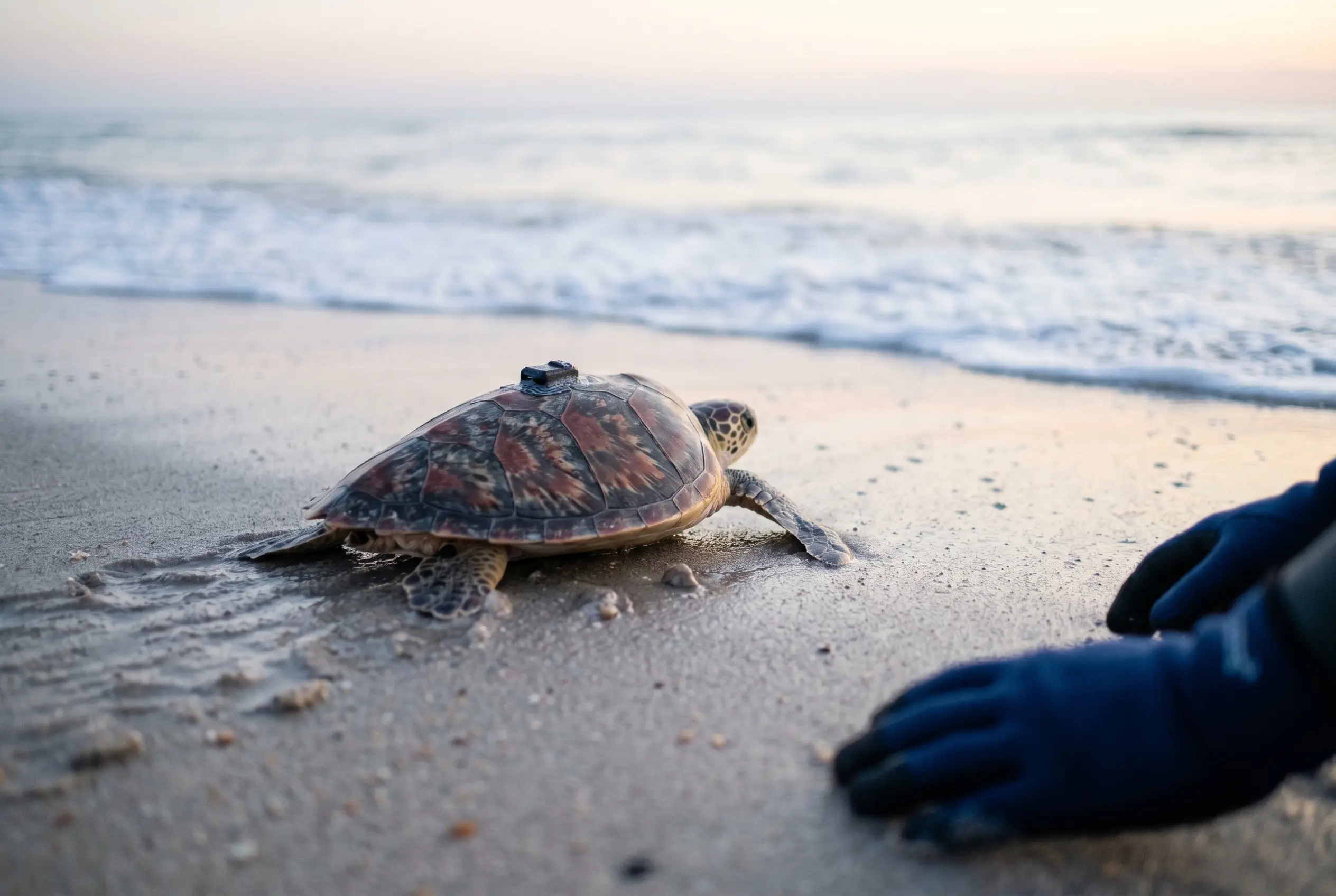
Earl Grey, a hybrid sea turtle with a loggerhead father and a Kemp’s ridley mother, swam back into the Atlantic off Georgia’s Jekyll Island on May 28, a satellite tag glued to its shell. Genetic testing confirmed the juvenile as a first-generation hybrid of two distinct species, the first such cross the Georgia Sea Turtle Center has confirmed in its care. A short video of the case has drawn more than 28.1 million views.
The feel-good rescue lands on top of a quieter scientific story. Sea turtle hybrids are rarer in the North Atlantic than almost anywhere, yet researchers have documented them for two decades elsewhere, and the data is split on whether mixed genetics widen a species’ odds or thin its breeding pool.
How a Cold-Stunned Stray Turned Out to Be a Genetic First
When the first hard cold of fall reaches the hook of Cape Cod, the rescues begin. Turtles drifting south get trapped by the bay’s geography, their bodies slow in the chilling water, and they wash up half-frozen on the sand. One juvenile pulled off a Massachusetts beach late last year looked wrong to the people who handled it. A hooked beak at the tip pointed to one species. A round, ridged carapace hinted at another.
It moved from the New England Aquarium’s hospital onto a private flight south and reached the Georgia Sea Turtle Center on Jekyll Island in November. At roughly 32 centimeters (about 13 inches), it was small, constantly hungry, and, by staff accounts, full of attitude. Then came six months of slow rewarming, bloodwork, X-rays and feeding before the turtle was strong enough to go home.
By release day, the routine cold-stun file had become something the center had never logged. You can read the rehabilitation center’s own account of the case, down to the eye exam and the X-rays. The release itself was kept private, a call the veterinary team made for the animal’s transition back to the wild.
Loggerhead Father, Kemp’s Ridley Mother
The proof came from a lab, not a beach. The center worked with the University of Georgia and Dr. Brian Shamblin, a geneticist who has built more than 15 years of sea turtle DNA records along the U.S. East Coast. His analysis settled the parentage: a loggerhead (Caretta caretta) father and a Kemp’s ridley (Lepidochelys kempii) mother, producing what biologists call an F1, or first-generation, cross with roughly half its genes from each side.
That mixed inheritance shows up in the body. The hooked beak and the rounded shell read as Kemp’s ridley. The shell ridges and coloring lean loggerhead. Side by side, the traits sort out like this:
| Trait | Kemp’s ridley | Loggerhead | The hybrid juvenile |
|---|---|---|---|
| Beak tip | Sharp, hooked | Blunter | Sharp, hooked |
| Carapace shape | Round | Heart-shaped, elongated | Unusually round |
| Shell ridges and color | Grey-olive, smooth | Reddish-brown, ridged | Ridged, loggerhead tones |
DNA is now routine in this field rather than exotic. Georgia researchers recently used a sperm-DNA method to count fathers they never see, the subject of a study tracking male loggerheads through egg-yolk genetics. The same toolkit is what flagged this juvenile as a cross instead of an odd-looking ridley.
Why Cape Cod’s Hook Traps Turtles Every Winter
The reason a Gulf-born species ended up on a New England beach comes down to one bad piece of map. Cape Cod Bay curls into a hook, and turtles feeding north through summer can’t always find their way back out before the water turns. They go hypothermic, stop swimming, and strand. Jaynie Gaskin, director of the Georgia Sea Turtle Center on Jekyll Island, describes the trap plainly.
When sea turtles start to get really, really cold, and they start swimming south, a lot of times they will get caught in that hook.
Last winter was a brutal one. The numbers from the season tell the scale of the rescue effort:
- 667 cold-stunned turtles recovered from Cape Cod Bay beaches by mid-December, per Mass Audubon’s season review.
- 573 of them Kemp’s ridleys, the most endangered sea turtle on the planet.
- 73 turtles pulled from the sand in a single day at the November peak.
- More than 500 live turtles taken in for treatment at the New England Aquarium’s stranding-season hospital before the long transfer south.
Centers across the Southeast absorb the overflow. Jekyll Island has taken in waves of these patients before; in April it returned 22 cold-stunned sea turtles to Georgia waters after months of rehab. The hybrid was one quiet case inside a system built to process hundreds.
Hybrid Turtles Are More Common Than the Headlines Suggest
Call it the first confirmed loggerhead-Kemp’s ridley cross at this center, and that’s accurate. Call it unprecedented, and the science pushes back. Sea turtle hybrids have been documented and genotyped for years, mostly far from the North Atlantic, and in a few places they’re not rare at all.
Brazil’s Hybrid Hotspot
The clearest record comes from Brazil’s coast, where loggerheads cross with hawksbills and olive ridleys often enough to alarm researchers. On the northern coast of Bahia state, up to 42% of nesting females identified by sight as hawksbills carried loggerhead genetics. At the Abrolhos Archipelago, a 2020 paper in the journal Scientific Reports found that 5 of 20 nesting females, a quarter of the group, were first-generation hybrids, with some backcrossing into the parent species. You can read the Abrolhos hybridization study in full.
Why Crosses Happen at All
Different sea turtle species can interbreed because they diverged relatively recently in evolutionary terms and still share compatible chromosomes. When ranges overlap, nesting seasons sync up, and one species is scarce, a female may mate with a male of a related species rather than miss a breeding window. That last point matters here. The Kemp’s ridley is so reduced that a thin pool of mates is exactly the pressure that can nudge cross-species pairings.
The Science Cuts Both Ways on Mixed Genetics
Gaskin offers a hopeful read. Kemp’s ridleys are fussy animals, narrow in their feeding and their nesting range, and she wonders whether a dose of loggerhead flexibility could broaden both.
It could be that there’s hybrids out there. We’re not sure, but I also do have a theory that this is something new that the turtles are doing to ensure the survival of their species.
Gaskin went further, telling Georgia Public Broadcasting that “having loggerhead genetics … actually might be a strength for Earl Grey.” The wider literature is more cautious. The Abrolhos team found hybrid nests hatched at about 27%, against roughly 57% for loggerhead nests at the same beach, and warned that heavy hybridization could swamp an endangered population’s gene pool over time. Other work, including a Conservation Genetics paper on the fitness consequences of hybrid hatchlings, found the disadvantage less severe and sometimes negligible. The honest answer is that one healthy juvenile proves nothing about whether the cross helps or harms the species. It’s a single animal, and the population-level case for either reading rests on different beaches and far larger samples.
What the Satellite Tag Could Reveal
This is where the tracker earns its place. A Kemp’s ridley feeds and nests inside a tight band of the Gulf and the Southeast; a loggerhead ranges far wider. Where a hybrid chooses to go is an open question, and the satellite tag will answer part of it for as long as the battery and the adhesive hold.
The data fits a recovery still on a knife’s edge. The Kemp’s ridley collapsed to fewer than 250 nests in the 1980s, and while a record 383 nests on the Texas coast in 2025 marked real progress, roughly one in a thousand hatchlings reaches adulthood. The loggerhead side has its own swings; Georgia loggerheads bounced back this spring after a weak 2025 nesting season. Against numbers that fragile, a single tracked hybrid is a rare line of evidence biologists can actually follow.
On the morning of the release, the juvenile crossed wet sand, hit the surf, and disappeared. Somewhere off the Southeast coast, the only confirmed loggerhead-Kemp’s ridley hybrid in the North Atlantic is now a moving dot on a map, and that dot is the part of the story still being written.
Frequently Asked Questions
What is a hybrid sea turtle?
A hybrid sea turtle is the offspring of two different sea turtle species that have mated in the wild. A first-generation hybrid carries roughly half its genes from each parent species and often shows physical traits of both, such as one species’ beak shape paired with another’s shell pattern.
Is Earl Grey the first known sea turtle hybrid?
No. It is the first confirmed loggerhead-Kemp’s ridley hybrid the Georgia Sea Turtle Center has treated, but cross-species hybrids have been genotyped for years, especially along Brazil’s coast, where some nesting sites show hybrid rates above 40%.
Can different sea turtle species mate in the wild?
Yes. Several sea turtle species diverged recently enough in evolutionary terms to still produce viable offspring together. Crosses are most likely when species share overlapping ranges and nesting seasons and when one species is scarce enough that mates of its own kind are hard to find.
Why is the Kemp’s ridley the world’s most endangered sea turtle?
Its population crashed from tens of thousands of nesting females to fewer than 250 nests in the 1980s, driven largely by egg harvesting and bycatch in fishing gear. It nests in a small geographic area, and only about one in a thousand hatchlings survives to adulthood, which keeps recovery slow and fragile. See the federal profile of the Kemp’s ridley’s status for current figures.
Is hybridization good or bad for endangered sea turtles?
The science is mixed. Some researchers argue mixed genetics could broaden a narrow species’ feeding and nesting flexibility, while studies in Brazil link heavy hybridization to lower hatching success and warn it could swamp an endangered population’s gene pool. There is no settled answer, and a single healthy hybrid does not resolve it.