India’s Unified Payments Interface (UPI, the country’s instant bank-to-bank payments network) crossed 23 billion monthly transactions for the first time in May 2026, clearing the mark with 23.2 billion payments worth Rs 29.90 lakh crore (about $358 billion). That works out to roughly 748 million transactions every single day, a fresh peak for the nine-year-old system and a 24 percent jump in volume over the same month a year earlier.
That growth is real. So is a problem the National Payments Corporation of India (NPCI, the body that runs UPI) has spent more than five years declining to settle: two apps still move four out of every five of those payments, and the rule built to loosen that grip has just slipped to its third deadline.
A Record Built on Steady, Relentless Monthly Gains
May did not arrive as a sudden spike. It was the latest step in a climb that has barely paused all year. According to NPCI’s monthly UPI ecosystem statistics, volumes moved from 20.39 billion in February to 22.64 billion in March, dipped slightly to 22.35 billion in April, then pushed past the 23 billion line in May.
Month on month, transaction count rose 3.8 percent while value climbed 3.4 percent. The year-on-year picture is steeper. Volume grew 24 percent and value grew 19 percent against May 2025, the kind of spread that tells you Indians are reaching for UPI on smaller and smaller payments, not just big ones.
Here is how the month landed in raw terms:
- 23.2 billion transactions processed, the first month above the 23 billion threshold
- Rs 29.90 lakh crore in total value, inching toward the Rs 30 lakh crore wall
- 748 million payments handled on an average day
- Around Rs 96,465 crore moved through the network daily
For a fuller breakdown of the spending that lifted the month, our report on how summer travel and cricket-season spending drove the record value figure walks through where the money went.
Two Apps Move Four-Fifths of Every UPI Payment
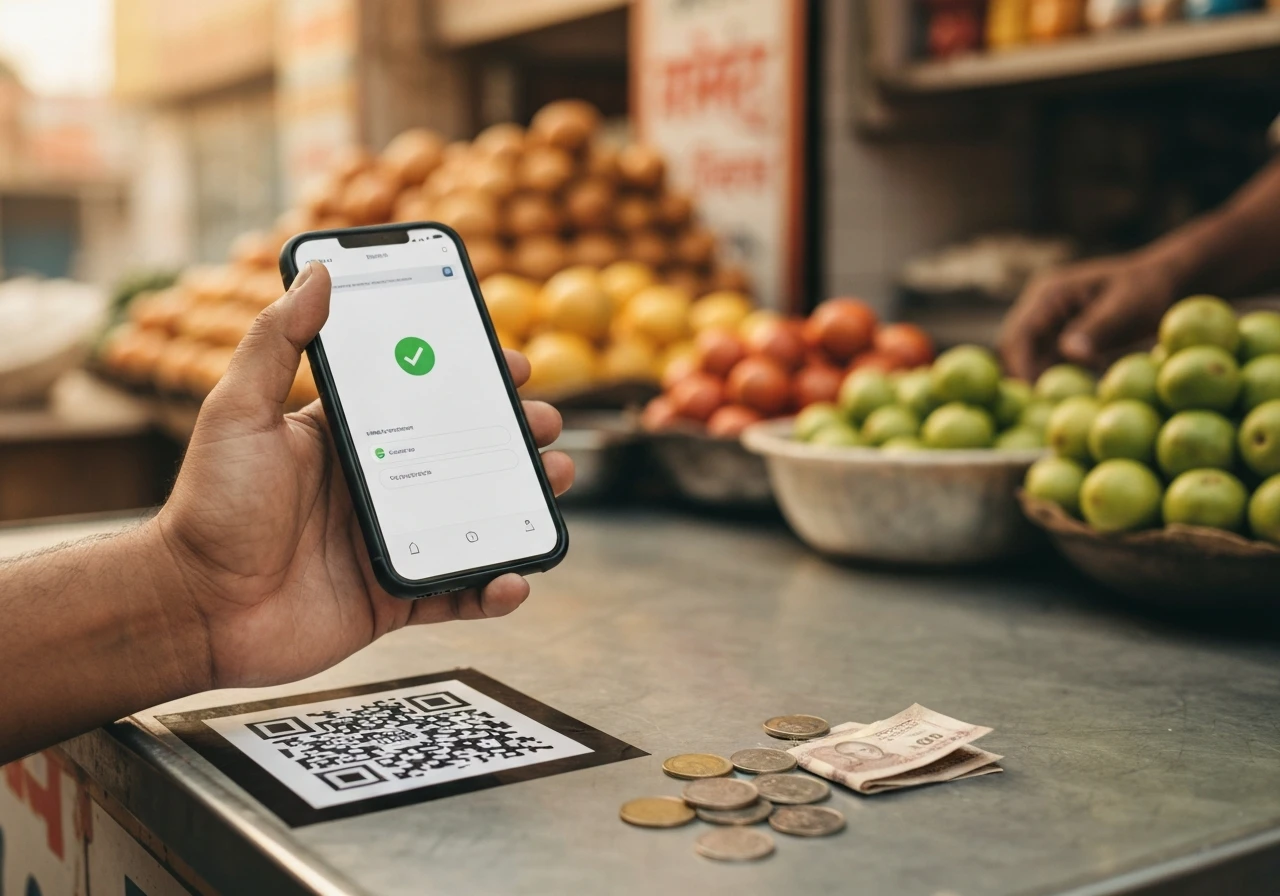
Strip the totals back to who actually processed them and the concentration is hard to miss. PhonePe, the Walmart-backed payments app, held 47.07 percent of UPI volume in April 2026, up from 46.70 percent in March. Google Pay sat second at 33.54 percent. Together, those two handled more than 80 percent of every UPI payment in the country.
Paytm, the listed fintech run by One97 Communications, came a distant third at 8.10 percent. Everyone else, dozens of banks and apps combined, splits what is left of a single-digit slice.
The value side tilts the same way. PhonePe alone pushed transactions worth Rs 14.31 lakh crore in April, a sum larger than most national payment systems handle in a year.
| App | Volume share (Apr 2026) | Approx. monthly transactions |
|---|---|---|
| PhonePe | 47.07% | 10.33 billion |
| Google Pay | 33.54% | 7.36 billion |
| Paytm | 8.10% | 1.78 billion |
| All others | ~11% | remainder |
NPCI has not yet published the app-level split for May. Given the trend, few expect the top two to have given up much ground.
The 30 Percent Ceiling That Keeps Sliding to Next Year
This is where the record collides with policy. Back in November 2020, NPCI set a rule capping any single third-party app at 30 percent of total UPI volume, measured on a rolling basis. The idea was to stop exactly the concentration that now defines the network. The rule has never once been enforced.
Instead, the deadline has been pushed back twice, each time as the leaders blew past the limit rather than retreated toward it. The current expiry, set out in NPCI’s framework for UPI third-party app providers, runs to December 31, 2026.
The timeline tells its own story:
- November 2020 – NPCI announces the 30 percent volume cap for any third-party app provider (TPAP, an app that offers UPI through partner banks rather than its own), with a December 2022 compliance date
- December 2022 – first deadline arrives, no app is anywhere near compliant, and it is extended to December 2024
- December 2024 – the limit is deferred again, this time to December 31, 2026
- 2026 – PhonePe sits above 47 percent and Google Pay above 33 percent, both still well over the ceiling
Enforcing the rule now would mean ordering the two most popular payment apps in India to actively turn away their own users, a politically and technically awkward ask that helps explain why the date keeps moving.
Zero Fees Built the Habit, Now Someone Has to Fund It
The concentration problem has a twin: nobody is getting paid to run this. UPI carries no merchant discount rate (MDR, the per-transaction fee a merchant normally pays on card and digital payments) on person-to-merchant flows. For users and shops, it is free. For the apps and banks carrying the load, it is a cost centre.
What the Government Put on the Table
To keep the system attractive, the Centre runs an incentive scheme that reimburses part of the cost on small-ticket payments. For the financial year 2027 (FY27), the Union Budget set that allocation at Rs 2,000 crore, aimed at low-value UPI and RuPay transactions up to Rs 2,000.
The industry had asked for far more. Estimates of what it actually costs to sustain the network ran between Rs 10,000 crore and Rs 15,000 crore, several times the sum on offer. India’s own Economic Survey flagged the gap, noting that UPI’s long-term health leans on continued incentives and steady investment in reliability and risk controls, a point laid out in the government’s annual Economic Survey of India.
Why a Tiered Fee Keeps Coming Up
A parliamentary panel has gone further, recommending that MDR be brought back on at least some UPI payments to give fintech firms a stable revenue line. One proposal doing the rounds would allow a controlled fee of 30 basis points (bps, where 100 bps equals 1 percent) on merchant payments for larger sellers with turnover above Rs 20 lakh, while keeping small merchants and peer-to-peer transfers free.
The topic is sensitive enough to move markets. Earlier this year, a false report that MDR was returning briefly sank Paytm’s stock before the Finance Ministry stepped in to deny it. Any real move on fees would land on the same nerve.
Amazon, Meta and the Smaller Apps Pressing for Change
The leaders’ dominance has finally pulled the rest of the field into the open. In late April 2026, executives from a cluster of challenger platforms met NPCI to push for a more even contest. The group included Amazon Pay, Meta-owned WhatsApp, CRED, MobiKwik and Flipkart’s Super.money.
Their pitch was not subtle. With PhonePe and Google Pay processing roughly 80 percent of March’s 22.64 billion transactions, the smaller apps argued the current setup makes it nearly impossible to scale.
The asks on the table covered several fronts:
- Limits on how dominant apps onboard new users and tap contact-list data
- Equal access to high-value features such as autopay and payment mandates
- Regulatory support and incentives to help smaller platforms grow
- A clearer path to monetisation across the UPI ecosystem
So far NPCI has held the meeting but announced no changes. The smaller players left with a hearing and little else, which is roughly where the market-share debate has sat for years.
What Happens When the Deadline Arrives
The next real test is on the calendar. December 31, 2026 is the date the volume cap is once again due to bite, and NPCI faces a choice it has dodged twice before.
If the regulator enforces the limit, PhonePe and Google Pay would have to throttle their own growth in a way no dominant app has ever been asked to, and the challengers finally get room to move. If the date slides a third time, May’s 23.2 billion becomes one more record set inside a system where two apps keep the keys and the question of who pays to run it stays open.
Frequently Asked Questions
Does UPI charge any fees to users in 2026?
No. UPI remains free for users and merchants on person-to-merchant and peer-to-peer payments, with no merchant discount rate applied. A parliamentary panel has recommended bringing back MDR on larger merchants, but as of June 2026 no such charge has been introduced.
What is the 30 percent UPI market-share cap?
It is an NPCI rule from November 2020 limiting any single third-party app to 30 percent of total UPI transaction volume. It was meant to prevent concentration, but the compliance deadline has been extended twice and now runs to December 31, 2026, with no app currently in compliance.
Which app has the largest UPI market share?
PhonePe led with 47.07 percent of UPI volume in April 2026, followed by Google Pay at 33.54 percent and Paytm at 8.10 percent. Together, PhonePe and Google Pay handled more than 80 percent of all UPI payments.
How many UPI transactions happened in May 2026?
UPI processed 23.2 billion transactions worth Rs 29.90 lakh crore in May 2026, the first month above the 23 billion mark. That averaged about 748 million payments a day and represented 24 percent volume growth year on year.
Why do smaller apps want NPCI to change the rules?
Smaller platforms such as Amazon Pay, WhatsApp, CRED, MobiKwik and Super.money argue the two-app dominance makes growth nearly impossible. In late April 2026 they met NPCI to seek limits on user onboarding by dominant apps, equal feature access, and clearer monetisation options.